The day I laid my husband to rest, my children a.ban.don.ed me at the airport. Rather than plead for their attention, I chose to make one phone call they would remember forever.
“Mom, just get a cab. We’re occupied.”
Jason’s voice sliced through the airport noise before I could even explain that my flight had arrived.
Three nights without proper sleep weighed heavily on me, and forty years of marriage had just ended with Henry being laid to rest in the village where his life began.
“Jason, I haven’t slept for three days.”
“Stop expecting everyone else to carry your grief.”
He sighed sharply into the phone. Behind him, I heard my grandson laughing, followed by an excited shout.
“Tell Melissa I’m taking Grandpa’s truck!”
My throat tightened. I held the phone more firmly.
“Dad is gone, Mom. Stop expecting everyone else to carry your grief.”
The call ended before I could respond.
“You can make it home on your own.”
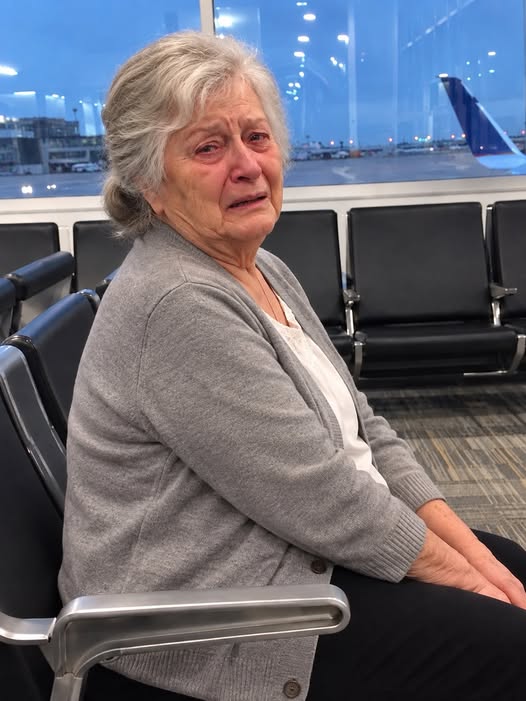
The terminal smelled like old coffee and damp coats. I remained beside the empty luggage carousel long after the final suitcase disappeared, my phone still warm against my palm.
A young employee behind the counter eventually glanced up from her computer.
“Ma’am, I’m sorry. Your suitcase missed the connection in Zurich. We’ll deliver it once it arrives.”
“Thank you,” I murmured, although my own words barely registered.
I settled onto a bench near the exit and watched families embrace around me.
Then I found Melissa’s number.
“They’re still our children.”
“You knew Dad was ill, Mom. This wasn’t completely unexpected. You can make it home on your own.”
I lowered the phone into my lap. Rain traced lines down the towering glass windows.
I thought about Henry, who every morning throughout our marriage tucked a small sealed envelope into the inner pocket of his coat before leaving for work.
“Bills,” he would explain, tapping his pocket. “I’ll leave them at the post office.”
I never questioned him. In forty years, I never asked even once.
Henry noticed. I preferred not to notice.
He had been a gentle man who folded his hands during prayer and almost never raised his voice.
Not even the final time he shared what he truly believed about our children.
“They take us for granted, Eleanor.”
“They’re still our children,” I replied.
He simply nodded. He never argued with me, not once.
I remembered how birthdays slowly became quieter over the years, how the phone seemed to ring only when Jason wanted help with a down payment or Melissa needed someone to babysit. Henry noticed. I preferred not to notice.
Then I remembered that call.
A cab driver tapped the window and gestured toward my empty hands.
“No luggage, ma’am?”
“No luggage.”
I got inside and gave him the address of the home Henry and I had built together.
While the city passed outside the window, my phone remained silent.
Then I remembered that call. One week before Henry passed away, a gentle voice had reached me by phone, a young reporter named Claire Bennett from the local news station, politely asking whether our family might speak on camera about him.
I stood in my own driveway.
“He was an extremely private man,” I had told her. “I’m sorry.”
She said she understood. She left me her number.
I searched backward through my recent calls until I found it. My thumb remained suspended over her name for a long moment.
But I couldn’t press it. Not yet.
The taxi disappeared down the street, leaving me standing in my driveway, staring at the house where I had lived for thirty-two years.
“You finally got here?”
The porch lamp glowed. Warm light shone through the curtains.
From inside, I could already hear my grandchildren laughing.
I opened the front door and froze in the hallway.
Small adhesive labels. On the rocking chair. On Henry’s toolbox beside the hall closet. On the glass door of my jewelry cabinet.
“MELISSA.”
“JASON.”
“SOPHIE.”
Names written in blue marker across pieces of masking tape, attached to forty years of my memories.
“Fine. Don’t answer me.”
Melissa stepped from the kitchen with a dish towel resting over one shoulder. Her eyes traveled over me.
“You finally got here? Why did it take so long? We had to prepare dinner ourselves.”
I said nothing.
“Mom, don’t act like this. We’re all exhausted.”
I lifted my carry-on and moved past her toward the staircase.
“Fine. Don’t answer me. Very mature.”
“Your husband covered my mother’s surgery.”
Upstairs, I shut the bedroom door and sat on the edge of the bed Henry and I had shared for four decades. His flannel shirt remained folded across his pillow exactly where I had placed it before leaving for Switzerland.
I raised it to my face and breathed in the familiar scent.
Then I remembered Marcus, the young mechanic who had approached me following the funeral in Zurich. He wore a suit clearly too large for him, turning his cap nervously between his hands as though uncertain whether he belonged among Henry’s longtime friends.
“Eleanor,” he had said softly. “I’m Marcus Weber. My mother is Anna Weber. Your husband covered the cost of her cancer surgery ten years ago. She’s still here because of what he did.”
“You said you wanted to share Henry’s story.”
I had not known how to respond. I still didn’t.
I took my phone from my bag and found Claire Bennett’s number.
She answered after the second ring.
“Eleanor. I’m so sorry. I heard what happened.”
“Claire,” I said. My voice sounded steadier than I felt. “You called last week. You said you wanted to share Henry’s story.”
“I’ll come to you.”
Silence lingered briefly between us.
“Yes. I did.”
“Is that offer still available?”
“It is. It was always meant to be.”
Something about her answer made me straighten my back.
“I’ll come to you,” I said. “Six o’clock. I’ll bring Henry’s records. He kept everything inside the study. I have the key.”
“Then don’t leave anything hidden.”
“I’ll arrange a car for you. And Eleanor, I’d also like to send a small crew past the house separately tomorrow morning for exterior footage. If the curtains happen to be open, they’ll record only what is visible legally from the sidewalk. They won’t knock. They won’t bother anyone.”
Claire paused.
“Eleanor… if we share this story, people may see everything.”
I glanced toward the kitchen, where Jason and Melissa’s laughter carried upstairs.
For forty years, I had protected them from nearly every consequence.
“He said the choice needed to be yours.”
“Then don’t leave anything hidden,” I said softly. “Show them exactly what Henry intended people to see.”
Claire remained silent for several seconds.
“Eleanor… your husband visited me several months ago.”
“He planned for more than one outcome,” Claire explained. “He said grief can make people choose differently. My responsibility was simply to wait until you made your choice.”
My fingers tightened around the phone.
“Henry?”
I did not join them downstairs for dinner.
“He said the choice needed to be yours. If you never contacted me, the story would never be broadcast.”
“What did he want?”
“I’m sorry. He made me promise to explain everything face-to-face.”
I stared through the window at the rain.
“Six o’clock,” I murmured.
“I’ll be waiting.”
I would never truly know the man beside whom I’d spent my life. I ended the call and looked at the flannel shirt resting across my lap. I did not join them downstairs for dinner.
Before sunrise, I dressed without making a sound, took the key from Henry’s bedside table, and entered his study with nothing but the desk lamp illuminating the room.
Inside the bottom drawer rested a leather folder I had never noticed before.
For forty years, I would have shut that drawer and walked away. Henry’s personal belongings had always remained precisely that — personal.
But if I walked away once more, I might never understand the man beside whom I’d spent my entire life.
‘Jason’s forgiven debt.’
Inside was a bank ledger filled with Henry’s careful handwriting.
One transaction immediately drew my attention. March. Three years earlier. $22,000.
Beside it, Henry had written only three words.
Jason’s forgiven debt.
I studied the entry twice. Three years earlier… I remembered Jason telling us he had finally moved beyond that difficult period.
I had no idea what Henry’s note meant.
I closed the ledger and tucked it beneath my arm.
“We should sell the cabin.”
Then I did exactly what I had promised Claire. I moved quietly through the sleeping house, opening every curtain so the first pale morning light could enter each room.
Nobody noticed that I had left.
The living room carried the scent of pot roast and growing impatience. My family gathered around the television for the six o’clock broadcast, dinner plates balanced across their knees while their conversations overlapped the anchor’s opening remarks.
Jason settled comfortably into Henry’s recliner. He had already marked it as his own with a piece of blue painter’s tape attached to the arm.
“She’ll get over it.”
“After we figure out what happens with the truck, we should sell the cabin,” Jason said.
“Works for me,” Melissa answered. “As long as I receive my portion.”
I continued eating quietly.
“Mom, aren’t you going to say anything?”
“I’m listening.”
Jason gave a shrug. “She’ll get over it.”
Then I appeared on the television screen, sitting inside Claire’s studio.
Sophie, my granddaughter, looked toward me from the sofa. She was only fifteen, yet she was the only person in the room whose expression softened.
“Grandma, would you like some more water?”
“No, sweetheart. Thank you.”
The anchor’s tone changed as the lead story began. A photograph filled the television screen. It showed me sitting inside Claire’s studio earlier that morning, my hands folded calmly in my lap.
Sophie’s fork dropped onto her plate.
“Grandma?”
Henry had covered cancer care for six children in the community.
Jason sprang upright.
“What is this supposed to be?”
On television, my voice remained calm. I described a man who sent letters nearly every morning of his life. I talked about envelopes I had never once opened.
Then Claire began speaking, her voice measured and gentle.
“For over thirty years, Henry quietly covered cancer care for six children in this community. He helped four veterans attend trade school. He cleared the mortgage for a neighbor who had lost her husband. He created a scholarship at the community college using a name other than his own.”
“Denver. Three years ago.”
Melissa’s jaw dropped, her fork suspended halfway to her mouth.
A woman appeared on television, brushing tears from her cheeks. “I never knew who helped me. I discovered it only last week at the funeral home, when the director gave me a letter.”
Then another person appeared. A young man dressed in a mechanic’s uniform. “Henry helped save my daughter’s life. I believed he was simply a stranger passing through.”
“Jason,” I said softly. “Denver. Three years ago.”
Something shifted across his face.
“Was the will ever changed?”
“What are you talking about?”
“Twenty-two thousand dollars,” I said quietly.
The color disappeared from Jason’s face.
Melissa narrowed her eyes. “What twenty-two thousand dollars?”
Jason did not respond. He already understood precisely what that ledger entry represented.
“I told you to turn it off.”
“Was the will ever changed?” Melissa repeated, her voice becoming sharper. “Mom. Was there a change?”
I gave her no answer. Instead, I returned my attention to the television.
Marcus appeared next in the report, the young man I had met following the funeral in Switzerland. He spoke about his mother. He described a check that had arrived in 2013 without any return address.
“Turn that off,” Jason demanded.
No one moved.
“I said turn it off.”
“There’s another part of Henry’s story.”
Sophie was quietly crying now, one hand covering her mouth. I reached across the sofa and rested my fingers gently against her wrist.
Claire’s voice returned, even softer than before, moving through the room like a distant warning.
“But there’s another part of Henry’s story. A request he made several months before his passing. A request concerning the person he loved more than anyone.”
Everyone in the room became silent. I placed my plate carefully onto the side table because I already understood what would come next.
The entire town was watching.
On television, Claire lowered her voice.
“Several months before his passing, Henry entered our station with one condition. Whatever story we eventually shared about his life would be shown only when his wife felt ready. He asked us to stand beside her against anyone who might attempt to claim what was hers after he was gone.”
The footage suddenly changed. Our living room appeared, recorded earlier that morning from outside the front window. Labels covered the rocking chair. Jason’s handwriting was attached to my jewelry cabinet.
The entire town was watching.
“I am the only trustee.”
Jason jumped to his feet.
“How could you put us through this? Do you realize what everyone is going to think?”
Melissa was crying, though her tears were unlike any I remembered seeing before.
“My children’s inheritance, Mom. You just gave it away on television.”
For the first time in three days, my voice remained completely steady.
“Henry placed everything into a foundation carrying his name. The documents became final on the day he was buried. I am the only trustee.”
“I only needed someone to pick me up.”
Jason stared directly at me.
“You arranged all of this.”
“No,” I replied softly. “I only needed someone to pick me up.”
“We didn’t realize you needed us that much,” Jason said.
“Henry worried about what could happen after he was gone. He deeply hoped that his concerns were misplaced.”
Jason looked toward Melissa.
“He never hesitated.”
“What is that supposed to mean?”
“It means he understood you might begin dividing everything he owned before I even returned home.”
“We weren’t dividing anything,” Jason replied quickly. “We were just trying to organize things.”
I opened the ledger I had kept beside me throughout the day.
I opened the ledger I had kept beside me throughout the day. My gaze settled on the same entry that had confused me earlier that morning. Jason’s forgiven debt.
At last, I understood exactly what Henry had meant.
“Three years ago, when you approached him because you needed help, he never hesitated.”
“Never made you feel ashamed.”
Jason went completely still.
“He covered the twenty-two thousand dollars you owed and never requested anything from you afterward.”
The room fell silent.
“A few months afterward, a brand-new truck appeared in your driveway.”
“That doesn’t have anything to do with this,” Jason murmured.
“You remained his son.”
“He never brought up that money afterward. Never reminded you about it. Never made you feel ashamed.”
Melissa stared across at her brother. “You never told any of us.”
“Because regardless of what kind of son you became… you were still his son.”
For the first time, my voice faltered.
“And rather than honoring your father after he was gone, you entered this home and placed labels on his belongings, argued about his truck, and started dividing everything he had spent decades creating.”
“Neither one of you attended your father’s funeral.”
My eyes moved between Jason and Melissa.
“Neither one of you attended your father’s funeral.”
Then I looked directly at Jason again.
“He simply made certain I would never have to face this day completely alone.”
For the first time since Switzerland, I finally slept.
Sophie was the only person whose eyes remained on me rather than the television.
“Grandma, I’m sorry.”
I gently touched her cheek and walked beyond everyone else, climbing the stairs into the bedroom where forty years of marriage still remained inside the closet. I removed Jason’s label from the rocking chair.
Then I lowered myself into it.
For the first time since Switzerland, I finally slept.
Henry had devoted his life to helping strangers.
Several weeks later, I sat behind Henry’s former desk at the foundation office, with a folder filled with scholarship applications resting open across my lap. Claire brought me coffee without asking how I preferred it.
By then, she already knew.
My phone illuminated the desk. Sophie’s name appeared on the screen, followed by one simple question. Could she visit for the weekend?
I poured another cup of coffee, just as Henry had done every morning throughout our forty years together, and placed it on the opposite side of the desk.
Then I lifted my phone and typed a single word in reply: Yes.
For forty years, I had devoted myself to shielding the people I loved from the consequences created by their own decisions.
Henry had devoted his life to helping strangers through circumstances they had never asked to face.
It was only after losing him that I finally understood which kind of kindness can truly change the world.
I could never bring my husband back.
But I could make certain the kindness he left behind would continue long after him.