
“Sir, your son has been sleeping in my house for six days, and I can no longer keep hiding him.”
That was the first sentence I heard after spending nearly a week out of touch while crop-dusting cornfields between the border towns of Fairview and Pinecrest.
My name is Lucas Drake, I am forty-one years old, and I work as an agricultural pilot. When you fly just a few feet above the ground with power lines, high trees, and fence posts passing right in front of your windshield, a mobile phone is completely useless. During long working days, we would leave our phones stored inside a locker in the hangar and only check them once the daily operations were fully over.
That particular job lasted six whole days.
That was approximately one hundred and forty-eight hours of total silence.
When I finally turned my cell phone back on, the screen displayed eighty-seven missed calls.
Most of those incoming calls belonged to my elderly neighbor, Mrs. Beatrice Gable.
I initially thought my house had caught fire while I was away.
I was completely wrong about that.
The reality was far worse.
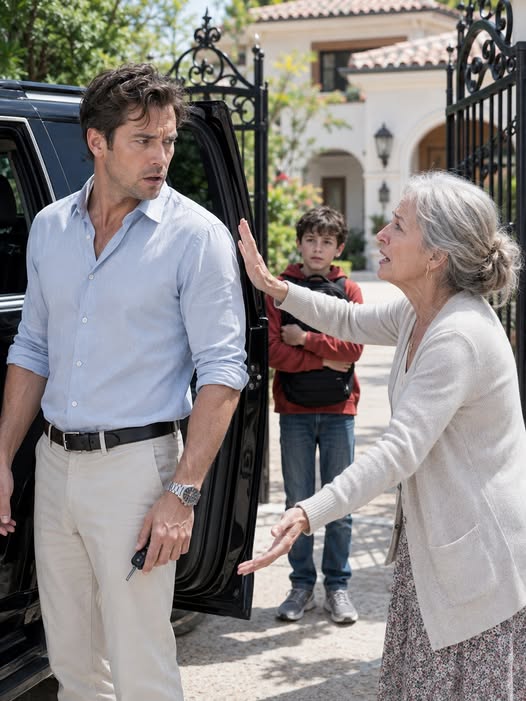
Upon returning to my small hometown near the Redwood Valley, I saw Mrs. Beatrice waiting for me right in front of my driveway gate. She was sixty-four years old, had cared for neighborhood children for half her life, and was the kind of woman who knew every single family in the county.
I quickly stepped out of my pickup truck.
“What on earth happened here, Beatrice?” I asked, looking at her stressed face.
She looked back at me as if she had been practicing this difficult conversation for days.
“I cannot go on like this anymore, Lucas,” she said, her voice trembling. “The poor child keeps asking when you are coming back home.”
“Which child are you talking about?” I asked, completely bewildered.
Mrs. Beatrice suddenly burst into tears.
“Your son, Lucas,” she whispered, wiping her eyes.
I felt something vital shut down inside my chest at those words.
My wife, Claire, had died seven years ago in a horrific highway crash. She was traveling with our tiny son, Toby, who was only two years old at the time.
Their sedan caught fire after colliding with an overturned semi-truck that was blocked by heavy valley fog.
Claire was eventually identified through her dental records.
The authorities never allowed me to see Toby’s small body.
The official police report clearly stated that his death had been determined presumptively due to the total destruction of the vehicle.
To me, my little boy was dead and gone forever.
I had personally buried an urn.
I had purchased a granite gravestone.
I had spent seven long years visiting two quiet graves every single weekend.
“Beatrice, my son died seven years ago,” I said, trying to keep my voice steady.
She slowly moved away from her front entrance door.
A small child appeared right behind her slender frame.
He looked to be about nine years old.
He was very skinny, with dark hair cut unevenly, wearing an oversized gray shirt and holding an old, faded backpack.
He was not crying at all.
He did not seem frightened either.
That unsettling calm was what disturbed me the most.
He watched me with a quiet patience unbecoming of a young child, like someone who was already accustomed to waiting for adults to figure out what to do with him.
“Who is this boy?” I asked, turning back to my neighbor.
“You left him for me to watch,” she replied, holding out her shaking hand.
The little boy took a small, folded piece of paper out of his coat pocket and handed it over to her.
It was a lined sheet torn from a standard school notebook.
The handwritten note said: “Beatrice, an urgent emergency came up. Please take care of him until I get back home. Do not tell anyone, not even your sister. I will explain everything later and make it up to you. Lucas.”
I felt my knees buckle underneath my weight.
That letter was undeniably written in my own handwriting.
It did not just look like my penmanship.
It was identical to mine in every detail.
The strange, crooked shape of the capital L, the peculiar way I crossed my lowercase letter t, and even the forward tilt I used when filling out flight logs on my knee inside the plane cockpit were all present.
“Who gave you this note, Beatrice?” I asked, staring at the paper.
“Nobody handed it to me directly,” she explained. “On Sunday morning, I found the boy sitting in front of my porch with his bag, and this note was tucked right under my doorbell.”
Mrs. Beatrice pulled out her mobile phone to show me forty frantic calls made to my private number.
Then she pointed toward the quiet little boy standing beside us.
“He hides leftover food under his bedroom pillow,” she whispered softly. “He refuses to eat if anyone is watching him, and he slept inside the hall closet two nights ago. Every time a car drives down our street, he asks if someone is coming to take him away.”
The little boy raised a thin hand and offered me a shy wave.
I had landed a failing plane with an engine shutdown before.
I had flown between high-voltage power lines during heavy winds.
I had seen an entire wheat field catch fire right beneath my wings.
Yet I ended up sitting down on the wooden porch bench because my legs simply could not support me anymore.
Later that evening, officers from the local sheriff’s department arrived, followed closely by child protection workers.
They questioned me relentlessly for several hours inside my living room.
“Where exactly were you for the past six days, Mr. Drake?” the lead investigator asked.
“I was dusting crops out in the remote valley fields,” I answered, rubbing my face.
“Who can independently verify your whereabouts during those days?” he pressed on.
“The airfield hangar manager and three local farmers can confirm it,” I replied immediately.
“Then why did your neighbor receive a handwritten note signed by you?” the social worker inquired.
“I have no idea who wrote that note, but it was not me,” I insisted firmly.
“Why would an abandoned child show up specifically during the six days you were unreachable?” the officer asked, writing in his notebook.
The young boy offered no personal name to the authorities.
He answered politely when offered a glass of water or food, but he remained completely silent whenever anyone asked where he came from.
Before loading him into their vehicle, the senior social worker pulled me aside.
“Until we discover his true identity, you cannot assume this child has any connection to your family,” she told me sternly.
I returned inside my empty home alone after midnight.
I opened a dusty wooden box in my closet that I had been actively avoiding for seven long years.
Inside lay my son Toby’s official death certificate.
I read through every single line of text word for word.
Then I finally noticed the specific phrase that I had never truly understood before.
The official line read: “Presumptive Identification.”
There had been no genetic testing completed back then.
There had been no physical identification performed by family members.
The medical examiner had simply assumed my son was inside the burning car because everyone believed he was traveling with his mother that morning.
I suddenly remembered another crucial detail from that painful time.
Three days after the crash, a grief support volunteer had come directly to my house.
Her name was Mrs. Evelyn Hayes.
She had made hot coffee, answered incoming calls, and organized official documents while I could barely speak from overwhelming grief.
She had also asked me for a simple mouth swab sample back then.
“It is just a standard safety procedure in case we ever need to confirm something later,” she had told me reassuringly.
I had never questioned what happened to that biological sample.
Until that dark night.
When I called the county records office the following morning to inquire about it, the clerk spent several long minutes searching through the computer system.
“Mr. Drake, are you absolute certain you never requested to have your genetic sample withdrawn from our system?” the clerk asked cautiously.
“I never made any such request in my life,” I answered, feeling my hands freeze on the receiver.
There was a long, heavy silence on the other end of the line.
“That is very strange, because an official signed application appears right here in your file, submitted just three days after you turned it in,” the clerk reported.
The signature on that withdrawal form looked exactly like my own handwriting.
I had no idea at that moment that this disturbing discovery was only the beginning of something much worse.
PART 2
Five days later, child protective services authorized supervised visits for me with the young boy while they investigated his mysterious background.
They did not grant this permission because they believed he was my lost son Toby.
They granted it simply because they could not locate any living relatives, any recent missing child reports matching his description, or any local adults willing to claim responsibility for him.
The very first afternoon he stepped inside my house, he did something incredibly strange.
He did not ask where the bathroom was located.
He did not ask if he could turn on the television screen.
Instead, he methodically checked every single exterior door.
He touched each wooden frame with his small palm and tested whether he could unlock the handles from the inside.
When he reached the quiet bedroom that had remained strictly closed for seven years, he stopped in his tracks.
Inside that room were a star-shaped nightlight, a box of wooden building blocks, and pencil marks on the wall where my wife had measured Toby’s growth when he was two years old.
“Did somebody used to sleep in this room?” he asked quietly.
That was the very first personal question he had ever asked me directly.
“Yes, my son slept here,” I replied, watching his expression closely.
He looked up at me with wide eyes.
“Is he ever coming back home?” he asked.
I found myself completely unable to answer him.
During the following weeks, I discovered small, heartbreaking details about his daily habits that deeply devastated me.
The boy refused to eat his meals in front of adults.
He constantly hid pieces of bread and leftover biscuits inside his jacket pockets.
He insisted on sleeping fully clothed every night.
He never closed his bedroom door all the way shut.
Furthermore, I was not even sure what his actual birth name was.
“One lady used to call me Leo,” he explained to me one afternoon. “Another man called me Buddy, and at a different house, they sometimes called me Toby.”
I felt my heart stop beating for a second.
“Did you say they called you Toby?” I asked, my voice trembling.
He casually shrugged his small shoulders.
“The lady who handled the paper boxes said that was my very first name,” he replied.
“What paper boxes are you talking about?” I asked immediately.
The boy pointed toward a cardboard file box that I had just brought inside from my truck.
He instinctively took two steps backward away from it.
“A brown box just like that one,” he whispered.
“Who was that lady, son?” I pressed gently.
“I do not know her real name,” he answered.
“What did she look like?” I asked, kneeling down to his eye level.
“She had short blonde hair, smelled like vanilla lotion, and always carried thick folders,” he described carefully.
Then he added a detail that made the situation infinitely worse.
“She kept a framed photograph on her desk of a yellow plane spraying a green field,” he said softly. “She told me my dad flew that exact plane.”
Two days after that conversation, I personally paid for a private, certified paternity test with a strict chain of custody.
The medical technician took a cheek swab sample from me and another sample from the little boy.
I spent five agonizing days waiting for the laboratory results.
The official report arrived in my mailbox on a rainy Friday afternoon.
The probability of paternity read: 99.9998%.
I read that incredible number four times in a row to make sure I was not dreaming.
I walked out to my truck, sat inside, and cried harder than I had at my family’s funeral.
He was my biological son.
I did not understand how it was possible yet.
However, he was undeniably mine.
I immediately drove the laboratory results to the county prosecutor’s office.
The lead investigator examined the document for several minutes under his desk lamp.
“This document legally proves you are his biological father, Mr. Drake,” he stated calmly. “It does not automatically prove he is the same child declared deceased seven years ago.”
“What else could you possibly need to see?” I demanded, leaning over his desk.
“We need court authorization to exhume the grave,” the investigator answered gravely.
Securing the legal authorization took several agonizing weeks.
When the excavation crew finally exhumed the tiny wooden casket, I stood several yards back under a plastic tarp, watching three forensic specialists work in the steady rain.
They carefully unsealed the outer casket.
Inside lay the small metal urn.
Beside the urn rested a faded plush blue bear.
I recognized that toy instantly.
I had personally handed that exact blue bear to Mrs. Evelyn Hayes shortly after the fatal accident.
“I thought this toy should stay with the poor child,” she had told me back then with tears in her eyes.
The forensic experts thoroughly analyzed the contents inside the metal urn.
They found zero human remains inside.
The urn contained nothing more than incinerated wood ash and crushed industrial minerals.
My son had never been inside that urn.
He had never been cremated.
He had never been buried beneath that granite tombstone.
Someone had deliberately forged my signature to make me believe my child was dead.
My immediate reaction was to drive straight to Evelyn’s house to confront her.
I stopped abruptly with my truck keys held tightly in my hand.
I realized that if I showed up furious at her front door, she could easily frame me as a grieving, unstable widower harassing a respected community volunteer.
Evelyn was exceptionally well-regarded throughout the entire county.
She had spent over twenty years assisting families following terrible highway accidents, house fires, and missing person cases.
She had received official commendations from the town mayor.
Her picture hung in local news archives alongside civic leaders.
Dozens of grateful local families would swear that woman had helped them navigate the absolute worst moments of their lives.
I needed solid evidence that did not rely on whether people believed my word over hers.
Then I remembered the altered genetic sample file at the county office.
I traveled to the regional capital in Sterling City and requested a meeting with a senior forensic records specialist.
I showed Dr. Henry Vance the document where I had supposedly requested the withdrawal of my biological sample.
The doctor reviewed my medical record on his computer.
Then he pulled up a second file.
Then a third file.
His professional expression changed entirely.
“Mr. Drake, your family file is not an isolated case,” Dr. Vance said gravely.
He uncovered thirteen separate requests for the withdrawal of family genetic samples submitted over the past decade.
All thirteen cases originated from the exact same rural valley region.
All thirteen were directly linked to vehicular accidents, mysterious house fires, or incomplete body identifications.
In almost every single file, the same name appeared as the official volunteer responsible for transferring documents: Evelyn Hayes.
Among those suspicious files was one belonging to a young girl who had vanished seven years ago.
Her grieving father still called the state police every single month for updates.
Dr. Vance quietly closed his office door.
“If these desperate families never requested to withdraw their samples, someone was deliberately preventing potential DNA matches from ever occurring,” Dr. Vance explained.
“Why on earth would anyone do that?” I asked, my voice shaking with rage.
“That is precisely what the state authorities will have to figure out,” he replied.
Before we could formally submit the gathered evidence to the state police unit, Evelyn unexpectedly appeared at my front porch one Sunday afternoon.
She brought a homemade lemon cake.
She was also carrying the exact same cardboard file box that my son deeply feared.
She walked inside my kitchen with a bright, warm smile.
She politely asked how the boy was sleeping.
She asked if he was eating well.
She asked if he suffered from bad nightmares.
Then she said, with a terrifying gentleness that made my stomach turn: “You should be very cautious with anything the child tells you, Lucas. Children who move through multiple temporary foster homes often fabricate complex memories. A professional psychological evaluation might be wise before you put too much faith in his words.”
At that exact moment, I understood her true motive.
She had not come to offer friendly neighborly help.
She had come to assess how much information I had actually uncovered.
As she was saying goodbye near the entrance, my son suddenly stepped out from the end of the hallway.
Evelyn caught sight of him immediately.
For barely a fraction of a second, her warm, friendly smile completely vanished.
The boy stood completely frozen near the wall.
Then he whispered in a tiny, terrified voice: “It is her.”
Evelyn slowly turned her head back toward me.
I knew right then that the hidden truth was finally about to explode.
PART 3
I did not react outwardly to his words.
Maintaining my composure at that moment was probably the hardest thing I have ever done in my entire life.
Evelyn was standing less than six feet away from me while my son openly identified her as the woman from his buried memories.
I desperately wanted to grab her by the collar and demand to know where she had kept my boy for seven long years.
I wanted to force her to explain why there was an urn full of fake mineral ash resting under my son’s gravestone.
Instead, I managed to force a neutral smile onto my face.
“He gets confused very easily these days,” I said calmly to her.
Evelyn immediately regained her warm, gentle expression.
“Of course he does, Lucas, that is completely understandable,” she replied softly.
She bent down slightly toward the hallway.
“Hello there, sweetheart,” she said in a soothing voice.
My son took a quick step backward away from her.
She stopped moving forward entirely.
“It is perfectly fine,” she added with a cold undertone. “You do not have to remember anything right now.”
That short sentence confirmed everything for me.
She did not say “you do not know me.”
She specifically said, “You do not have to remember.”
The second her car pulled out of my driveway, I called Dr. Vance in Sterling City.
Within forty-eight hours, the case was transferred out of local hands and given to a specialized state investigative unit that handled cold cases and missing children.
Following the explicit instructions of the state investigators, my son was formally registered as a recovered minor with pending identity status until his legal documents could be fully corrected.
I personally submitted a brand-new genetic sample at the state laboratory.
This time, I watched the technician seal the sample envelope with heavy tamper-proof tape.
I took clear photographs of the official registration numbers.
I demanded a certified copy of every single paper I signed.
I was never going to trust my family’s life to a vague promise like “we will handle it” ever again.
The fresh genetic profile officially confirmed the ninety-nine percent biological match between us.
However, entering the new data also triggered an automated system review of linked regional files.
That was when the horrifying scale of the operation was revealed.
For over a decade, dozens of family DNA samples had been quietly withdrawn from the state database just days after being submitted.
The formal withdrawal applications all appeared completely legitimate on the surface.
They contained correct names.
They listed valid case file numbers.
They featured convincing signatures at the bottom.
Yet when state investigators interviewed those grieving family members, every single one of them vehemently denied ever signing such requests.
A heartbroken father from the nearby town of Oak Ridge whose young daughter vanished eight years ago swore he had never asked to stop the search.
A woman from Pinecrest stated she had submitted a sample after her sister perished in a building fire and never received a single update.
Another family vividly remembered Evelyn sitting at their kitchen table, drinking tea, and pointing out where they needed to sign routine support paperwork.
She had always arrived when people were far too broken to carefully read what was placed in front of them.
She was consistently helpful and attentive.
She made fresh coffee for grieving relatives.
She organized funeral calls.
She offered to transport official documents directly to the county courthouse.
The state investigators obtained access to her original document archives.
They secured a formal search warrant for her suburban home.
They did not initially arrest her for kidnapping.
They targeted her for systematic record tampering and document forgery.
That strategic legal choice allowed the investigation to move forward rapidly without relying solely on the testimony of a traumatized child or a grieving father.
A dozen state troopers entered her house early one Tuesday morning.
What they uncovered inside her basement office proved that this tragedy extended far beyond my family.
Evelyn maintained an organized record room filled with filing cabinets sorted strictly by year.
There were stacks of outdated official forms, stolen birth certificates, forged custody consents, and withdrawal requests.
Inside a hidden wall safe, investigators discovered a smaller metal box containing the true core of her operation.
It revealed her precise forgery method.
She used thin tracing paper laid over authentic signatures.
On the sheets below, she practiced writing the exact same signature ten, fifteen, or twenty times in a row.
The first few attempts appeared rigid and awkward.
The middle attempts looked progressively more natural.
The final versions were virtually indistinguishable from the real thing.
There were forged signatures from grieving mothers, desperate fathers, grandmothers, and widows.
These were innocent people who believed they were signing routine administrative forms during the absolute worst days of their lives.
I saw my own name written repeatedly across those tracing sheets.
“Lucas.”
“Lucas.”
“Lucas.”
Practicing my name over and over again until she perfected the stroke.
The investigators also discovered copies of my professional flight logs inside her files.
She possessed my exact crop-dusting schedules for the entire season.
There was even a clipped newspaper photograph from the local agricultural Gazette showing my yellow biplane spraying a field.
Suddenly, the bizarre timing of the boy’s appearance made total sense.
Our seasonal dusting schedules were posted publicly at the hangar for farmers and field workers to see.
Evelyn knew precisely when I would be flying in remote areas without phone service.
She knew our strict rule about storing mobile phones inside lockers during active flight days.
She knew my neighbor Mrs. Beatrice had known my family for thirty years.
Most importantly, she understood human behavior.
If a stray child was abandoned in front of a stranger’s house, they would call the police within an hour.
However, if she left the child with my trusted neighbor alongside a note written in my handwriting, Beatrice would hesitate.
Beatrice would wait for me to return.
She would spend days trying to call my dead phone line.
Evelyn desperately needed that six-day window of total silence.
She was not attempting to lovingly return my son to me.
She was frantically trying to hide him.
The illegal couple who had been keeping my son in a neighboring state ran into unexpected legal trouble when the husband was arrested for an unrelated financial crime.
Fearing that local authorities would discover the child lacked legal adoption papers, the panicked wife called Evelyn demanding an immediate solution.
“Come pick him up tonight or I am leaving him at a police station,” the woman had threatened.
Evelyn drove through the night to retrieve the boy.
For the first time in years, she found herself stuck with a child and no pre-arranged illegal buyer ready to take him.
That was when she remembered the grieving father who still believed his boy was buried in a cemetery.
Me.
The most undetectable place to hide my son was the one location no law enforcement officer would ever think to search: his biological father’s house.
If everything went wrong, her forged note would make me look like an irresponsible father who had abandoned his child with a neighbor.
The recovered files allowed investigators to piece together what really happened on the night of my wife’s accident.
During the chaotic emergency response along the foggy highway, multiple rescue teams worked for hours around the burning wreckage.
There was total confusion at the scene.
Evelyn was acting as the official civic liaison for victims’ families.
When an off-duty paramedic pulled my bruised, conscious toddler from the back seat before the fire spread, he handed the boy to Evelyn, believing she was a relative helping the family.
That initial paramedic handoff note was lost in the chaos.
Evelyn realized that night that no one else knew the child had survived.
She should have reported the truth to the authorities immediately.
Instead, she saw a lucrative opportunity.
Months earlier, she had met a wealthy, desperate couple who had been trying to adopt a child for years without success.
She was not running a massive international crime syndicate.
There were no giant warehouses or vast networks of armed criminals.
It was a small, quiet, localized scheme, which made it far more difficult for state authorities to detect.
Evelyn targeted vulnerable people on both sides of tragedy.
She targeted destroyed families who were too broken to review paperwork, and wealthy adults desperate to obtain a child outside of slow legal channels.
She positioned herself right in the middle as a benevolent savior.
According to her private journals, she never used the word “trafficking.”
She wrote terms like “placement assistance,” “medical compensation,” and “family relocation support.”
Her fees ranged from thirty thousand dollars to over one hundred thousand dollars per child.
When state prosecutors interrogated her, Evelyn stubbornly insisted for weeks that she had only ever “helped” people.
She claimed those children would have languished in state orphanages.
She argued that wealthy families could provide superior lives for them.
She insisted she was simply bypassing bureaucratic delays.
However, the lead prosecutor asked her one single question that shattered her defense completely.
“If you were truly just helping these children, why did you forge their parents’ signatures, destroy their official records, and wipe away every trace of their true identities?”
She had no answer for that.
My son had been shuffled through three different homes over seven years.
The first family kept him for under two years before the woman passed away.
Evelyn then relocated him to a second household, where he stayed for four years until the couple went through a messy divorce.
He was transferred a third time shortly before ending up back on my porch.
That was why he did not know his true last name.
That was why he hid bread under his pillow.
That was why he obsessively checked exterior door locks.
He had learned from a very young age that a home could vanish from his life without any warning.
A state child psychologist explained that his strange habits were logical survival mechanisms.
Saving bread meant preparing for days without food.
Sleeping near doors meant being ready to escape quickly.
Refusing to use a permanent name meant that losing his identity again would hurt less.
For the first few months, he never called me “dad.”
I never pushed him to say it either.
One evening during dinner, he wrapped half a warm roll inside a paper napkin.
He folded the edges neatly and looked toward his bedroom.
Then he slowly unfolded the napkin and set the roll back down on his plate.
It was a tiny, simple gesture.
To me, it meant more than any formal speech.
It was the very first time he felt confident that there would still be food waiting for him tomorrow.
The state investigation continued to expand across the region.
Thanks to Evelyn’s meticulous hidden archives, law enforcement located several other missing children.
A teenage girl who vanished eight years ago was found living in another state under an assumed name.
Her father had called the police every single month for nearly a decade searching for her.
When they were finally reunited in an office, she did not run into his arms.
There was no emotional movie reunion.
They sat across from each other in silence for nearly an hour.
The girl was angry, deeply confused, and struggled with memories of a completely different family.
The legal system could restore her birth name, but it could never give her back her lost childhood.
Two missing children linked to Evelyn’s files were never located.
That tragic reality remains the hardest thing for me to accept.
For a long time, I foolishly imagined that exposing Evelyn would automatically fix everything.
It did not.
The truth does not magically repair the devastation caused by a long lie.
Evelyn eventually faced multiple felony counts of child abduction, document forgery, record tampering, and extortion.
The legal investigation also targeted several adults who had accepted children through her while knowing the arrangements were entirely illegal.
Some faced heavy prison terms, while others claimed they truly believed the adoption papers were genuine.
It took the court system over a year to sort through the legal mess.
I eventually stopped attending every court hearing.
I realized I had a far more important responsibility at home.
I needed to learn how to be a father to a traumatized nine-year-old boy whom I had re-encountered just months earlier.
One quiet afternoon, I brought my son to the local cemetery.
I did not force him to go.
He asked to visit the site himself.
We walked side by side to the plot where the two granite gravestones stood.
One bore my wife’s name, Claire Drake.
The other bore his name.
He stood staring at his own name carved deep into the grey stone: TOBY DRAKE.
Below his name was his actual birth date and a death date that had never occurred.
“Is that supposed to be me?” he asked softly, touching the stone.
“Yes, son,” I replied gently.
“But the carving says I am dead,” he whispered.
“The people who made this were completely wrong,” I told him.
“Does that mean this name can still belong to me?” he asked, looking up at me.
I struggled to keep my voice steady.
“It was always your name, son,” I said. “However, if you want to choose a totally new name, we can do that together.”
He remained completely silent for a long moment.
Then he pointed to a small angel figure carved into the corner of the granite.
“I do not like that angel,” he said plainly.
I burst out laughing.
It was the very first time I had laughed standing in front of that grave in seven years.
“To be honest, I do not like it either,” I admitted.
A few days later, he told me he wanted to be called Toby again.
He chose it entirely on his own terms.
We hired a contractor to remove the false gravestone.
When the workers pulled the small, empty casket out of the ground, Toby asked if we could help fill the hole back in ourselves.
The cemetery manager looked surprised, but I immediately agreed to his request.
A friend brought over two heavy shovels.
We spent the entire morning working together under the sun.
My son used his shovel to fill the earth back into the deep grave where I had mourned an empty urn for seven long years.
When we finally finished the physical labor, he rested his shovel against the ground and looked at the smooth dirt.
“Now I am really not down there anymore,” he said firmly.
“No, you are definitely not down there,” I agreed.
“Where am I now then?” he asked, looking up at me.
I smiled down at him.
“You are right here with me,” I said.
He thought about my answer for a moment, nodded quietly, and picked up his shovel again to smooth out the remaining dirt.
Months later, I made a major decision that surprised many people in our town.
I officially volunteered for a state support network that assists families dealing with sudden traumatic accidents and missing persons.
I wanted to understand the exact administrative procedures that Evelyn had manipulated for so many years.
I completed training courses, memorized state protocols, and learned precisely which documents belonged to every stage of an investigation.
Now, I occasionally accompany local families who have just received the absolute worst phone call of their lives.
Whenever a biological sample or critical document is presented to a family, I always do one specific thing.
I place the document envelope flat on the kitchen table.
I clearly point out the official case file number.
Then I tell them firmly: “Take a clear photograph of this document with your phone right now. Keep it saved. Ask the officer exactly where this piece of paper will be filed next month. Do not do this because everyone is corrupt, but because you have an absolute legal right to track your own files.”
Some grieving people can barely process my words.
I understand their pain completely.
I was standing in their exact shoes seven years ago.
I was the broken man sitting at a kitchen table while a polite volunteer made hot coffee and said, “Just sign right here.”
Back then, I thought to myself, “Thank God someone knowledgeable is here to handle this for me.”
I lost seven priceless years with my biological son because a forged signature took only seconds to write.
However, I also got my boy back because an alert neighbor named Beatrice decided that something was not right.
Because a dedicated forensic doctor re-examined an forgotten system record.
Because an expert opened an empty urn.
Because someone preserved a file number.
Because a group of people finally stopped assuming that someone else had already taken care of the details.
Today, Toby sleeps peacefully in the bedroom that was always meant to be his.
We replaced the tiny toddler bed with a full-sized frame.
We repainted the blue walls.
He decided to keep the star-shaped nightlight on his nightstand.
He no longer hides leftover bread beneath his pillows.
Furthermore, he does something that seemed completely impossible during those first terrifying months.
He closes his bedroom door completely when he goes to sleep at night. He does not close it out of fear that someone will break in.
He closes it because he knows he can open it whenever he wants.
Sometimes I walk down the quiet hallway at night and see that door completely shut.
For seven long years, a closed door inside my house represented painful absence and total grief.
Now, it represents the exact opposite.
It means my living son is right behind it.
He is safe, healthy, and complaining about his daily school homework.
He leaves his muddy sneakers right in the middle of the hallway.
He asks me every weekend when I can take him up in my yellow biplane again.
We can never get those seven lost years back.
There is no legal court on Earth capable of returning lost childhood years to a father.
There is no criminal punishment that automatically heals a damaged childhood.
There are still other heartbroken families waiting for answers across our state.
That is precisely why, when people ask me what I learned from this terrifying journey, I never tell them that I learned to blindly distrust every good person.
I learned a far more important lesson.
Being kind and well-liked does not make anyone immune to scrutiny.
A shiny award on a wall does not replace systematic oversight.
A person can easily appear indispensable to a community simply because no one has ever taken the time to double-check their work.
Above all, I learned that during the absolute worst moments of our lives, we are vulnerable enough to hand over critical decisions, documents, and total trust to whoever seems to know what they are doing.
We do not do this because we are naive.
We do it because we are completely broken inside.
That is exactly why protective systems must exist to function properly, even when a grieving person lacks the emotional strength to monitor them.
That wicked woman took advantage of my overwhelming grief because she knew I would never ask hard questions.
Now, whenever I walk into another family’s home and see a grieving parent sitting at a table with the same blank, broken stare I carried for seven years, I do not ask them to blindly trust me.
I hand them the official file number.
I explain where every single sheet of paper is heading.
I tell them the crucial advice that no one ever offered me: “No matter how much you trust the people helping you, ask questions anyway.”
Trust is a noble human emotion.
However, verified control must always exist alongside it.
Sometimes, a single simple question, asked at the right moment, can mean the absolute difference between burying a lie or finding a child alive whom everyone had presumed dead.
THE END.