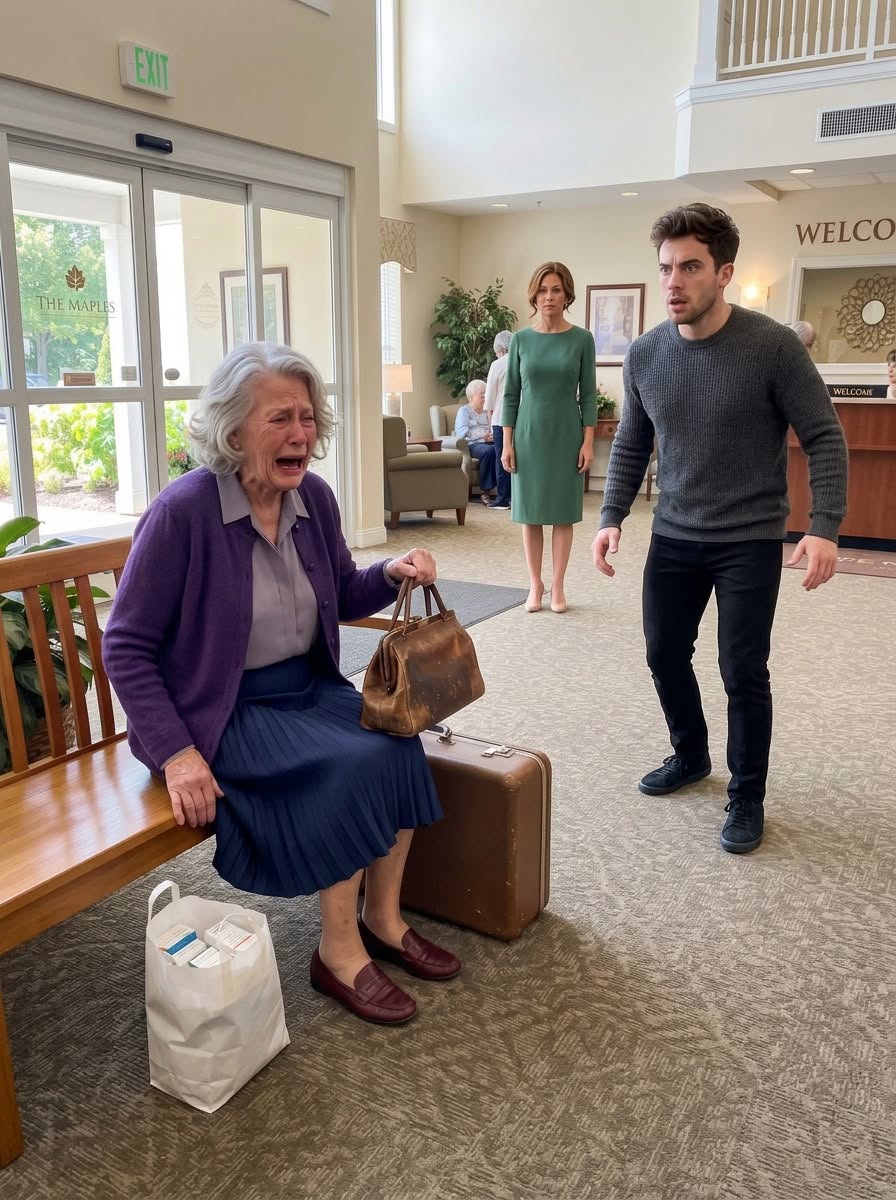
My parents told Grandma Eleanor they were taking her out for lunch.
Three hours later, I received a call from a nursing facility in Ohio.
“Is this Daniel Mercer?” the woman asked. “Your grandmother listed you as her emergency contact. Her suitcase is sitting in our lobby, but the relatives who brought her here left before the admission process was finished.”
I was standing in the kitchen of my Indianapolis apartment, holding a cup of coffee I suddenly had no interest in drinking.
“What do you mean, they left?”
The administrator paused. “They said they needed to retrieve some paperwork from their car. They never returned.”
I called my father. Straight to voicemail.
Then my mother. Same result.
I drove 190 miles with both hands gripping the steering wheel.
When I arrived, Grandma was seated beside one brown suitcase and a grocery bag filled with medications. She still wore her church coat despite the warm lobby. Her gray hair was neatly pinned, and her expression had that familiar calmness she always showed whenever she was deeply upset.
I knelt beside her. “Grandma.”
She studied me for several seconds. Then she rose.
No tears. No questions.
She walked toward my car, climbed inside, and fastened her seatbelt.
“Don’t call them,” she said.
I stared at her.
“I’ll tell you where we’re going.”
“Where?”
“First, the county courthouse.”
That immediately caught my attention.
On the highway, she opened her purse and passed me a folded bank statement. Three withdrawals were circled in red. Twelve thousand dollars. Eighteen thousand. Twenty-five thousand.
All made within six weeks.
“Your father has power of attorney,” she said. “Temporary. I signed it after my surgery because I trusted him.”
My stomach tightened.
“He told me I was becoming forgetful. He said I needed assistance managing my bills.” She turned toward the window. “Then yesterday I discovered this.”
“Did you confront him?”
“I did.”
“And?”
“He claimed the money was being spent on my care.”
I glanced toward the single suitcase sitting in the back seat.
Grandma gave a humorless laugh.
“At lunch today, your mother told me we were visiting somewhere with a garden. They walked me into that facility, completed nothing, and disappeared.”
My phone buzzed. Dad.
Grandma reached across and turned it face down.
“Courthouse first,” she repeated. “Then the bank. Then one final place.”
“What place?”
She looked directly at me.
“My house.”
I swallowed. “Why?”
“Because if they’ve done what I believe they’ve done, your parents didn’t simply leave me there today.”
She removed a small envelope from inside her coat. Written across the front, in my grandfather’s handwriting, were two words: HOUSE DEED.
“I hid this before they came to get me,” she explained. “I wanted to see whether they would search for it.”
Her voice became quieter.
“They wanted me out of the way.”
The county courthouse was only ten minutes from closing when we arrived.
Grandma moved more quickly than I expected.
At the clerk’s window, she requested copies of every document recorded against her property within the previous ninety days.
The clerk searched using the address.
Then her expression shifted.
“There’s a quitclaim deed recorded twelve days ago.”
Grandma tightened her grip on the counter.
“To whom?”
The clerk angled the monitor slightly toward us. My father’s name appeared there: Richard Mercer.
I felt my face grow warm.
Grandma showed no immediate reaction. She simply requested a certified copy.
In the parking lot, she carefully read every line.
Her signature appeared at the bottom.
“That isn’t my signature,” she said.
I examined it more closely. It looked similar to hers, but the final letters were different. Too smooth. Too deliberate.
“Can Dad transfer your house using power of attorney?”
“Not by signing my name without permission.”
We headed to her bank next.
A branch manager named Claire Benton brought us into a private office. Grandma presented identification, removed my father’s access, changed every account password, and requested complete transaction records.
Claire appeared uneasy as the statements began printing.
There were more transfers than Grandma had originally discovered.
Not fifty-five thousand dollars.
Eighty-three thousand.
Most of the money had gone into an account belonging to Mercer Renovations LLC, my father’s struggling contracting business.
Another twenty thousand had been wired to a title company.
Grandma pointed at that transaction.
“That’s connected to the house.”
Claire nodded cautiously. “I can’t tell you what the title company ultimately used it for, but this transfer was initiated through online banking with authorized credentials.”
“His credentials,” Grandma said.
The manager remained silent.
Outside, I finally called my father.
Grandma made no attempt to stop me.
He answered on the second ring.
“Daniel, where is she?”
The question caught me completely off guard.
“You left her at a nursing facility.”
“That wasn’t supposed to happen.”
“Then what was supposed to happen, Dad?”
Silence.
Then I heard my mother’s voice faintly in the background. “Tell him she needs supervision.”
Dad lowered his voice. “Your grandmother has been making questionable decisions. We were trying to place her somewhere safe.”
“She passed a cognitive evaluation two months ago.”
Another pause.
I hadn’t known about the evaluation. Grandma had.
Dad switched approaches.
“You don’t understand what’s happening financially.”
“I understand that eighty-three thousand dollars is unaccounted for.”
He went silent for half a second.
Grandma watched my expression and immediately understood.
“Daniel,” Dad said, “do not bring her back to that house.”
“Why?”
“Because it doesn’t belong to her anymore.”
Grandma reached toward the phone.
I gave it to her.
“Richard,” she said, “you signed my name without my permission.”
His answer came immediately.
“You signed documents.”
“I signed a temporary power of attorney after my surgery. I never signed away my home.”
“You said you wanted to support the family.”
“I said I would help when I could. I never gave you permission to take what belonged to me.”
My mother took the phone from him.
“Eleanor, stop turning this into something bigger than it is. Richard was trying to protect the property. His business is struggling. We planned to repay everything.”
Grandma’s expression hardened.
“So you brought me to a nursing home?”
“You need additional care.”
“No. You needed me somewhere I couldn’t challenge what you were doing.”
My mother said something I knew I would never forget.
“You’re eighty-one years old. What exactly are you keeping that house for?”
Grandma ended the call.
For several seconds, neither of us said anything.
Then she gave me the next destination.
Her house.
When we turned onto Maple Ridge Road, two pickup trucks were sitting in the driveway.
The front door stood open.
A man I had never seen before was carrying Grandma’s dining chairs onto the porch.
I hit the brakes.
Grandma stared through the windshield.
A red-and-white sign had been planted in the yard.
ESTATE LIQUIDATION — SATURDAY.
Tomorrow.
Her entire life had already been sorted and priced for sale.
I parked behind both pickup trucks so neither could leave without getting past us.
Grandma opened her door before I had a chance to ask her to remain in the car.
The man holding the dining chairs stopped when he noticed her.
He looked to be in his late forties, heavyset, wearing a gray sweatshirt bearing the logo of a local estate-sale company. He carefully lowered the chairs.
“Mrs. Mercer?”
“Yes.”
His gaze moved toward me, then returned to her.
“I was told you had relocated permanently.”
“Who told you that?”
“Your son.”
Grandma walked straight past him toward the house.
I followed behind her.
Inside, I could barely recognize the living room. Blue stickers covered furniture, lamps, framed photographs, even the oak clock my grandfather had built with his own hands. Cardboard boxes filled the floor. Someone had emptied cabinets and organized Grandma’s possessions into inexpensive plastic bins.
On the dining room table was a clipboard marked MERCER ESTATE SALE.
Grandma lifted it.
The contract carried my father’s signature.
The estate-sale operator introduced himself as Kevin Doyle. He became increasingly uneasy as Grandma began questioning him.
“My son hired you?”
“Yes, ma’am.”
“Did he tell you I had passed away?”
Kevin swallowed. “No. He told me you had moved into long-term care and that ownership of the property had transferred to him. He showed us documentation.”
“What documentation?”
“A deed. And a power of attorney.”
Grandma turned toward me.
“Photograph everything.”
I did.
Every room. Every sticker. Every box. Every document Kevin had received.
Kevin, apparently realizing he had become involved in something much more serious than a normal family disagreement, voluntarily emailed me copies of both the contract and deed.
Then Grandma told him she wanted the sale stopped.
He agreed immediately.
“I don’t want to be involved if the ownership is being challenged,” he said.
The second pickup belonged to a man hired to remove anything considered unsuitable for sale. He returned the few boxes already loaded into his truck and drove away.
By then, my father had called eleven times.
My mother had called six.
Grandma answered neither.
I expected her to fall apart after the strangers finally left.
Instead, she made tea.
That was Grandma’s way. Whenever life became overwhelming, she turned it into a list of things to do.
At six-thirty, she contacted the county sheriff’s non-emergency line and reported suspected financial misuse, unauthorized signatures, and missing funds involving someone acting under power of attorney.
A deputy arrived at the house, photographed the scene, copied the banking records, and listened while Grandma explained what had happened at the nursing facility.
The deputy carefully avoided promising that anyone would be arrested.
“These situations can become complicated when relatives and legal authority are involved,” he explained. “But disputed signatures and improper use of someone else’s funds go beyond an ordinary family disagreement.”
Grandma nodded.
“Good. Because I’m not reporting a disagreement.”
After he left, I asked her what the envelope from my grandfather contained.
She opened it at the kitchen table.
Inside was the original deed from twenty-three years earlier, when Grandma and Grandpa had refinanced the property after paying off most of their mortgage. There was also a handwritten note from Grandpa, who had p@ssed away seven years earlier.
Keep the originals somewhere Richard cannot access if he ever begins asking about the house.
I read the sentence twice.
“You thought Dad might eventually do something like this?”
“No,” Grandma replied. “Your grandfather was worried he might.”
She looked at the note for a long moment.
My father had always been the charming one in our family. He could persuade a mechanic to extend a payment deadline, convince customers to provide deposits early, and reassure relatives that his next business opportunity would fix the problems created by the previous one.
As a child, I thought that talent made him impressive.
Grandpa had apparently interpreted it differently.
At eight-fifteen, headlights moved across the front windows.
Dad’s SUV pulled into the driveway.
My mother stepped out first.
“Stay inside,” I told Grandma.
The look she gave me immediately ended that conversation.
We met them outside on the porch.
Dad looked exhausted. His shirt was wrinkled, and stress had drained the color from his face. Mom looked furious.
“What have you done?” she demanded.
Grandma crossed her arms.
“I came back to my home.”
“You contacted the police,” Dad said.
“Yes.”
“You’re going to ruin my business.”
“You used my money to keep it operating.”
“I borrowed it.”
“Without my permission.”
“I had legal authority.”
“You had authority to manage my bills while I recovered from surgery. You did not have permission to move my savings into your own accounts.”
Dad dragged both hands across his face.
“You don’t understand. Three projects went wrong at the same time. Suppliers were threatening liens. Payroll was coming due. I needed temporary funding.”
“So you used mine.”
“I intended to repay it.”
Grandma pointed toward the front yard.
“And what about the deed?”
He turned his eyes away.
Mom stepped forward.
“The house was only being used as collateral.”
My stomach tightened.
Grandma’s voice became unusually quiet.
“Collateral for what?”
Neither of them responded.
I remembered the twenty-thousand-dollar transfer to the title company.
Dad finally answered.
“A bridge loan.”
“How much?”
“Mom—”
“How much?”
He let out a long breath.
“One hundred and sixty thousand.”
Grandma placed one hand against the porch railing, not because she was weak, but as though she needed something solid beneath her fingers.
“You used my house as security for a company loan?”
Dad’s jaw tightened.
“It was meant to cover a temporary financing gap. Once the commercial project paid out, I would have cleared everything.”
“And when is that supposed to happen?”
He stayed silent.
Mom answered for him.
“The client declared bankruptcy.”
For several seconds, the distant traffic on the county road was the only sound we could hear.
Then everything became clear to me.
The nursing facility.
The questionable deed.
The estate sale.
They had not merely been attempting to gain control of Grandma’s assets.
They were working against a deadline.
“What happens to the house now?” I asked.
Dad stared angrily at me.
Grandma answered before he could.
“If the deed and loan were obtained improperly, an attorney can challenge them.”
“Attorneys cost money,” Mom said sharply.
Grandma nearly smiled.
“You left me enough.”
Mom’s expression shifted.
That tiny reaction told Grandma something important.
She looked directly at Dad.
“How much debt exists that I haven’t been told about?”
He remained silent.
Grandma went inside and closed the door.
Dad attempted to follow her.
I stepped in front of him.
“This is my mother’s house,” he said.
“No,” I replied. “That seems to be the entire problem.”
He looked at me in disbelief, as though disloyalty only existed when someone stopped cooperating with him.
They drove away ten minutes later.
The following morning, Grandma and I met with attorney Rebecca Sloan, a sixty-two-year-old lawyer specializing in elder law and property disputes. Grandma had previously worked with her for estate planning.
Rebecca moved quickly.
By noon, she had filed an emergency petition asking the court to invalidate the quitclaim deed, revoke the power of attorney, and temporarily block any sale, transfer, or foreclosure involving the property until legal ownership could be established.
She also contacted the lender.
That changed everything.
The lender’s attorney provided the notarized deed used for the transaction.
The notary was a man named Scott Vance.
Grandma had never met him.
Rebecca checked his commission records and located his office address.
It belonged to an accounting service only two blocks from my father’s business.
Then Kevin Doyle forwarded another document from the estate-sale records: an email Dad had written three days earlier.
Need house emptied immediately. Owner has entered memory care and will not be coming back.
Grandma read it in silence.
Rebecca placed the document on her desk.
“Eleanor, I need you to understand something. The circumstances are becoming much clearer. Your son represented to several third parties that you lacked capacity or had permanently relocated. If those statements were used to dispose of your property, they may support a broader financial exploitation claim.”
Grandma asked only one question.
“Can I keep my home?”
Rebecca did not offer unrealistic reassurance.
“If the lender received inaccurate information and the deed was signed without your authorization, you have a strong argument. But litigation may still be necessary. The lender could argue that it relied in good faith on officially recorded documents.”
“How long?”
“Months. Maybe longer.”
Grandma nodded.
“Then we begin.”
The following week was exhausting.
Investigators interviewed bank employees, nursing facility staff, Kevin, me, my parents, and eventually the notary.
Security cameras at the nursing facility had recorded Dad and Mom walking Grandma into the lobby at 12:41 p.m.
Dad carried her suitcase.
Mom spoke with the receptionist.
At 12:58, both of them exited through a side entrance.
Neither returned.
More importantly, the admissions coordinator had written a note after Mom stated that Grandma experienced “progressive confusion” and could no longer independently manage everyday life.
Grandma’s recent cognitive evaluation directly contradicted that claim.
The notary became the critical link.
Scott Vance initially insisted Grandma had personally appeared before him.
Then investigators showed him images establishing that Grandma had been attending a physical therapy appointment across town on the date the deed was supposedly notarized.
His explanation changed.
He acknowledged that my father had brought the document into his office already signed and explained that his mother was recovering from surgery and unable to travel.
Scott had notarized the document as a personal favor.
He maintained that he had no knowledge the signature was unauthorized.
That decision placed his professional license at risk and created potential legal consequences.
Two weeks later, he turned over his journal and emails.
One message from Dad read:
She won’t understand the paperwork anyway. Just need this completed by Friday.
That sentence eliminated whatever possibility remained that I could view everything as desperate improvisation rather than deliberate planning.
Dad understood exactly what he was doing.
But the most pa!nful discovery came from his company’s financial records.
The eighty-three thousand dollars removed from Grandma’s accounts had not all been used for payroll.
Almost twenty-seven thousand had gone toward personal credit-card balances.
Nine thousand had covered payments on Mom’s SUV.
Six thousand had paid toward a vacation deposit they later canceled.
The remaining money had been distributed among supplier balances and overdue taxes.
When Rebecca showed Grandma the breakdown, she remained silent for nearly a minute.
Then she asked, “Did Daniel know?”
“No,” Rebecca replied.
Grandma nodded once.
That question affected me more deeply than anything else.
She could recover from losing money.
What she struggled to accept was no longer knowing how far the betrayal extended.
I stayed in her guest room for the following month. Not because she required supervision, but because unfamiliar cars occasionally slowed near the property and because my parents continued finding excuses to come by.
Dad appeared twice asking to speak with her privately.
Grandma declined.
Mom sent me lengthy messages accusing me of turning Grandma against them.
I kept every message.
Then, six weeks after the nursing-facility incident, the lender agreed to release its claim on the house and instead pursue my father and his company directly.
Their attorneys had examined the evidence and concluded that defending the mortgage would be more costly than reversing the transaction.
Grandma’s title was restored.
The legal investigation continued.
Dad faced multiple charges connected to unauthorized documents, financial misuse, and alleged exploitation of an elderly person.
Scott faced separate legal proceedings and professional disciplinary action.
Mom was not charged in connection with signing the deed, but investigators alleged that she had participated in the effort to place Grandma in long-term care using inaccurate representations. Her attorney entered negotiations while prosecutors considered what the available evidence could establish.
The family is divided exactly the way families often do when the consequences become real.
One aunt told Grandma she should let the matter go because Dad was still her son.
A cousin argued that legal consequences would not bring the missing money back.
Another relative suggested that the entire family try counseling.
Grandma listened patiently to every opinion.
Then she asked each person the same question.
“If someone outside this family had done this to me, would you still tell me to protect them?”
Nobody had a convincing response.
Dad eventually accepted responsibility for reduced charges rather than take the case to trial.
The outcome included time in custody, supervised release, restitution, and a court order preventing him from handling Grandma’s finances or contacting her without approval.
His contracting business eventually closed.
The restitution did not somehow return everything she had lost.
Some of the money was already gone.
Legal expenses consumed more.
Grandma recovered part of her losses through insurance and civil settlements, but she never recovered all of it.
Life did not simply return to normal.
That was the part people rarely talk about.
After a family crisis, there is no perfect ending waiting at the finish line. There are passwords to update, documents to replace, credit reports to check, legal bills to handle, relatives to keep at a distance, and quiet mornings when someone remembers exactly who carried her suitcase into that building and walked away.
About eight months later, Grandma sold her house.
Not because anyone pressured her.
Because it was her decision.
She purchased a smaller single-story home thirty minutes from me, with two bedrooms, a broad front porch, and enough garden space to grow tomatoes.
On moving day, I discovered the old red-and-white estate-sale sign folded behind a shelf in the garage.
I held it up.
“Do you want me to throw this out?”
Grandma studied it for a moment.
“No.”
I assumed she wanted to preserve it as evidence.
Instead, she picked up a black marker and wrote across the front:
NOT YOURS TO SELL.
Then she hung the sign inside her new garage.
One year after that unexpected call from the nursing facility, we passed Maple Ridge Road while driving to lunch.
The old house belonged to new owners now. A young couple had painted the shutters dark green. Two bicycles rested against the porch.
Grandma watched until the house disappeared behind us.
“Do you miss it?” I asked.
“Sometimes.”
I waited for her to continue.
She adjusted her seatbelt.
“But a home only has value when you’re free to live your own life inside it.”
We stopped at a diner outside Columbus.
She ordered chicken soup with half a turkey sandwich.
After the waitress walked away, Grandma looked across the table at me.
“You know what your parents misunderstood?”
“What?”
“They believed getting older made it easier to overlook.”
She opened a packet of crackers.
“It only made me less willing to stay quiet.”
For the first time in months, I laughed hard enough that Grandma started laughing too.
And when lunch was finished, nobody vanished.
We walked back to the car side by side.