The accident happened on a Tuesday evening in October, on the stretch of Route 7 just past the overpass where the road curves sharply and the guardrail had been damaged twice before without ever being properly reinforced.
I know these details not because I remember them but because a police officer named Sergeant Delaney told them to me three days after I woke up, sitting in a chair at the side of my hospital bed with a notepad on his knee and the careful measured voice of someone who has delivered difficult information many times and has learned to pace it. He told me the time of the accident, which was 8:47 p.m., and the location, and the fact that my car had been hit on the driver’s side by a vehicle that ran the curve too fast and crossed the center line. He told me I had been transported by ambulance and that I had been unconscious for fourteen hours.
He also told me, in the same careful voice, that the driver of the other vehicle had not survived.
I received this information the way you receive things when you are three days out of surgery with a fractured tibia and nine stitches in your forehead and a brain that is still sorting out which memories belong to it, which is with a kind of blurred acceptance that is not understanding but is the nearest thing to it that is available.
My name is Claire. I was twenty-nine years old when the accident happened, working as a graphic designer for a small firm in Hartford, living in an apartment I had been gradually making into a home for two years, in possession of the ordinary life that you inhabit without thinking about it until it is interrupted.
The interruption was thorough.
My left leg was in a cast from the knee down, and there were the nine stitches, and there was the head injury which the neurologist explained in terms that I wrote down but could not fully absorb, something about the specific nature of the impact and the way certain memory functions can be disrupted, and the fact that the period immediately surrounding the accident might never fully return, that there could be gaps not just in the night itself but in the days and weeks preceding it.
“How far back?” I asked.
“It’s different for everyone,” he said. “For most people in your situation, the acute retrograde period is the night itself and perhaps a few hours before. But the weeks leading up can be hazy. You may find things come back gradually, or some of it may simply stay unclear.”
“What was I doing that night?” I said. “Before the accident.”
“That’s what we were hoping you could tell us,” he said.
I could not tell him.
The weeks in the hospital had their own texture, different from ordinary time, the particular quality of institutional days where the structure is external and the body is the primary project. My sister Carol came and stayed for the first week and then returned to her job in Boston but called every evening. My parents drove up from New Jersey and my mother cried and my father fixed things that did not need fixing, which was how he expressed love, and they stayed for four days and then had to go back. Friends came in shifts, bringing food and books and the careful cheerfulness of people who are not sure what to say to someone who has had the kind of thing happen that has happened to you.
Richard I noticed on the third day.
He was one of the nurses on my floor, not my primary nurse but one who appeared frequently enough that his face became familiar before his name did. He was tall, dark-haired, with the efficient quiet of someone who knew how to be in a hospital room without amplifying its tension. Most of the nurses on the floor were excellent in the professional way, careful and competent and kind within the parameters of competence. Richard was all of those things and also something else that I could not name immediately, an attentiveness that exceeded what the job required.
He paid me more attention than the other patients.
I noticed this in the way you notice things when you have nothing to do but observe, when your body is immobile and your mind is the only thing doing anything. He would stop in the doorway sometimes when he was passing, for just a moment longer than necessary, not quite watching me but present in a way that I registered.
At the time I told myself he was simply attentive. That some nurses were like that, that he had the particular quality of someone who took individual patients seriously rather than treating them as a category of need. This explanation satisfied me for a while.
There was one afternoon, maybe two weeks in, when he came to take my blood pressure and I caught him looking at me with an expression that I could not classify. Not attraction exactly, or not only that. Something more specific, more worried. He became aware that I had seen it and it disappeared so quickly that afterward I was not sure I had seen it.
“Do you know what I was doing?” I asked him once. “Before the accident. Do you know anything about it?”
He looked at me steadily.
“Why would I know that?” he said.
“I don’t know,” I said. “You just seemed like you might.”
“I didn’t know you before you were admitted,” he said.
He said it without any change of expression, with the simple delivery of a fact, and I accepted it and did not return to it again.
Three months after I was discharged, he asked me to dinner.
I had run into him twice in the interim, once at the grocery store in a coincidence that felt unremarkable at the time, and once at the farmers market near my apartment where he had a basket of peaches and I had a bunch of kale and we had stood in the October sun and talked for forty minutes. He was easy to talk to in the way that some people are easy, where the conversation finds its shape without effort and an hour passes like twenty minutes.
At dinner I told him about my work and about my sister in Boston and about the apartment and the slow recovery. He told me about nursing, how he had come to it after a year in pre-med that had convinced him he wanted to be closer to the patient than medicine usually allowed. He was thirty-four, had grown up in Vermont, had moved to Hartford three years earlier.
He asked thoughtful questions and remembered the answers.
On the walk back to my apartment he took my hand.
I said yes when he asked to see me again.
What followed was the kind of relationship that feels, when you are inside it, like it has found you rather than you having found it, the particular inevitability of a connection that seems to have been arranged by something outside yourself. Richard was attentive in the way he had been as my nurse, which in a romantic context felt different, felt like being truly seen rather than carefully monitored, and I let the feeling be what it seemed to be, which was what I wanted it to be.
He proposed in the spring, in the garden of the restaurant where we had had our third date, with a ring he told me had been his grandmother’s, a small oval sapphire set in yellow gold that was exactly the kind of ring I would have chosen if I had been choosing.
I said yes immediately, before he had finished the sentence.
The wedding was in September.
We had been together less than a year, which some people observed to me with the careful phrasing of people who are registering a concern without quite stating it, and I received these observations with the patience of someone who is certain enough not to be unsettled by doubt. I was thirty, I knew what I wanted, I had found the person who felt like the answer to a question I had been asking without always knowing I was asking it.
I was happy.
I was also, in the weeks before the wedding, occasionally visited by a feeling I could not name, a quality of unease that had no specific object, that arrived and departed without explaining itself. I attributed it to the general anxiety of a significant occasion, the normal response of someone who is reorganizing her life around another person.
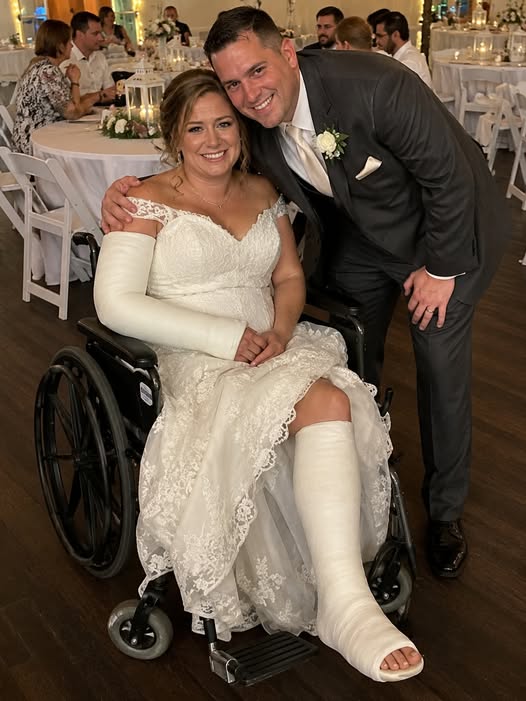
The wedding was beautiful in most of the ways a wedding should be beautiful.
The venue was a restored mill on the river, with timber beams and candlelight and the kind of spaces that make people feel both elevated and at ease. My sister Carol was my maid of honor and she had given a toast at the rehearsal dinner that had made my father cry in the way he only cried when he was proud rather than sad. My mother had been in some form of delighted motion for six weeks.
Richard’s side was smaller. His parents had both died, his father years earlier and his mother recently enough that the grief was still current, and he had a few close friends and two cousins, and they filled their half of the venue without it feeling sparse.
He was handsome in the tuxedo.
I want to say this because the image of him at the altar, when I came down the aisle on my father’s arm, is something I have returned to many times in the months since, the way images become strange when you hold them too long, the way a face you know can become briefly unknown if you look at it without the context of what you know about it.
He looked at me with love.
I believe that is what I saw.
The ceremony was everything.
The reception was when things began to change.
I noticed it first at dinner, when his hand shook badly enough that wine spilled over the rim of his glass. He apologized and blotted it with his napkin and said something light about champagne, but he had not been drinking enough champagne to account for the shaking, and his face when he looked up from the spill was not the face of someone who is tipsy and slightly embarrassed, it was the face of someone managing something much heavier.
I let it go.
Later, while the guests were dancing, I went to find him because he had been gone from the reception floor for twenty minutes and no one had seen him, and I found him on the terrace, standing at the railing looking out at the river in the dark. He had a glass in his hand that was mostly empty and he was swaying slightly.
“What’s wrong with you tonight?” I asked.
He turned.
There was no smile.
His face was the face I had seen in the hospital room doorway, the look I had told myself I had imagined, the look that was not quite attraction and not quite watching but something between them, something that had always existed at the edge of what I could see.
“If you knew what I really did,” he whispered, “you wouldn’t be wearing that ring.”
The terrace was quiet.
Behind us, through the tall windows, the reception continued, music and voices and the clink of glasses, completely separate from where we were standing.
I felt cold.
“Richard,” I said.
“I should have told you before we got married.” He was not quite slurring but the words had the weight of alcohol behind them. “I was selfish. I thought if I waited long enough, maybe it wouldn’t matter anymore.”
“Tell me now,” I said.
But he was already gone in the way that very drunk people go, the sudden collapse from present to absent, and he sank to the floor of the terrace and was asleep before I could catch him.
One of the groomsmen helped me get him to the bedroom.
I lay beside him in the dark with my wedding dress still on for the first hour, just lying there, unable to move into what the night was supposed to be, listening to him breathe and thinking about the words.
If you knew what I really did, you wouldn’t be wearing that ring.
I tried to construct the innocent versions.
He had done something embarrassing before we met. He had a secret he considered shameful that was in reality ordinary. He had made a mistake in his past that he had never confessed and that was eating at him with the specific guilt that occasions of significance produce, the way weddings make people reckon with themselves.
I found none of these constructions fully satisfying.
I eventually changed out of the dress and lay with my eyes open until the gray light of early morning came through the curtains.
Richard was still sleeping.
I got up.
I began gathering the clothes that had been left on the floor the night before, because tidying was what I did when I was anxious, the physical work of organizing small things when larger things were beyond my organizing.
His tuxedo jacket was over the back of the chair.
I picked it up to hang it.
Something shifted in the inner pocket.
Heavy. Shifting the way papers shift, or a book, or a folder.
I reached into the pocket.
And I pulled out a manila envelope, letter-sized, the kind used for documents, thick with whatever was inside it, and on the front, in Richard’s handwriting, were two words.
For Claire.
I sat down on the edge of the bed.
I held the envelope for a long time before I opened it.
The bedroom was very quiet.
Richard was breathing evenly on his side of the bed.
I opened the envelope.
Inside was a letter in Richard’s handwriting, several pages, and beneath the letter was another envelope, smaller, and on this one were the words Do not open until you have read everything.
I read the letter.
I am going to tell you what was in it, because the letter is the whole of what I need to tell you, the thing that everything else has been building toward, the explanation for the doorway and the watching and the shaking hand and the words on the terrace and all the months that preceded them.
The letter said this.
Richard had been driving the other car.
He had been on Route 7 on a Tuesday evening in October, driving back from a shift, tired in the way that nurses are tired at the end of a long day, and he had taken the curve too fast and crossed the center line.
He was the driver who had not survived.
He stopped and I had to read this sentence three times before it resolved into meaning, because the grammar of it was impossible, Richard was in the bed beside me, Richard had survived, and then I understood that he had written it wrong and I kept reading.
He had survived.
The police report had listed him as the other driver, had listed him as a fatality because he had gone through the windshield and been thrown from the vehicle and had been found forty feet from the car, and there had been a confusion in the chaos of the scene, a terrible administrative error that had compounded in the subsequent hours, and by the time the error was discovered, by the time his identity was properly established, he had been found alive, badly injured but alive, and transported to a different hospital across the county line.
He had been in that hospital for eight days.
During those eight days, the report of his death had been recorded and shared.
His family had been notified.
And then he had recovered, and the correction had been made in the official records, and the insurance and legal processes had begun, and he had returned to work and to his life, and he had done something that the letter explained in the most careful and tortured language I have ever read.
He had gotten my name from the accident report.
He had gone to the hospital where I was a patient.
He had taken a position on my floor.
He had watched me.
He had been watching me for weeks, coming to the doorway, waiting for something he did not know how to ask for and could not request through ordinary means, which was the answer to the question that was destroying him, the question of whether I was all right.
He had caused the accident.
He had survived it when the report said he had not.
And he had come to see for himself whether I had survived it.
What he had not planned, what the letter said he had not predicted and had not intended, was that he would fall in love with me.
He wrote: I came to the hospital to see if you were going to be okay. I thought I would look once and leave. I thought seeing you alive would be enough. I did not know what I would find. I did not know that the person I had hurt without meaning to would become the person I could not be without. I know how that sounds. I know there is no good way to say it and no version of this story in which I am not the person who did what I did. I am asking you to read to the end before you decide anything. That is all I am asking.
He had left the hospital.
He had tried to leave.
He had run into me at the grocery store because he lived six blocks from my apartment, which was a coincidence and not a plan, and he had been unable to leave when he had the chance because standing there in the grocery store with his basket he had understood something about himself that he could not undo, which was that he was already in love with me.
He had taken me to dinner.
He had let himself fall into the relationship.
He had tried, he wrote, to tell me many times. He had tried on the third date and on the night of the first snowfall and on the morning after the first time I stayed at his apartment and on the drive to see his cousins in Vermont. He had written and deleted texts and emails. He had sat across from me at dinner tables with the words at the surface and had watched them sink again before they reached his mouth.
He had proposed instead.
He wrote: I told myself I would tell you after the proposal, when the question was settled, when the answer was yes, when it was real. Then I told myself I would tell you before the wedding, when we had time to sit with it. Then I told myself I would tell you on the wedding night, when we were alone, when there was no occasion to manage. I have told myself every version of the better time and the better time has not come because there is no better time. There is only now, which is the morning after the night I was not able to say it, and this envelope in my jacket pocket that I have been carrying for four months, and you, reading this, which is the thing I have been most afraid of and most certain I deserved.
I screamed.
I am not sure when exactly, while reading or after, but I screamed and Richard woke up and I was standing and the pages were in my hands and he sat up in the bed and looked at me and his face was already collapsed, already fully collapsed in the way of someone who has known this moment was coming and has not known how to prepare for it and has arrived at it without adequate preparation.
“Claire,” he said.
I could not speak.
I held the pages up.
He said nothing.
I put the pages down on the chair, because holding them felt wrong, and I stood in the middle of the room with my hands at my sides, and the morning light was coming through the curtains at the angle of early morning in September, and my husband was sitting up in the bed of our honeymoon suite in his wedding clothes still partially on, and I was wearing the silk robe from the closet and my wedding ring.
“You were driving the other car,” I said.
“Yes,” he said.
“You survived.”
“Yes.”
“And you came to the hospital.”
“Yes.”
“And you took a position on my floor,” I said. “As my nurse. While I was recovering from the accident you caused.”
“Yes.”
“And then you dated me,” I said. “And proposed to me. And married me.”
He said nothing.
The room was so quiet I could hear the river outside the window.
“Richard,” I said.
“Yes.”
“What was in the other envelope?” I said. “The one that said do not open until you’ve read everything.”
He got up from the bed.
He walked to the chair where I had put the pages and he picked up the smaller envelope from the floor where it had fallen.
He handed it to me.
I opened it.
Inside was a single piece of paper, folded once.
It was a legal document.
Specifically it was a statement, notarized, from an attorney, detailing the terms of a restitution arrangement that Richard had established with a legal firm nine months earlier, two months before he had asked me to dinner. The arrangement described the transfer of a significant sum of money, the details of which the document laid out specifically, into a trust that had been established in my name, designated for whatever purposes I chose, accessible to me at any point and under any circumstances including and especially the circumstance of my choosing to end our marriage upon learning the truth.
There was a separate note at the bottom in Richard’s handwriting that was not part of the legal document.
It said: This is not an apology because money is not an apology. This is not an attempt to buy your forgiveness because I know there is no buying it. This is the only thing I know how to do that is concrete and real and that cannot be taken back. Whatever you decide, whatever you need, whatever comes next: this is yours and it will always be yours and I am not attaching any condition to it.
I put the document on the chair.
I sat down on the edge of the bed, which was the nearest flat surface, and I sat there with my hands in my lap.
Richard was still standing by the window.
He had the quality of someone waiting for a verdict who has made his peace with the worst version of it, the specific stillness of a person who has decided not to argue for himself.
“You have been living with this for over a year,” I said.
“Yes,” he said.
“And you decided that the way to handle it was to fall in love with me and propose and marry me and carry a letter in your pocket and get drunk at the reception and whisper something at me on the terrace and then fall asleep and let me find it in the morning.”
“Yes,” he said. “Except for the plan. It wasn’t a plan. None of it was a plan after the first part.”
“The first part was a plan,” I said.
“The first part was a decision,” he said. “To go to the hospital. The rest of it stopped being anything I decided.”
“You proposed,” I said. “Proposals are decisions.”
“I proposed because I loved you,” he said. “And because I was a coward. Both of those things were true at the same time.”
I looked at the window.
I thought about the months. The grocery store. The farmers market with the peaches and the kale. The dinner. The forty-minute conversation on the walk home. The hand he had taken.
“Did you follow me?” I said. “To the grocery store.”
“No,” he said. “I lived six blocks from your apartment because I had lived there for three years. I was in the store because I needed groceries. I saw you and I could have left and I didn’t.”
“Could you have? Actually?”
He was quiet.
“No,” he said. “I don’t think I could have. I had been thinking about you every day for five months. I had been to the hospital and watched you and convinced myself I was leaving and not left. I don’t think the grocery store was something I could have walked away from.”
“Because you felt guilty,” I said.
“Because I was in love with you,” he said. “Both things. Both things were present all the time.”
I stood up and went to the window and stood beside him.
Outside, the river was moving the way rivers move in early morning, with the self-contained purpose of something that does not know it is being watched. The mill buildings that made up the venue were reflected in the water, slightly distorted, the way reflections always distort.
“Why did you bring the envelope to the wedding?” I said.
“Because I had been carrying it for four months and it was the deadline,” he said. “I had told myself that if I couldn’t say it before the wedding I would leave it somewhere you would find it after. The tuxedo was the somewhere.”
“You planned for me to find it,” I said.
“I planned for you to have it,” he said. “I didn’t plan the exact moment. I thought it would be later. I thought we would have the night and the morning and maybe breakfast and then you would find it.”
“And you thought that was better,” I said. “The letter rather than the conversation.”
“I thought the letter was what I owed you,” he said. “The complete thing, without me in the room managing your response. I thought you deserved to read it without watching my face while you read it.”
I turned and looked at him.
He looked terrible in the specific way of people who have not slept and have been crying, which I had not seen him do but which the evidence suggested had happened at some point in the night.
“You love me,” I said.
“Yes,” he said. “That’s the most true thing I have ever said and the most complicated.”
“Because of what it’s attached to,” I said.
“Because of what it’s attached to,” he said.
I went to the small table where the remains of the wedding night room service were still sitting, two glasses and a bottle that was mostly full because neither of us had touched it, and I poured water from the pitcher and drank it and looked at the wall for a while.
“I lost three weeks,” I said. “From before the accident. The neurologist said some of it might be hazy and some of it might never come back.”
“I know,” he said.
“What was I doing?” I said. “The night of the accident. Do you know?”
He was quiet.
“I don’t know specifically,” he said. “I know you were heading east. I know you had been in Hartford. Beyond that I don’t know.”
“Were we going to the same place?” I said.
“Possibly,” he said. “The road goes to two different exits. I was going to the second one.”
“Were you following me?” I said.
“No,” he said. “I had never seen you before that night.”
I believed him. I do not know precisely why I believed him, but I did, the same instinct that had told me something was true and something was not during the months of the relationship, the same instinct I had sometimes dismissed and sometimes trusted.
I sat down again.
I spent a long time not speaking.
Richard sat in the chair across the room and he did not speak either, and the morning light moved across the floor the way it moves in hotel rooms on the morning after something significant, with the indifference of light to human events.
“The document,” I said. “The trust.”
“It’s real,” he said. “It’s in your name now. It has been since January.”
“That was before we were engaged,” I said.
“Yes,” he said.
“You set up a financial trust for me before you asked me to marry you.”
“I set up a way to give you something concrete before anything else happened,” he said. “Because I knew that if I kept seeing you and nothing concrete had been done, it was only about what I wanted. And I didn’t want it to be only about what I wanted.”
“But you proposed anyway,” I said.
“Yes,” he said. “Because I loved you. And because I am a person who made a terrible mistake and fell in love with the person I hurt and spent a year being unable to do the right thing and the wrong thing simultaneously.”
“Richard,” I said.
“Yes.”
“I don’t know what to do with this,” I said.
“I know,” he said.
“I need you to understand that,” I said. “I don’t mean I know what I’m going to do and I’m making you wait. I mean I genuinely do not know.”
“I understand that,” he said.
“Because there are two things that are both true,” I said. “And I don’t know how to hold them.”
“Tell me,” he said.
“You caused the accident that broke my leg and put stitches in my head and took three weeks of my memory,” I said. “That is one thing. It is true and it does not change.”
“Yes,” he said.
“And you came to the hospital,” I said. “You watched me and you were afraid for me and you fell in love with me before you had any reason to think I would love you back. That is also true.”
“Yes,” he said.
“And I love you,” I said.
He was very still.
“That is also true,” I said. “Whether I want it to be or not. Whether it is complicated or not.”
“Claire,” he said.
“Don’t,” I said. “I’m not saying that means everything is fine. I’m saying it’s true and I’m going to have to figure out what to do with it.”
He pressed his hand over his eyes.
“I need time,” I said. “And I need to talk to Carol. And I need to talk to someone who is not you and not a family member, probably someone professional. And I need you to not be here while I do that.”
“Okay,” he said.
“I want you to check into another room in this hotel,” I said. “Today. And I want you to leave your phone on and I will call you when I am ready to talk. It might be today and it might be next week.”
“Okay,” he said.
“And I want to know one more thing,” I said.
“Yes.”
“The night on the terrace,” I said. “When you said those words to me. Were you trying to tell me?”
He looked at me.
“Yes,” he said. “I was trying. I had been drinking because I was terrified and the words got as far as the outside but not all the way.”
“And then you collapsed,” I said.
“And then I collapsed,” he said.
I looked at my wedding ring.
The small oval sapphire in the yellow gold that had been his grandmother’s.
“Did she know?” I said. “Your grandmother. That you were going to use this ring for this?”
“She died four years ago,” he said. “She didn’t know you existed.”
“But you chose her ring,” I said.
“Because it was the most real thing I had,” he said. “And I wanted everything I gave you to be real.”
I stood up.
I picked up the letter from the chair and the document from the smaller envelope and I put them back in the manila envelope and I put it on the dresser.
“Get your things,” I said. “And go to the front desk.”
He got his things.
He paused at the door.
“Claire,” he said.
“I’ll call you,” I said.
He left.
I sat in the hotel room for two hours and then I called Carol.
Carol is four years older than me and she has always had the quality, which I have sometimes envied and sometimes desperately needed, of being able to receive the worst possible information without losing her composure in a way that requires management. She received this information on the phone in her apartment in Boston on what was supposed to be the first morning of my honeymoon and she was quiet for a long time after I finished.
Then she said: “What do you need from me right now.”
“I don’t know,” I said.
“Do you want me to come?” she said.
“No,” I said. “Not yet. I need to sit with this.”
“Are you safe?” she said.
“Yes,” I said.
“Do you love him?” she said.
This was the question no one else would have asked that directly, that immediately, without the cautious approach of someone trying to guide me toward what they thought the answer should be. Carol asked because she wanted to know, because she understood that the answer to that question was the most important information in the situation.
“Yes,” I said.
She was quiet.
“That doesn’t make everything okay,” I said.
“I know,” she said.
“I don’t know what to do with it,” I said.
“You don’t have to know today,” she said.
“He set up a trust,” I said. “Before we were even engaged. In my name. So that whatever I decided had no financial condition attached to it.”
She was quiet again.
“That’s a strange thing to do,” she said.
“Yes,” I said.
“It’s also the kind of thing you do when you know you’ve done something you can’t undo and you want to give the other person every possible way out,” she said.
“Yes,” I said.
“I’m not saying that makes him right,” she said.
“I know,” I said.
“I’m just saying I understand what it is,” she said.
I looked at the window.
“He watched me in the hospital,” I said. “From the doorway. I thought he was watching me because he liked me.”
“Maybe he was,” Carol said. “Both things.”
“Both things,” I said.
“This is an impossible situation,” she said.
“Yes,” I said.
“And you’re going to have to sit in the impossible part of it for a while,” she said.
“I know,” I said.
“And then,” she said, “when you’re ready, you’re going to decide what the impossible leads to.”
I called a therapist that afternoon, a woman named Dr. Reeves who I had seen briefly after the accident and who had been recommended by my neurologist. She had a cancellation on Tuesday. I took it.
I called Richard at six in the evening.
He answered on the first ring.
“I’m not ready to decide anything,” I said.
“Okay,” he said.
“I’m going home tomorrow,” I said. “I’ve arranged a car. You can stay or go, whatever you need.”
“I’ll go home tomorrow too,” he said.
“I want you to know something,” I said.
“Yes.”
“I’m not done with you,” I said. “That’s not the same as saying everything is okay. It’s not okay. What you did, all of it, the accident and the hospital and the months of not telling me, it’s not okay. It may never be fully okay.”
“I know that,” he said.
“But I’m not done with you,” I said. “And I’m going to take time to understand what that means.”
“That’s more than I deserve,” he said.
“Probably,” I said.
“Claire,” he said.
“Yes.”
“I’m sorry,” he said. “For all of it. Not for loving you. But for the accident and for the year and for the terrace and for the letter instead of the conversation.”
“I know,” I said.
“I’ll spend however long you need,” he said.
“I know that too,” I said.
I slept that night for the first time in two nights, in the honeymoon suite alone with the window slightly open and the sound of the river below, and I slept because the thing had been named and was no longer circling in the dark where I could not see it but was simply the thing that it was, out in the light where I could look at it.
I looked at my wedding ring before I turned the light off.
The oval sapphire.
His grandmother’s ring.
The most real thing he had.
I thought about the two true things.
The accident and the love.
The watching in the doorway and the letter in the pocket.
The wrong and the real.
I did not know yet what they added up to.
But I was still wearing the ring, and the light was off, and the river was moving outside the window, and somewhere in another room of the same hotel my husband was lying in the dark with whatever version of hope he had managed to preserve, and I was not ready to answer the question but I was not done with the question, which is sometimes all you can say on the morning after a life has been rearranged.
The morning would come.
We would figure out what the morning was for.