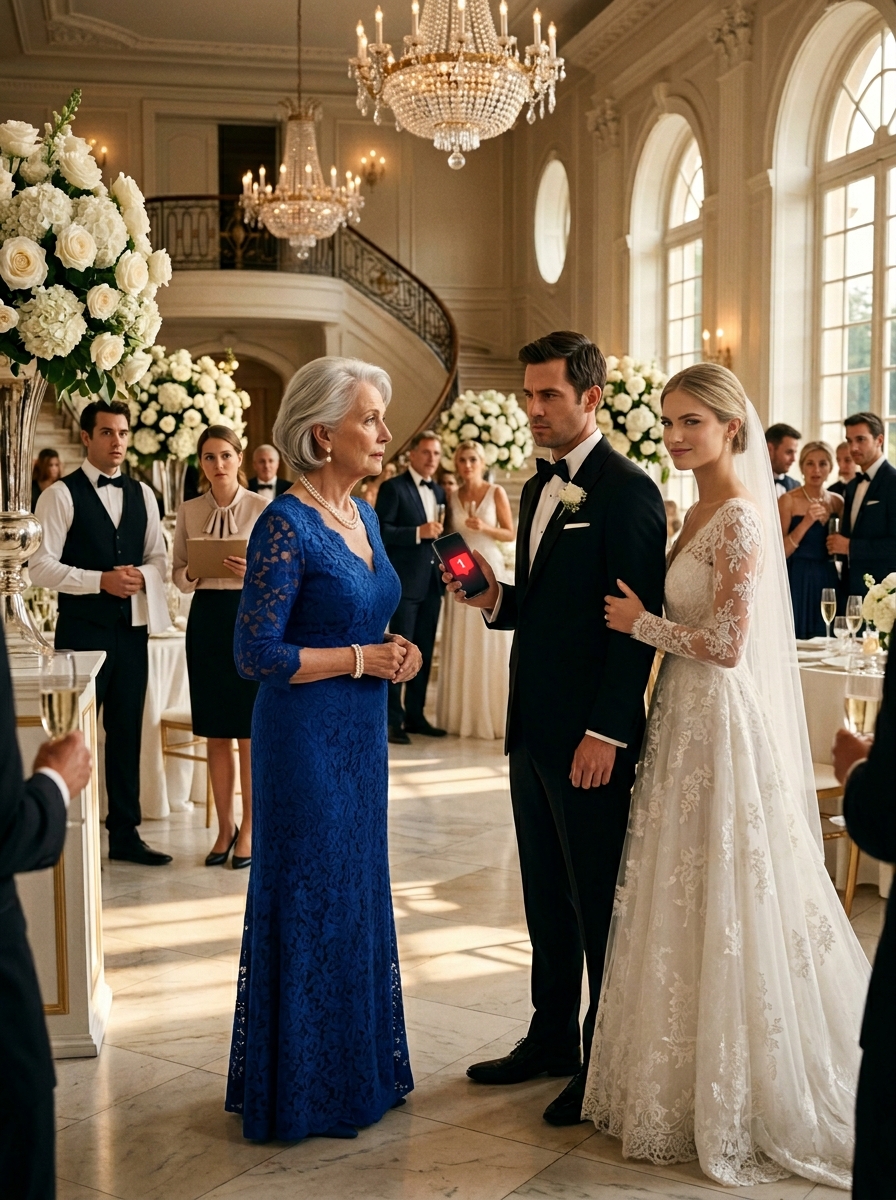

My Son Looked Me In The Eye At His Wedding And Said, “Did You Really Think You’d Be Invited?” His Bride Smiled Like I Was Dirt On Her Dress.
I Smiled Back And Said, “I Understand Perfectly.” Then I Walked Out, Called My Lawyer, And Somewhere Between The Vows And The Champagne Toast, Ethan’s Phone Started Vibrating Inside His Tux—Because The Woman He Had Just Thrown Away Was The Only Reason He Had A House, A Job, And A Life Worth Showing Off.
I arrived at my son’s wedding wearing the blue dress I had saved for months to buy, the one I imagined he would see and say, “Mom, you look beautiful.” Instead, the girl at the reception table checked the list three times and whispered, “I’m sorry, ma’am. Your name isn’t here.” I thought it had to be a mistake. Mothers are not forgotten from their sons’ weddings. Then Ethan walked over in his tuxedo, looked me up and down, and rolled his eyes like I was embarrassing him by existing. “Did you really think you’d be invited?” he asked. That was when I finally understood the boy I raised was gone.
My name is Clara. I am seventy-one years old, and I adopted Ethan when he was three.
He had been abandoned before he was old enough to understand what abandonment meant. I still remember the first time I saw him at the orphanage, sitting in the corner with his knees pulled to his chest, staring at the floor while the other children played. He did not cry loudly. He cried the way children do when they have already learned nobody is coming.
I came.
I gave him my last name. My home. My bed when he had nightmares. My paychecks. My youth. My whole life.
I was not rich then, at least not in any way he could see. I worked as a secretary, then took extra jobs when school fees arrived, then more when he needed braces, tutoring, sports uniforms, a computer, college applications, clothes that would help him fit in with children whose parents did not count every dollar at the grocery store.
When Ethan graduated with his engineering degree, I cried so hard my hands shook around the program. I thought every sacrifice had been worth it.
Then Brooke came.
She was beautiful in a polished, sharp-edged way, with perfect hair, perfect nails, and a smile that never reached the part of her eyes that judged people. At first, I tried to love her because Ethan loved her. I cooked her favorite meals. I bought thoughtful gifts. I asked about her work, her family, her dreams.
She treated me like a stain she was trying to scrub out of Ethan’s life.
“Clara, don’t you think that blouse is a little young for you?” she once said at dinner, smiling across my own table.
Another time, when I brought Ethan homemade soup because he had the flu, she said, “You know, normal couples handle illness without their mothers hovering.”
Ethan heard her.
He said nothing.
The first time she insulted my cooking, calling it “salty old-lady food,” I waited for him to defend me. He kept eating. The silence hurt more than her words.
Little by little, my son changed. The calls became shorter. The visits became rarer. When I asked if I could come over, Brooke was tired. Brooke needed space. Brooke thought boundaries were healthy. Brooke felt I was “too attached.”
Then came the engagement dinner.
I was the last to know.
I arrived thinking we were having a normal family meal. Instead, Brooke sat at the table with her parents, her siblings, and a diamond ring so large it looked almost theatrical under the chandelier.
“Surprise!” they all shouted.
I smiled. I congratulated them. I hugged Ethan while Brooke watched as if measuring how long my hands stayed on his back.
Later that night, Ethan said, “Mom, Brooke and I want a small wedding. Just close family.”
I nodded, thinking I was close family.
I had never been more wrong.
For weeks, every time I asked about the venue, the time, the rehearsal, Brooke gave vague answers. “We’ll let you know.” “Still finalizing.” “It’s complicated.” Then, three days before the wedding, I called Ethan.
“What time should I arrive?” I asked.
There was a pause long enough for my heart to start hurting before he spoke.
“Mom,” he said, “Brooke and I decided the wedding is only for the closest family.”
“But Ethan,” I whispered, “I am your mother.”
“I know. But Brooke feels you don’t fit the image we want to project.”
The image.
I thought about that sentence for three days.
Then I went anyway.
Not to make a scene. Not to ruin anything. I went because some foolish, faithful part of me believed that if Ethan saw me standing there in the dress I bought for his wedding, maybe he would remember the woman who had chosen him when the world had not.
At the reception table, the staff looked embarrassed when my name did not appear. Then Ethan came over.
“Mom, what are you doing here?”
“I came to your wedding,” I said. “There must be a mistake.”
“It’s not a mistake.” His voice was cold. “I told you. Close family only.”
“But I am your family.”
He sighed, as if I were exhausting him.
“Did you really think you were going to be invited after everything you’ve done?”
Everything I had done.
Feeding him. Clothing him. Raising him. Working until my feet swelled. Paying his bills when he was grown and still pretending to be independent. Calling in favors to get him hired. Quietly paying what he could not afford so he could look like the man Brooke wanted to marry.
Then Brooke appeared in her wedding gown.
“What is she doing here?” she asked, like I was a stranger who had wandered in from the street.
“She’s leaving,” Ethan said. “Right, Mom?”
I could have cried.
I could have begged.
Instead, I smiled.
“I understand perfectly,” I said. “Have a beautiful wedding.”
Then I walked out.
In the taxi, I called Samuel, my lawyer of more than twenty years.
“Samuel,” I said, “it’s time.”
He was quiet for a moment. “Are you sure, Clara? Once we begin, there’s no going back.”
I looked down at the blue dress folded across my knees, the dress no one had wanted to see.
“I’m sure,” I said. “My son just showed me what I am worth to him. Now he can learn what he has really been standing on.”
Because Ethan never knew the truth about me.
He knew the struggling secretary who adopted him. He knew the mother who lived modestly, saved coupons, drove an old car, and wore the same coat for years. He knew I helped him, but he never asked how I always had money when he needed it.
He did not know about my father’s inheritance.
He did not know about the properties in Geneva, the stocks, the investment accounts, the quiet fortune I kept hidden because I wanted my son to love me for myself and not my bank balance.
He also did not know that the house he bragged about owning had been held up by my payments.
That his job existed because I had asked an old family connection to give him a chance.
That Brooke’s shopping card, his utilities, his emergencies, his reputation, and half the life he was displaying at that wedding were all standing on invisible wires connected to me.
And as the ceremony began, Samuel started cutting those wires one by one.
Somewhere between the vows and the champagne, Ethan’s phone began vibrating inside his tux.
First the utility company.
Then the bank.
Then his boss.
Then Brooke’s card issuer.
And while he stood at the altar pretending to be a man who had outgrown his mother, the life I had built for him began quietly disappearing from under his feet..
At first, Ethan ignored the phone.
Of course he did.
The ceremony was happening inside the Grand Astoria Ballroom, one of the most expensive venues in Manhattan, with crystal chandeliers hanging like frozen waterfalls above rows of white roses and imported candles. Brooke had spent eleven months designing every detail to look “editorial,” which apparently meant no colors that looked too warm, no guests over a certain age in family photos, and no visible signs that either bride or groom came from ordinary people.
Including me.
The string quartet played softly as Brooke walked down the aisle.
Guests smiled.
Phones recorded.
Champagne waited on silver trays near the back of the room.
And inside Ethan’s tuxedo jacket, his phone vibrated once.
Then again.
Then again.
He pressed his hand lightly against his chest, annoyed but trying to maintain his polished wedding smile.
Brooke reached the altar.
The officiant began speaking.
Ethan’s jaw tightened slightly as the phone buzzed a fourth time.
He finally slipped it out just enough to glance at the screen.
PRIVATE BANKING ALERT.
His expression flickered.
Small.
Fast.
But real.
I know my son’s face.
Or at least I used to.
The officiant continued.
“Marriage is built on trust—”
Buzz.
Another notification.
OVERDUE BALANCE NOTICE.
Buzz.
EMPLOYMENT OFFICE — URGENT.
Buzz.
WIRE TRANSFER REVOKED.
Ethan swallowed hard.
Brooke noticed immediately.
Her smile remained frozen for the guests, but through years of watching her manipulate every room she entered, I knew that tiny narrowing of her eyes meant irritation.
“What are you doing?” she whispered through clenched teeth.
“Nothing.”
The officiant asked everyone to bow their heads for prayer.
Instead, Ethan looked at his phone again.
And the color drained slowly from his face.
* * *
An hour earlier, Samuel had started exactly where I told him to.
Not revenge.
Correction.
People like Brooke and Ethan believed wealth appeared naturally around deserving people. They treated comfort like weather — something that simply existed for them.
They never imagined someone was holding the roof above their heads the entire time.
The first call went to the mortgage company.
The penthouse Ethan believed he owned outright was, in truth, under a trust arrangement connected to my estate. I had purchased it through a holding company years earlier after Ethan’s startup failed and he was too ashamed to admit he was drowning in debt.
He thought he had “recovered financially.”
In reality, I had quietly become the bridge beneath him.
That bridge was now closing.
The second call went to the private investment firm covering Brooke’s “lifestyle account.”
That one still makes me laugh bitterly.
Brooke thought Ethan had secretly built an impressive portfolio after college.
No.
It was my money.
Every designer bag.
Every luxury vacation.
Every brunch she photographed for social media with captions about “building success together.”
Mine.
Samuel froze the account at 2:14 p.m.
The third call mattered most.
Ethan’s job.
Three years ago, Ethan nearly lost everything after making a disastrous financial mistake at his engineering firm. He was brilliant technically but careless with leadership. One failed project almost ended his career before it began.
I saved him.
An old friend of my father’s, Richard Mercer, sat on the hospital board overseeing Ethan’s division.
I asked for a favor.
One conversation later, Ethan kept his position.
Six months later, he was promoted.
He never asked why the company suddenly became so forgiving.
Children rarely investigate miracles when miracles benefit them.
But favors work both ways.
At 3:02 p.m., Richard called Samuel personally.
“He’s being terminated effective immediately,” he said quietly. “I assume Clara is certain?”
“She’s certain.”
Richard sighed.
“I warned her this boy would eventually mistake support for entitlement.”
* * *
Back at the wedding, the vows had begun.
Brooke spoke first.
“Ethan, from the moment we met, I knew you were a man who could build a beautiful future…”
I almost admired the timing.
Because at that exact moment, Ethan received the email informing him his corporate access credentials had been revoked.
His hand started shaking.
Tiny tremors.
Barely visible to anyone else.
Not to me.
Brooke noticed again.
Her smile tightened.
Then it was Ethan’s turn.
He opened his mouth.
Nothing came out.
The guests laughed softly, assuming nerves.
The officiant smiled patiently.
Ethan stared at the phone screen hidden beside his leg.
Another message appeared.
FINAL NOTICE: ACCOUNT ACCESS REMOVED.
Brooke whispered sharply:
“What is wrong with you?”
He looked at her.
And for the first time all day, he looked afraid.
Real fear.
The kind that strips polish away from people.
“I…” he started hoarsely.
The room waited.
Then his phone rang.
Actually rang.
Loud enough to echo through the ballroom.
The caller ID read:
WHITMORE NATIONAL BANK.
Several guests glanced over awkwardly.
Brooke’s father frowned.
Brooke hissed under her breath:
“Decline it.”
Ethan did.
Immediately another call appeared.
Then another.
Then another.
His breathing became uneven.
Because now the messages were arriving too quickly to process.
PAYMENT FAILURE.
INSUFFICIENT COLLATERAL.
CARD SUSPENDED.
LEGAL REVIEW INITIATED.
The officiant cleared his throat gently.
“Mr. Whitmore?”
Ethan looked like a man realizing the floor beneath him was not floor at all.
Just glass.
And someone had finally cracked it.
* * *
Meanwhile, I sat quietly in the back of the taxi watching rain gather against the windows.
New York blurred silver and gold outside.
Samuel sat beside me holding a leather folder on his lap.
“You could still stop this,” he said carefully.
“No,” I replied softly. “I couldn’t.”
Because people misunderstand betrayal at my age.
They think the deepest pain comes from cruelty.
It doesn’t.
Cruelty from strangers is survivable.
The deepest pain comes from being erased by someone whose entire life passed through your hands.
I remembered Ethan at four years old with scraped knees, falling asleep on my chest after nightmares.
Ethan at nine, crying because classmates mocked his thrift-store shoes.
Ethan at seventeen, shaking with fear before college interviews.
Every version of him had once loved me openly.
So when exactly had shame replaced love?
When had Brooke convinced him I was something to hide?
Samuel opened the folder slowly.
“There’s one more thing.”
I looked down.
Inside were copies of documents I had kept sealed for decades.
Ethan’s adoption records.
His biological mother’s file.
And a letter.
The letter.
I had not read it in years.
My hands trembled touching the envelope.
“You never gave it to him,” Samuel said gently.
“I wanted to protect him.”
“From what?”
I stared out the window.
“The truth.”
* * *
Back at the wedding reception, disaster was unfolding quietly beneath the orchestra music and champagne laughter.
Brooke cornered Ethan near the bar while guests moved awkwardly around them pretending not to notice.
“What is happening?” she whispered furiously.
“Nothing.”
“Do not lie to me on our wedding day.”
Ethan rubbed his face hard.
“It’s probably some banking issue.”
“Why would your boss call six times during our ceremony?”
That stopped him cold.
Because Brooke had seen that notification too.
He tried calling back.
Straight to voicemail.
Again.
Voicemail.
Then came the final message.
Due to internal review regarding financial disclosures and sponsorship irregularities, your position has been terminated effective immediately.
Ethan stared at the screen.
Sponsorship irregularities.
His stomach dropped.
Because suddenly, for the first time in years, he began connecting invisible dots.
The apartment approval arriving too quickly.
His debt disappearing after college.
The promotion.
The endless financial rescues.
Not his achievements.
His mother.
“Oh my God,” he whispered.
Brooke grabbed his arm.
“What?”
He looked physically ill now.
“She did this.”
“Who?”
“My mother.”
Brooke laughed sharply.
“Your elderly mother canceled your bank account?”
But Ethan was no longer listening.
Because another memory had surfaced.
Age twenty-six.
Him drunkenly confessing financial panic to Clara over the phone.
Her calm voice saying:
“Don’t worry, sweetheart. I’ll handle it.”
He thought she meant emotional support.
Now he realized she literally handled it.
Everything.
Brooke’s expression slowly changed.
“You told me your mother barely had money.”
“So did she.”
The room suddenly felt smaller around him.
His entire adult identity had been built on the belief that he rescued himself.
That he became successful despite humble beginnings.
But what if none of it was entirely his?
What if the woman he discarded at the entrance had been quietly carrying him all along?
Brooke folded her arms tightly.
“How much control did she actually have?”
Ethan didn’t answer.
Because he didn’t know.
And that terrified him more than unemployment.
* * *
Three days later, Ethan came to my house.
Not the modest apartment he knew.
The real house.
The one hidden behind iron gates in Westchester, where my father’s estate had remained mostly untouched for forty years.
I watched through the security monitor as his car stopped outside the fountain.
He stared at the property in visible shock.
Then he rang the bell.
Twice.
I opened the door myself.
His eyes were bloodshot.
Wrinkled shirt.
Unshaven face.
No wedding ring.
Interesting.
“Mom…”
I waited silently.
He looked past me into the enormous marble foyer.
Portraits.
Antiques.
Crystal lighting.
Generational wealth sitting quietly in every corner.
“You lived here?” he whispered.
“No,” I said calmly. “I owned here.”
He looked like he might collapse.
“Why didn’t you tell me?”
I studied him carefully.
Because this mattered.
His next words mattered more than all the years before.
Would he ask:
Why did you hide this?
Or:
Why did you help me?
Instead he asked:
“How much of my life did you pay for?”
There it was.
Not grief.
Inventory.
I felt something inside me finally go still.
“The better question,” I said softly, “is how much you believed you built alone.”
He flinched.
“I loved you.”
“No,” I replied. “You loved what I provided while being embarrassed by who provided it.”
“That’s not fair.”
I laughed quietly.
“Fair? Ethan, you looked your mother in the eye on your wedding day and asked if she really thought she deserved an invitation.”
His face crumpled slightly.
“I was angry.”
“At what?”
He opened his mouth.
Closed it.
Because there was no answer that didn’t reveal ugliness.
I stepped aside slowly.
“Come in.”
He entered cautiously.
Every step seemed to unsettle him further.
Family portraits lined the walls.
Old photographs.
My father shaking hands with presidents.
My mother standing beside diplomats.
Generations of quiet influence Ethan never knew existed.
“You let me think you struggled your whole life.”
“I did struggle,” I said. “Not financially. Emotionally.”
We sat in the library.
Rain tapped softly against tall windows.
Finally, I slid the old envelope across the table.
“What’s this?” he asked.
“A letter from your biological mother.”
His eyes widened instantly.
“She wrote to you before she disappeared.”
His hands shook opening it.
The paper was fragile with age.
He began reading silently.
Then stopped halfway.
Tears filled his eyes.
“She was sixteen,” he whispered.
“Yes.”
The letter explained everything.
The poverty.
The abuse.
The addiction in her household.
She gave Ethan up because she believed someone else could love him better than she could survive loving him herself.
At the bottom was one final sentence written unevenly in blue ink:
Please make sure he never feels unwanted again.
Ethan broke.
Not dramatically.
Quietly.
Like something collapsing inward.
“I’m sorry,” he whispered.
I looked at the man in front of me carefully.
Not the little boy I raised.
Not the groom who humiliated me.
Just a human being finally meeting himself honestly.
“Are you sorry because you lost things,” I asked softly, “or because you lost me?”
He started crying harder.
And for the first time since the wedding, I believed he did not fully know the answer himself.
That was the tragedy of it.
Not Brooke.
Not the money.
Not even the humiliation.
The tragedy was that somewhere along the way, my son became the kind of man who could no longer tell the difference between love and convenience.
And that kind of poverty has nothing to do with money at all.