
My New Neighbors Poured a Concrete Foundation Across My Only Driveway While I Was Away and Told Me to “Drive Through the Woods.”
I Warned Them Once, Took Them to Court, and Fifteen Days Later I Returned With a Demolition Crew.
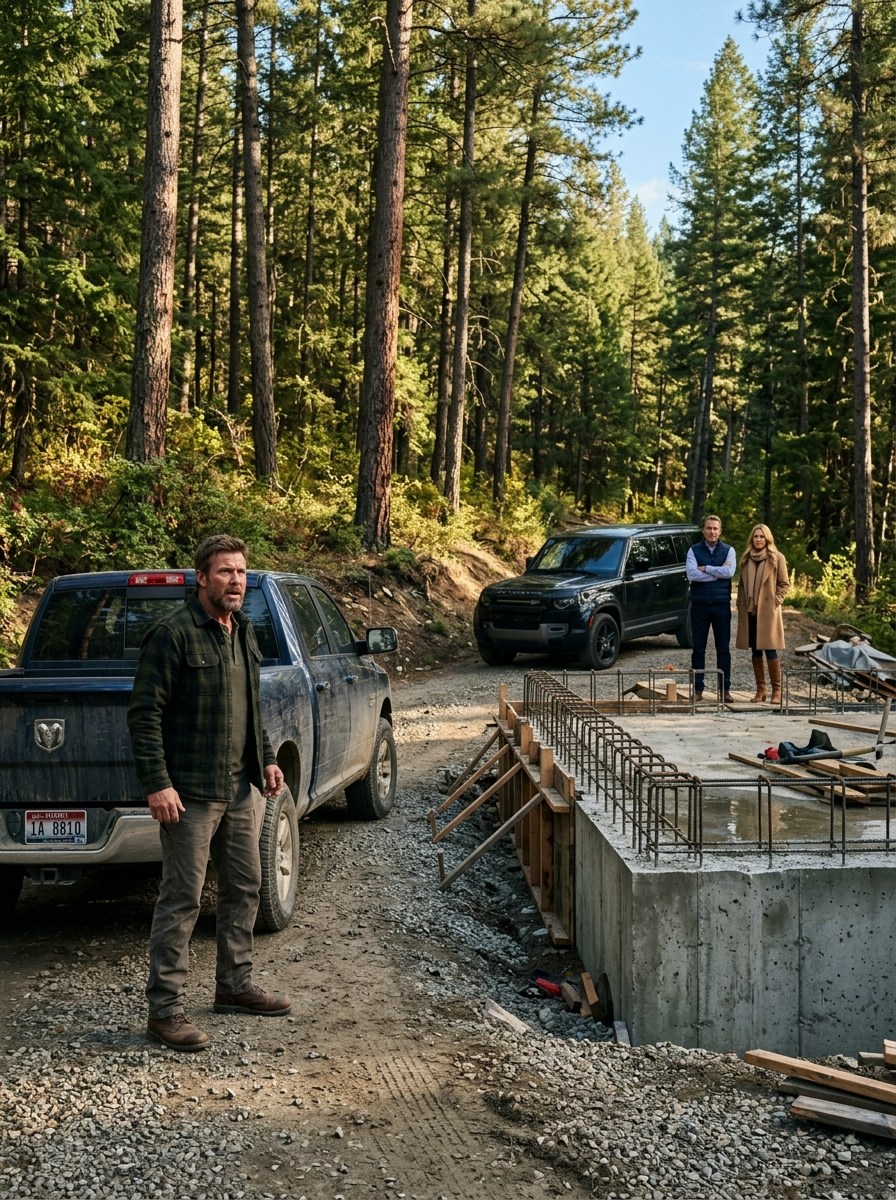
I was gone for only five days. Just five. But when I returned home, someone had poured a solid concrete foundation directly across my driveway. Not beside it. Not near it. Directly across it, as if my home suddenly no longer existed.
And honestly, the worst part wasn’t even the concrete.
It was the fact that whoever did it genuinely believed I would simply accept it.
I live on roughly seven and a half acres in northern Idaho, the kind of place people move to when they become tired of hearing traffic at night and would rather listen to wind moving through pine trees.
Tall pines.
Gravel crunching beneath your tires.
A long narrow driveway curving just enough that you cannot see the cabin until you are almost there.
That driveway matters more than most people understand.
It isn’t just a road.
It’s access.
It’s privacy.
It’s the only practical way in or out unless you feel like forcing your way through thick forest and uneven ground.
The property has been legally mine since 2011, but that driveway existed long before me. Late 1980s at least, maybe earlier.
It was already there when I bought the land, carved naturally into the slope so rainwater wouldn’t wash it away. I maintained it myself every single year—clearing fallen branches, spreading fresh gravel, repairing drainage after storms—not because I enjoyed the work, but because if I didn’t handle it, nobody else would.
For years, nobody questioned it either.
The property lines were clear.
Surveyed.
Documented.
There was a quiet understanding between neighbors.
Until the empty lot beside mine sold.
They arrived during early spring driving a brand-new black SUV that still carried the dealership sticker in the rear window. City plates. Tires so spotless they clearly had never touched dirt before.
Their names were Daniel and Elise Harper.
They moved from Chicago, and you could tell immediately they weren’t used to places like this.
Not in a bad way.
Just different energy.
Cleaner clothing.
Faster speech.
Always checking their phones like half their attention remained somewhere else.
The first time I met Daniel, I was outside clearing a fallen tree limb after a windstorm. He pulled up slowly, rolled down the window, and gave me that polite, slightly forced smile people use when they are trying to seem friendly but aren’t entirely comfortable.
“Hey there, you live out here full-time?”
“Sure do,” I answered while dragging a branch off the road. “Been here more than a decade.”
He nodded and stared down my driveway carefully like he was studying it.
“That your access road?”
“Sure is.”
He paused a little too long before replying:
“Good to know.”
Like he was storing the information away for later.
At the time, I didn’t think much about it.
People ask questions when they’re new. That’s normal.
He waved, drove away, and I assumed that was the end of it.
At least, that’s what I believed.
Seven weeks later, I returned from a fishing trip near the Selkirk Range.
I had been completely off-grid. No signal. Just me, a cooler, and a quiet lake. The kind of trip that clears your head and reminds you how simple life can feel.
I turned onto my road shortly before sunset, golden light slicing through the trees while dust rose behind my truck.
Everything looked exactly the way I left it.
Until suddenly it didn’t.
Halfway up the driveway, I slowed down because something felt strange.
Not wrong immediately.
Just unfamiliar.
Then I saw it.
Concrete.
Fresh.
Pale.
Completely unnatural against the dark soil.
Stretching across the width of my driveway like a barricade.
Wooden framing still stood around it.
Steel rebar stuck upward like exposed ribs.
Fresh tire tracks surrounded everything.
I stopped the truck completely but left the engine running while staring at it, like my brain needed extra seconds to accept what I was seeing.
They had poured an entire foundation.
Not beside the driveway.
Not nearby.
Directly across the only road leading to my house.
I stepped out, my boots crunching on gravel, and walked toward it. I ran my hand along the edge as though somehow touching it might make the situation less real.
It didn’t.
Beyond the foundation, I could still see my cabin through the trees maybe a couple hundred feet away.
Completely blocked off.
That’s when the anger started building.
Slowly at first.
Then all at once.
I immediately pulled out my phone and called Daniel.
He answered on the second ring sounding calm, almost cheerful.
“Hey, what’s up?”
“What’s up?” I repeated while staring at the slab in front of me. “You poured a foundation across my driveway. I can’t even reach my house.”
There was a pause.
Not long.
But deliberate enough to notice.
“Oh, that,” he said casually, like we were discussing a misplaced package.
“Yeah, we thought that section belonged to our lot.”
“You thought?” I repeated carefully, trying to stay calm. “Daniel, that’s my driveway. It’s been there for decades. I have the survey.”
Another pause.
Shorter this time.
“Well,” he said while his tone shifted slightly, “our contractor measured from the road. According to him, we’re inside our property boundaries.”
I exhaled slowly.
“You’re not. And even if you were, you don’t block somebody’s only access road. That’s not how this works.”
He sighed like he was already tired of the conversation.
“Look, man, you can still get around it. There’s open land beside it, right? Just drive through the woods a little.”
That was the moment I understood this wasn’t confusion.
It wasn’t an accident.
It was convenience.
For him.
“No,” I answered sharply. “I’m not rerouting my access through the forest because you guessed wrong.”
“You need to fix this.”
Silence.
Then his voice changed.
Colder.
More deliberate.
“If you truly think it’s your land,” he said, “you’re welcome to handle it legally.”
And just like that, everything changed.
I stood there after the call ended, phone still in my hand, staring at the concrete foundation like it had declared war on me.
Because in a way, it had.
I barely slept that night.
Not because I was stranded—I parked near the tree line and carried supplies to the cabin on foot—but because one question kept circling my head.
How does somebody convince themselves this is acceptable?
Not a misplaced fence.
Not a mailbox over the property line.
An entire concrete structure blocking the only road to someone’s home, followed by instructions to “just drive through the woods” like it was nothing.
It wasn’t carelessness.
It felt intentional.
Like they had already decided what mattered more.
By the following morning, I stopped processing the situation emotionally.
That’s something you learn living out here.
Feelings don’t solve problems.
Actions do.
So I drove into town with dust still covering my truck and went directly to Martin Keller.
Everyone called him Marty.
Marty had handled land disputes and property law in that county longer than most people had owned homes there.
He wasn’t flashy.
Didn’t make dramatic speeches.
But whenever Marty looked at something and said it was wrong, you could trust him completely.
He spread my property survey across his desk, adjusted his glasses, and slowly traced the boundary line with one finger before leaning back in his chair.
“Well,” he said with dry amusement, “this isn’t even close.”
I raised an eyebrow.
“Not even a little?”
He shook his head.
“That foundation, based on what you’ve told me, sits entirely on your parcel. Not overlapping. Not straddling. Entirely.”
I sat quietly for a moment because even though I already knew it, hearing it confirmed felt different.
“So what now?”
Marty folded his hands calmly.
“Now we give them one opportunity to correct the mistake formally.”
“I’ll send a letter. Ten days. Remove the structure, restore access, or we escalate.”
“And if they refuse?”
He shrugged slightly.
“Then we make it much more expensive for them not to.”
That same afternoon he drafted the letter.
No emotion.
No threats.
Just facts.
Survey attached.
Boundary lines clearly marked.
And one direct demand:
Remove the structure within ten days or face legal action, including removal at their expense.
We sent it certified.
For about a day and a half, I almost believed they would come to their senses.
Once lawyers become involved, most people step back and rethink things.
Pride usually weakens once reality appears in writing.
Then Marty called me.
“They responded,” he said.
“And?”
“They hired counsel out of Seattle. Big firm. They aren’t admitting fault.”
I laughed.
Not because it was funny.
Because it was so predictable it almost felt scripted.
“What are they saying?”
“That they relied on contractor measurements,” Marty replied while flipping through paperwork, “and that any boundary dispute needs to be established through damages.”
“They’re also proposing an easement agreement.”
I leaned forward.
“An easement?”
“Yeah,” Marty replied calmly, though even he sounded slightly amazed. “They basically want to buy the right to leave the structure exactly where it is. Which would legally reroute or share your driveway.”
I slowly shook my head.
“So they blocked my access road and then offered to purchase it from me?”
“More or less.”
There was a long pause.
Not because I didn’t know my answer.
But because I wanted to be absolutely certain.
“No,” I finally said. “Absolutely not.”
Marty nodded like he already expected that answer.
“All right then.”
“We file.”
And just like that, it stopped being a disagreement and became a war.
Not the kind fought with fists or shouting.
The kind fought with paperwork, deadlines, and expensive people in suits charging by the hour……..
The filing didn’t feel like victory.
It felt like ignition.
A match struck in a dry room where everyone insists they don’t smell smoke yet.
Marty moved quickly after that. Too quickly for it to be routine, which told me everything I needed to know about how solid our position actually was. There’s a difference between a lawyer who is confident and one who is preparing a file like it might be shown to a judge who has no patience for nonsense. Marty was the second type.
Within forty-eight hours, the injunction request was submitted.
Within seventy-two, the county surveyor had been officially requested to re-verify the boundary lines.
And within a week, Daniel Harper’s tone changed again.
Not in person.
Not directly.
But in the small, telltale ways people shift when they realize the ground beneath them isn’t metaphorically unstable—it is literally about to be measured out from under their feet.
A second contractor appeared on site.
Then a third.
Then nothing for two days, as if they were waiting for permission that never came.
I kept walking the perimeter of my land every morning, not because I needed to check anything, but because I needed to see it remain unchanged. The forest didn’t care about legal disputes. The trees stood exactly where they always had, indifferent witnesses to human stupidity.
On the ninth day, I noticed something that didn’t belong.
Survey flags.
Not mine.
Not official county markers.
Cheap plastic stakes with neon tape, placed in a line that cut diagonally through my driveway like someone had drawn a new truth on top of an older one and expected reality to accept the revision.
I pulled one out of the ground and turned it over in my hand.
No county seal.
No licensed surveyor ID.
Just a printed label with a construction company name I didn’t recognize.
That was when I understood what Daniel was doing.
He wasn’t defending his position anymore.
He was building a parallel version of it.
A competing reality made of paperwork and repetition.
If you say something loudly enough, long enough, and back it with enough contractors, maybe the land itself gets confused.
That afternoon Marty called again.
“They escalated,” he said.
“What does that mean this time?” I asked.
“They filed their own survey with the county.”
I paused.
“That’s not even finalized.”
“It doesn’t have to be,” Marty replied. “It just has to create delay.”
That word—delay—landed harder than anything else so far.
Because delay is what people with money use when they know they’re wrong but hope you’ll run out of patience before they run out of options.
But I didn’t run out of patience.
I ran out of interest in waiting.
The hearing was scheduled for early May.
The kind of procedural session that normally draws no attention. No drama. No tension beyond the paperwork itself.
But this wasn’t normal anymore.
Daniel and Elise arrived with a different attorney this time. Not the Seattle firm. Someone local. Sharper. Less polished, more aggressive. The kind of lawyer who doesn’t try to sound reasonable, only plausible.
Their argument shifted again.
Now it wasn’t “we believed it was ours.”
It was “historical ambiguity in access usage.”
A phrase that sounded like it belonged in a textbook rather than on my driveway.
Marty countered with something simple.
“There is no ambiguity in recorded access easement rights.”
The judge looked unimpressed with everyone equally.
But unimpressed judges still schedule things.
Still request clarifications.
Still give people enough rope to hang themselves in procedural order.
So the injunction was granted—but temporarily.
And that was all Daniel needed to interpret it as permission.
Because the next morning, I woke up to the sound of machinery.
Not distant.
Not subtle.
Close.
I stepped outside before fully processing what I was hearing and saw them pouring again.
Not across the driveway this time.
Beside it.
Expanding outward.
Encroaching in increments so small they could claim innocence while building certainty in concrete.
And standing near the edge of the work zone, Daniel Harper watched like a man supervising progress that belonged to him by assumption rather than law.
When he saw me, he didn’t wave.
He just called out casually.
“We’re just stabilizing the foundation footprint.”
Like I should understand that language.
Like concrete could “stabilize” its way into ownership.
I walked toward him.
Slow.
Not angry yet.
Not calm either.
Just focused in a way that tends to make people stop talking.
“You’re still building on my property,” I said.
He sighed like I was being difficult rather than accurate.
“Look,” he said, “this is exactly what the lawyers are handling. We’re just keeping the site secure.”
“Secure from what?” I asked.
“From damage,” he replied.
I looked at the machinery.
At the widening slab.
At the subtle expansion of something that wasn’t supposed to exist in the first place.
Then I said something I didn’t plan to say out loud.
“You’re not securing anything. You’re trying to make it irreversible.”
That’s when his expression shifted.
Not defensively.
Not angrily.
But briefly—uncomfortably honest.
And then it was gone.
“Everything is reversible,” he said. “That’s what courts are for.”
That line stuck with me.
Because it sounded rehearsed.
Not believed.
The next hearing came faster than expected.
And this time, something was different.
The county surveyor arrived first.
Then the judge requested an on-site inspection.
Then, almost casually, a third party entered the situation.
A title investigator.
I didn’t even know those existed outside of paperwork until Marty explained it.
“They’re verifying chain-of-title anomalies,” he said.
“What anomalies?” I asked.
He hesitated.
“That’s what we’re about to find out.”
The inspection took place on a gray morning where the sky looked like it couldn’t decide whether to rain or just stay disappointed.
Everyone stood at the edge of the driveway.
Everyone except Daniel, who kept insisting the boundary markers were “self-explanatory.”
The county surveyor didn’t argue.
He just measured.
Then re-measured.
Then walked further into the trees than anyone else was willing to follow.
When he came back, he didn’t look surprised.
Just tired.
And then he said something that changed the temperature of the entire situation.
“These markers don’t align with recorded plats,” he said.
“They align with an older filing.”
Marty’s head turned slightly.
“Older how?”
The surveyor exhaled.
“Pre-subdivision adjustment.”
That phrase meant nothing to me at first.
But it meant something to Daniel.
I saw it immediately.
A flicker.
A crack.
Not in confidence.
In certainty.
Because now the question wasn’t whether the driveway was mine.
It was whether someone had tried to move the history of the land itself.
The hearing two days later was no longer about the driveway.
It was about documents.
About filings.
About something buried deeper than dirt.
And that’s when Elise Harper spoke for the first time in court.
Until then, she had been silent. Present, but peripheral. Always a step behind Daniel, always letting him lead the narrative.
But when the investigator referenced the “1987 easement revision map,” she leaned forward.
And said, very quietly:
“That document doesn’t exist.”
The courtroom paused.
Even the judge looked up.
Marty didn’t react immediately.
But I saw his hand tighten slightly on the table.
The investigator blinked.
“It exists in county archives,” he said.
Elise shook her head.
“No,” she said again, more firmly now. “It doesn’t. Because it was never approved.”
That’s when Daniel turned toward her.
Not confused.
Not surprised.
Alarmed.
“Elise,” he said under his breath.
But she didn’t look at him.
She looked at the judge.
And continued.
“My father worked in county planning in the late eighties. That revision was rejected. It was never recorded as valid.”
A silence dropped into the room so heavy it felt like pressure.
Then Marty spoke.
“That’s not what our copy shows.”
Elise finally looked at Daniel.
And for the first time since this began, I saw something in her expression that didn’t match anything I had assumed about them.
Not arrogance.
Not entitlement.
Something closer to fear.
Because whatever was happening here, she had not expected it to be exposed.
The judge called for recess immediately.
Outside the courthouse, everything changed again.
Daniel didn’t speak to me.
He didn’t speak to Marty.
He walked straight to his attorney, phone already out, voice low and urgent.
Elise stood apart from him.
Watching the parking lot like it had suddenly become unfamiliar terrain.
And then she did something I didn’t expect.
She walked toward me.
Not aggressively.
Not apologetically.
Just… deliberately.
When she reached me, she stopped a few feet away.
“I need to ask you something,” she said.
I didn’t answer immediately.
She continued anyway.
“Did you ever receive any notice before we started building?”
I shook my head once.
“No.”
She closed her eyes briefly.
Like that confirmed something she already feared.
Then she said the line that changed everything.
“Because we weren’t the first ones to think that land was ours.”
And just like that, the story stopped being about a driveway.
And started becoming something else entirely.