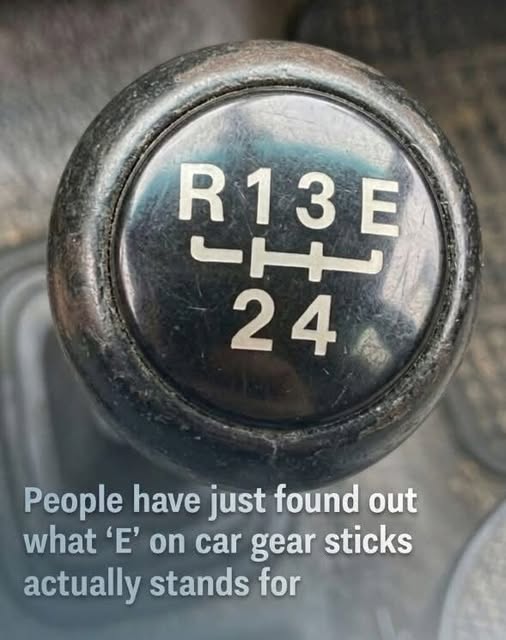

For many years, gear selectors in cars followed patterns that drivers could understand almost instantly. Manual vehicles usually showed numbered gears and an “R” for reverse, while automatic cars commonly used letters such as “P” for park, “N” for neutral, “D” for drive, and “R” for reverse.
Because these letters became so familiar, most people never stopped to wonder whether other symbols once existed on older vehicles.
That is why the letter “E” can still surprise some drivers when they see it on the gear stick of certain older cars. For younger drivers especially, the symbol may seem unusual, because it is rarely found in modern vehicles. But years ago, this small letter had a very practical meaning.
In many older cars, “E” stood for “Economy.”
This setting was created to help drivers save fuel. When selected, the vehicle adjusted the way the engine and transmission worked in order to use less fuel during normal driving. In many cases, Economy mode reduced engine revolutions, made the throttle response gentler, and changed the timing of gear shifts so the car would prioritize efficiency instead of power.
Drivers often used this mode on highways or during long trips, especially when traveling at a steady speed. It was not designed for fast acceleration or sporty driving. Instead, it helped the vehicle run more calmly and consume less fuel, which was especially valuable during times when fuel prices and energy conservation were major concerns.
The “E” setting also shows how different driving once was. In older cars, drivers often had to make more direct choices about how their vehicle behaved. They could select a setting for stronger performance or choose a more economical option when fuel savings mattered more. Today, many of these adjustments happen automatically, but at the time, the driver had more visible control.
As car technology improved, separate Economy gear settings became less common. Modern vehicles now use advanced computer systems that constantly monitor speed, engine load, driving habits, and road conditions. These systems can adjust fuel use, transmission behavior, and engine performance in real time, often without the driver needing to press a button or choose a special gear.
The meaning of the letter “E” has also changed with time. Today, many people associate it with electric vehicles, eco-friendly technology, and the future of cleaner transportation. The idea of efficiency is still there, but the way cars achieve it has become far more advanced.
Still, that old “E” on the gear stick remains an interesting detail from automotive history. It reminds us of a period when manufacturers were beginning to take fuel economy more seriously and when drivers had to consciously choose between performance and saving fuel.
And the most interesting part is that this forgotten little letter was not a mystery code at all. It was an early version of what many modern cars now do automatically: helping the driver go farther while using less fuel.