I was furious, but when my husband looked at me and said, “Don’t start anything,” I obeyed.
I didn’t argue. I didn’t make a scene. I simply took my daughters and walked out.
The next morning, my husband showed up at the door of a beautiful house he had never known was mine.
When he finally learned whose name was on the deed—and what else I had been keeping from him—his face went completely pale.
PART 1

For eleven years, my husband’s family mocked my “little job” and remained utterly convinced that I couldn’t survive a single week without his financial support.
I never bothered to correct them.
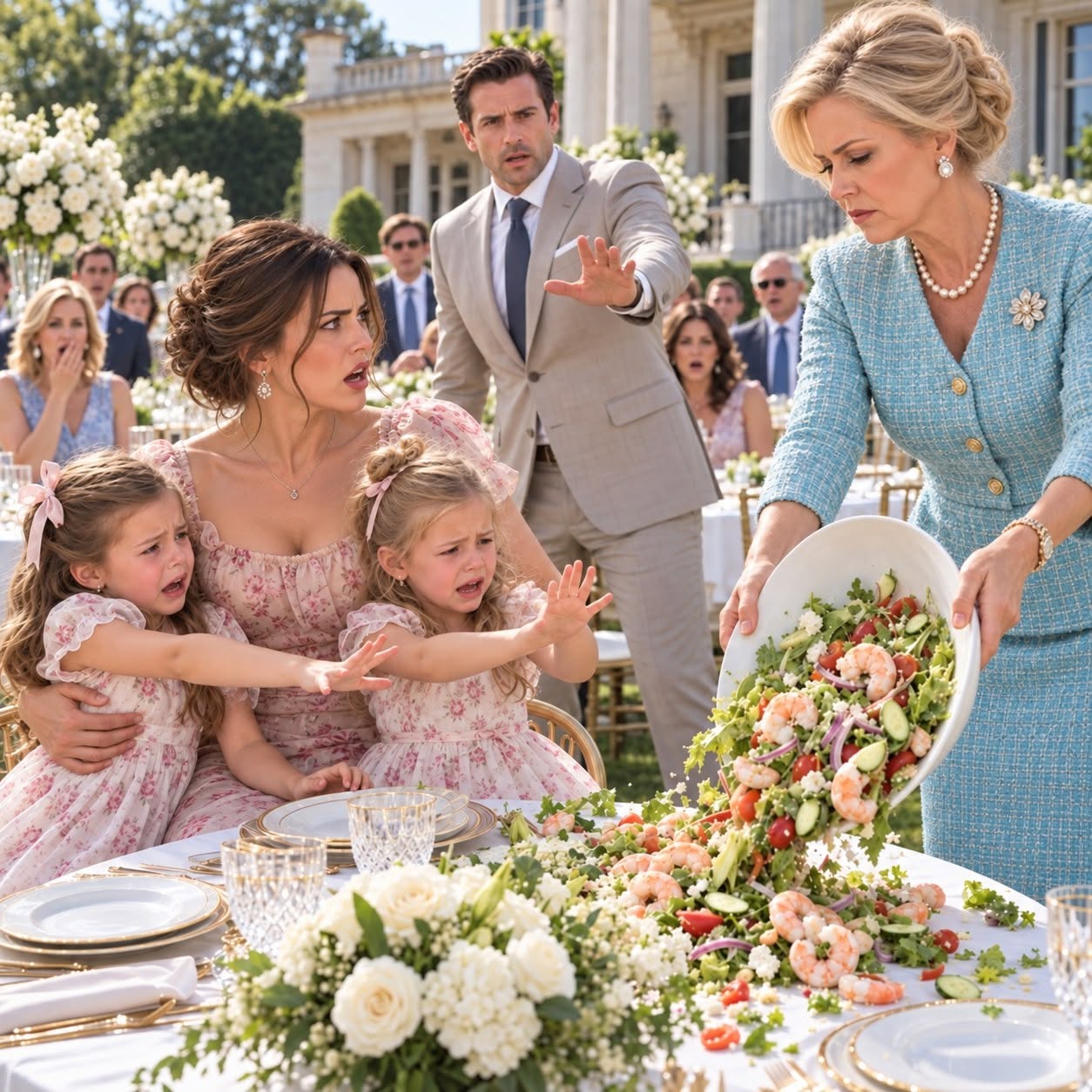
The day my mother-in-law snatched the plates of food right out from in front of my two young daughters in front of nearly ninety guests, my husband watched the entire scene from his table and simply said to me:
“Maren, don’t start anything. Just let me enjoy my day.”
I didn’t argue. I didn’t scream. I took my little girls by the hand, and I walked out.
The following morning, my husband arrived at a front door expecting to find the “dependent” wife he thought he knew. But when he stepped inside a home he never knew existed and saw the corporate files spread across the table, he understood—for the very first time in eleven years—who he had actually married.
It had all begun three days earlier at a spectacular estate in an affluent neighborhood just outside Mexico City.
My husband, Gabriel Holloway, had been talking about that property for weeks, grandly referring to it as “our new chapter.” He had organized a massive party filled with relatives, friends, high-profile clients, and corporate colleagues. There was a live band, towering floral arrangements, uniformed catering staff, prime cuts of meat, fresh seafood, expensive wine, and a dessert display that looked like it belonged at a celebrity wedding.
Gabriel beamed every time someone congratulated him on his “stunning success.”
There was only one tiny detail he conveniently omitted. He didn’t own the house. He had rented it for the weekend. But he never mentioned that to a single guest.
My daughters—Paula, eight, and Nora, five—were seated with me at a table tucked far away from the main family section. That was no accident.
My mother-in-law, Constance, possessed an unhealthy obsession with public appearances and what she called “continuing the family legacy.” Because Gabriel and I had been blessed with two daughters and no sons, she had spent years dropping cruel, passive-aggressive remarks.
That afternoon, she decided to push things even further.
Paula was still eating her lunch when Constance materialized beside our table. She was wearing an ivory suit, understated but wildly expensive jewelry, and that self-satisfied smirk she always wore whenever she had an audience.
Without asking, she picked up Paula’s plate. My daughter looked up, startled.
“Grandma, I’m not finished yet.”
Constance smiled coldly. “You’ve eaten quite enough.”
Then she reached down and took five-year-old Nora’s plate as well. Nora immediately looked at me, her eyes brimming with tears. “Mom, I’m still hungry.”
Several guests at neighboring tables turned to look. Then Constance did something I will remember with crystal clarity for the rest of my life.
She motioned to a passing waiter, taking a clear plastic bin filled with scraps of bread, discarded vegetables, and cold leftover trimmings from the serving trays. She set it down right in the middle of our table.
“This will be more than enough for the three of you,” she said smoothly.
As she shoved the bin forward, a splash of sauce spilled onto Nora’s light blue dress and splattered across Paula’s cheek. My daughters went completely still.
Constance leaned in, lowering her voice so only we could hear. “The primary courses are reserved for the main family table. Your mother really ought to understand that tradition matters. Someone has to carry on the family name, after all.”
Paula turned her tear-filled eyes toward the main table where her father was sitting. I looked, too.
Gabriel was watching us. For one brief second, I genuinely believed he would finally stand up, walk over, and put an end to it.
He didn’t. He merely frowned, caught my eye from across the lawn, and mouthed: “Maren, please don’t turn this into a problem. You know how my mother is. Just let me enjoy my day.”
Something deep inside me extinguished.
Not because it was the first time Gabriel had dismissed my feelings, but because my daughters had witnessed it, too.
I reached for a napkin and gently wiped the sauce from Paula’s cheek. Then I dabbed the stain on Nora’s dress. Neither of my girls said a word.
Sitting there, I confronted a deeply embarrassing truth: for years, I had confused my silence with emotional maturity. But my daughters weren’t learning patience—they were learning that when someone humiliated them, the proper response was to bow their heads and endure it so as not to make others uncomfortable.
I stood up. I grabbed Nora’s light cardigan. “Come on, girls.”
Gabriel finally got up from his seat and trotted over. “Where are you going?”
I looked at him, feeling a strange, hollow detachment. “Somewhere our daughters can actually finish their lunch.”
Constance folded her arms tightly. “Don’t be so dramatic, Maren.”
I didn’t dignify her with a response. Gabriel stood there, clearly expecting me to back down as I always did. I didn’t.
Before walking toward the valet, I looked at him one last time. “Enjoy your party, Gabriel. Enjoy your house. Enjoy everything you worked so hard to make everyone believe.”
His smile flickered for a fraction of a second. He didn’t understand yet. But he would soon.
The entire Holloway family had spent eleven years believing that Gabriel funded our comfortable lifestyle. They believed I merely managed a few rental properties part-time. Constance openly referred to it as my “little side job.”
My sister-in-law had even remarked one Christmas, “How lucky you are, Maren, that Gabriel earns enough to support someone with so little professional ambition.”
I had never bothered to correct her.
What none of them knew was that twelve years ago, I had founded Calderón Wealth Management. It had started with a single commercial client. Then came major real estate developers, private equity funds, institutional investors, and large-scale commercial projects across the country. I owned the controlling stake in the firm. My private investments were independently structured, and my personal income had surpassed Gabriel’s years ago.
The reason he didn’t know the full extent of my success was far sadder than it sounded.
I had tried to tell him once. Early in our marriage, when my firm secured its first major institutional contract, I came home bursting with excitement. Gabriel hadn’t even offered a congratulations. He spent the entire evening making dismissive jokes and asking why I needed to work so hard.
“So, what, suddenly you’re some big-shot corporate executive?” he had scoffed.
That night, I realized Gabriel loved the idea of showing off an attractive, elegant wife, but he couldn’t stomach the reality of that wife being more successful than him. So, I shrank myself. I called it “preserving my marriage.” Now I recognized it for what it truly was: I was appeasing his fragile ego.
And while I made myself small, Gabriel grew insufferably large.
PART 2
Gabriel worked in regional sales for a mid-sized tech company and made a decent living. The problem was that his spending habits far outpaced his income. A brand-new luxury SUV every two years, tailored suits, exclusive country club memberships, fine dining, and designer watches he bragged about even when no one asked.
At home, however, his generosity vanished. He handed me a strict monthly household allowance and scrutinized every single grocery receipt.
For years, I tolerated that absurd double standard—until it began to poison my daughters.
A few weeks before the party, Paula had walked into my bedroom while I was folding laundry. “Mom, can I ask you something?”
“Of course, sweetie.”
She hesitated. “Does Grandma wish Nora and I were boys?”
I set down the sweater I was holding. “Why would you ask that, Paula?”
“Because she always says men carry on the family,” she whispered, looking down at her shoes. “Does that mean we don’t matter as much?”
That question had haunted me. And it echoed in my mind as I drove away from the estate.
We had only been on the road for a few minutes when Paula spoke up from the backseat. “Mom?”
“Yes, sweetie?”
“Is Dad ashamed of us?”
I pulled the car over into a safe parking area, unbuckled, and climbed into the backseat between my two girls. Paula’s eyes were brimming with tears.
“No, Paula,” I said gently.
“Then why didn’t he do anything when Grandma took our food?”
I could have made up a comforting lie. I had done that for years. But not today.
“Because today, your father made a very bad choice,” I told her honestly. “He chose to keep someone else happy instead of standing up for his daughters. And I need to apologize to both of you, too.”
Nora tilted her head. “Why you, Mom?”
“Because I stayed quiet for far too long. I thought avoiding arguments kept our family peaceful. But sometimes, staying quiet just teaches people that they can keep hurting you.”
Nora buried her face against my side. “Do we have to go back there?”
I kissed the top of her head. “Never.”
I drove them to a high-end restaurant near the city center where I frequently held business dinners. When the waiter handed us the menus, Paula immediately began scanning the right side of the page, looking at the prices.
That broke my heart more than anything Constance had ever said. My eight-year-old daughter was already conditioned to worry about how much it cost to feed her.
“Order whatever you want, Paula,” I said warmly.
“Really? Anything?”
“Anything.”
They ordered salmon, handmade pasta, garlic bread, and three different desserts to share. When the waiter set the warm plate down in front of Nora, she instinctively glanced over her shoulder.
I knew exactly what she was doing. She was checking to see if someone was coming to take it away.
I reached across the table and held her small hand. “Nobody is ever going to take your food away again, Nora.”
She offered a bright, relieved smile.
While we ate in peace, Gabriel’s grand celebration was falling apart.
I learned the details later. The head event coordinator had approached Gabriel near the end of the evening with the remaining balance for the catering, staging, and live entertainment—nearly $45,000.
Gabriel pulled out his black credit card with a flair. “Charge it to this.”
Declined.
He tried a second card. Declined.
He pulled out a third. Declined.
By the third attempt, several high-profile guests were watching the awkward exchange. Constance began loudly blaming the bank’s processing system, but the coordinator remained firm. “Mr. Holloway, the contract specifies that full payment is due upon conclusion of the event.”
Gabriel began calling my phone frantically. Once. Twice. Five times. I left my phone tucked deep inside my purse.
Soon, uncomfortable questions began circulating among the guests. Someone asked why a man who had supposedly just purchased a $4.5 million estate couldn’t clear a catering balance. Another guest mentioned overhearing that the property was registered to a corporate luxury leasing agency.
Backed into a corner, Gabriel was forced to confess the truth in front of his colleagues: the house was a short-term rental. His magnificent “new chapter” was a hollow facade.
Worst of all, a month prior, he had come to me in a panic, desperate for capital to back a series of risky personal financial commitments. He had begged me to ask my “wealthy relatives” to invest in his projects. I had agreed to let my firm structure a formal bridge loan. Gabriel had signed binding financial agreements acknowledging personal liability for several million dollars. He had barely read the paperwork before signing, arrogantly remarking at the time, “Your family should be grateful someone finally knows how to put their stagnant capital to work.”
I remembered that comment vividly. For years, I had quietly cleaned up his financial messes. That afternoon, I simply stopped.
When we finished dinner, I drove my daughters to an elegant, gated property in Lomas de Chapultepec. The house sat behind high stone walls, surrounded by mature oak trees.
Paula peered out the window. “Whose house is this, Mom?”
I unlocked the main gate. “Come inside.”
The property was held under a private family trust my mother and I had established years ago. I had stayed there occasionally during difficult stretches in my marriage, but I had never brought the girls because I had always ended up returning to Gabriel, hoping things would magically improve.
Paula walked into the grand foyer, her eyes wide as she took in the warm hardwood floors and high ceilings. “Who lives here?”
I set our bags down by the staircase. “We do.”
Nora looked up at me. “Starting today?”
“Starting today. Tomorrow. And for as long as we ever want.”
Nora thought about that for a moment, then asked a question that brought tears to my eyes. “Does Grandma live here too? Can she take our food here?”
I knelt beside her, pulling both of my daughters into a tight hug. “In this house, no one will ever make you feel like you deserve anything less than complete respect.”
That night, after the girls fell into a peaceful sleep in their new bedrooms, I sat quietly in the living room. I thought about all the years I had diluted my own life just so Gabriel could feel important, and I realized that making myself small had never preserved my marriage—it had only taught my daughters a terrible, toxic lesson about love.
PART 3
At 9:30 the following morning, the front gate security called my internal intercom. Gabriel was outside, and Constance was with him.
I instructed security to let them up the driveway.
When Gabriel stepped through the front doors, he froze in his tracks. He stared at the custom furniture, the curated artwork, and the lush garden visible through the floor-to-ceiling glass doors.
“What is this place?” he stammered.
“A house,” I replied calmly.
“I can see that, Maren. Whose house?”
“Mine.”
Constance looked at me as if I were speaking a foreign language. “Where on earth did you get the money for a place like this?”
I didn’t answer right away. I walked over to the dining table and placed a thick leather binder in front of them. Inside were corporate registration documents, asset registries, commercial property holdings, and private trust agreements.
Gabriel picked up the top document, then turned to the next. With every page he flipped, his arrogant posture collapsed a little more.
Finally, he looked up, his face devoid of color. “What is Calderón Wealth Management?”
“My firm.”