I was too sick to stand at the stove, so I ordered dinner. My MIL threw every untouched container into the trash and told me a good wife cooks for her family herself. My husband didn’t argue when he got home. He made one call. The moment his mother saw who walked through the front door, she froze.
By five that evening, even sitting upright felt like fighting against gravity.
I had spent nearly the entire day beneath two blankets despite sweating through my T-shirt, sipping lukewarm water because anything colder hurt my throat.
Nathan had wanted to stay home that morning.
“Yoli, I’m serious. I can call in.”
“You have that quarterly meeting.”
“I also have a wife with a fever.”
“I have medicine, water, and a TV remote. Go.”
Nathan leaned down and kissed my forehead.
“Stay in bed.”
“I plan to,” I said.
“And order dinner.”
“I can make something easy.”
“No.” He pointed at me. “Don’t even look at the stove.”
I managed a weak laugh.
“Yes, sir.”
“I’m serious, Yoli.”
“So am I. Go.”
Before leaving, he filled my water bottle, placed my medicine on the nightstand, and texted the kids to come straight home after school.
At 4:30, the kids arrived home hungry enough to act as though school had deliberately starved them.
I ordered pasta for them, steak and potatoes for Nathan, and chicken soup for myself.
Then I texted Nathan.
Your dinner costs more than my medicine.
His response arrived immediately.
Worth it. Stay upstairs, Yoli. ❤️
Ten minutes later, I heard the front door open.
Then a familiar voice called from downstairs.
Angela.
Nathan’s mother never bothered knocking when she knew someone was home.
She hadn’t mentioned she was coming over, so I had no idea why she was there.
—
A moment later, she appeared in the bedroom doorway with her purse over one arm.
Her eyes traveled slowly over me.
Then she glanced at the clock on my nightstand.
“It’s five o’clock, Yolanda.”
“Yes.”
“And you’re STILL in bed?”
I stared at her.
“I have a fever, Angela.”
She placed two fingers lightly against my forehead.
For half a second, I almost appreciated it.
Then she said, “You always DID get dramatic when you’re sick.”
Angela had a remarkable ability to deliver an insult as though she were making ordinary conversation.
—
Throughout my marriage to Nathan, she had questioned whether I really needed a cleaning service after our second child was born.
Once, she picked up one of Nathan’s shirts and said, “You know, ironing takes five minutes if you care how your husband looks.”
Another time, she tasted my lasagna, smiled, and said, “Well, at least the children seem to like it.”
Nathan usually rolled his eyes afterward.
“That’s just Mom.”
And because I didn’t want every family gathering turning into an argument, I usually ignored it.
That had been a mistake.
—
The doorbell rang downstairs.
“That’s dinner,” I said. “Could you please bring it in?”
Angela frowned. “Dinner?”
“I ordered food.”
“You ORDERED it?”
“Yes.”
Ten minutes passed.
Then fifteen.
I couldn’t hear the kids arguing over pasta.
Nobody brought up my soup.
Eventually, I forced myself out of bed.
By the time I reached the bottom of the stairs, my legs felt useless.
I followed the kitchen light.
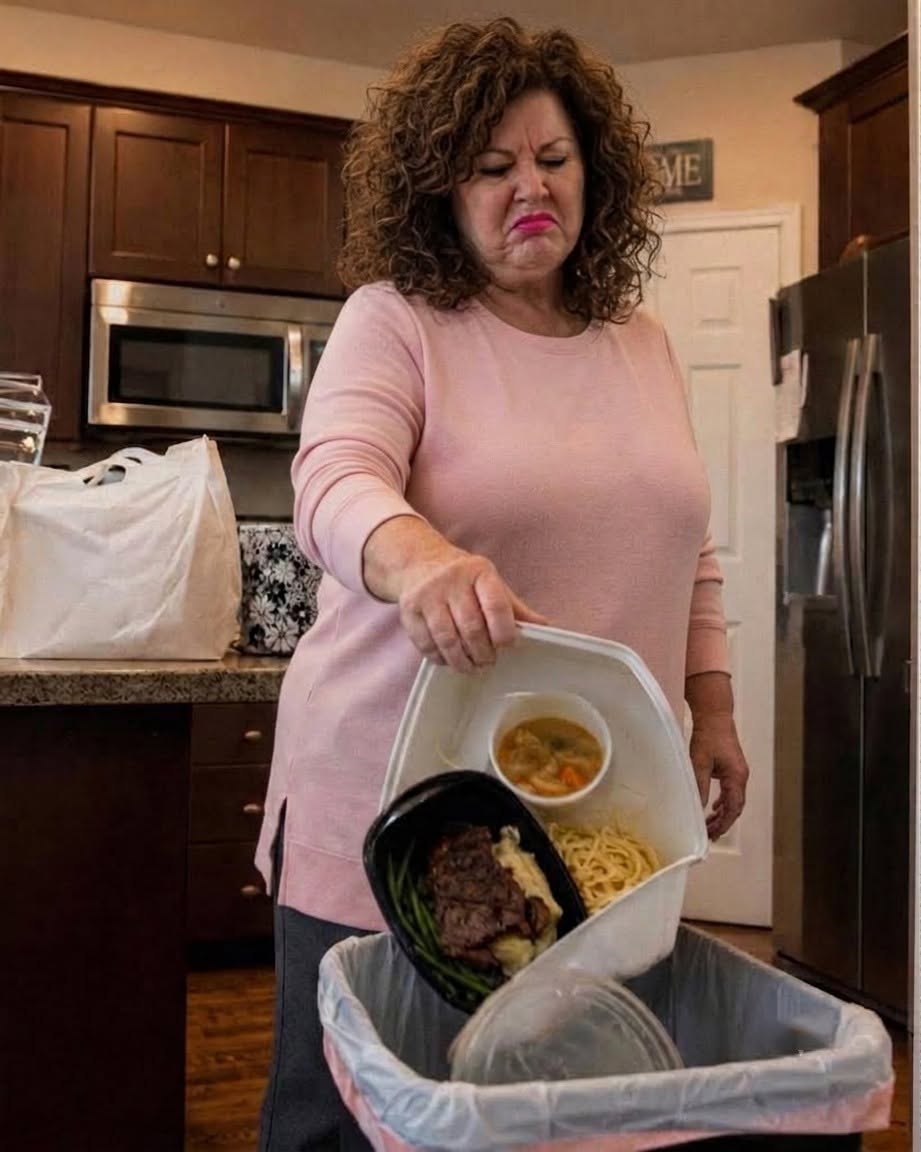
Angela stood beside the trash can.
Every restaurant container was inside.
The pasta.
Nathan’s steak.
All the side dishes.
Even my unopened soup.
“Angela?”
She turned around calmly.
“What are you even doing?” I sputtered.
She wiped her hands on a paper towel.
“Saving my son from eating that garbage.”
For a moment, I wondered whether the fever was making me misunderstand what I was seeing.
“You threw it away?”
“Of course!”
“Why?”
Angela glanced toward the stove.
“Because someone around here needs to remember what a kitchen is for.”
I stared at her.
“That was $90 of food.”
“And whose money paid for it?”
“Our money,” I blurted out.
“Meaning my son’s money.”
I could hardly believe she had said it aloud.
I lowered my voice because the children were in the living room.
“Angela, I am sick.”
“So?”
“So Nathan told me to order dinner.”
Her eyes narrowed.
“Of course he did. He babies you.”
“Excuse me?”
“When Nathan was little, he could be sick for days and I still put food on the table every night.”
“Congratulations.”
I hadn’t intended to say it out loud.
Angela raised her eyebrows.
Then she folded her arms.
“A good wife cooks dinner herself!”
I looked back into the trash.
My soup hadn’t even been opened.
“You threw away my food too.”
“You need soup? There’s a saucepan.”
I couldn’t believe someone could stand beside a garbage can filled with untouched food and tell a person with a 102-degree fever to start cooking.
Angela pointed toward the stove.
“Get up and make dinner yourself.”
“I am up.”
She shrugged casually. “Then what’s stopping you?”
Something inside me finally ran out.
I sat at the kitchen table because standing there arguing with her suddenly felt pointless.
One of the kids appeared in the doorway.
“Mom, can I have crackers?”
I nodded. “Yeah, honey.”
Angela sighed. “Crackers for dinner. Wonderful.”
I looked at her.
“Please stop talking.”
She appeared genuinely offended.
“I came here to help.”
“No, you didn’t.”
“Yolanda…”
“Please.”
For once, she stopped.
—
Twenty minutes later, the front door opened.
“Yoli?”
Nathan entered the kitchen carrying his laptop bag.
Then he stopped.
Our youngest was sitting at the counter eating crackers.
The older one was spreading peanut butter onto another stack.
I was sitting at the table crying because I felt miserable, hungry, and completely exhausted by Angela.
Nathan looked around the kitchen.
“Where’s… dinner?”
Angela answered before I could.
“In the trash.”
Nathan turned toward her.
“WHAT?”
“I threw it out.”
Slowly, Nathan placed his laptop bag on the floor.
Then he looked inside the trash can.
His untouched steak dinner sat crookedly on top of my soup.
He looked at me.
Then the children.
Then his mother.
“Mom, did you do this?”
Angela lifted her chin.
“Someone had to remind your wife what marriage means.”
Nathan stared at her.
I knew that look.
He wasn’t mildly annoyed.
He wasn’t irritated.
He was angry enough that he usually needed a moment before saying anything.
I expected him to tell her to leave.
Instead, his expression suddenly settled.
He became strangely calm.
Then, to my complete confusion, he smiled.
“You know what, Mom? You’re absolutely right.”
Angela immediately relaxed.
I stared at him.
“Nathan?”
He lifted one hand slightly toward me without looking away from his mother.
“Actually, thank you.”
Angela smiled.
“For what?”
“For looking out for me.”
She gave me the smallest satisfied glance.
Nathan continued.
“If takeout is unacceptable, then I think you deserve a reminder.”
Angela looked delighted.
“A gift?”
“In a way.” Nathan pulled out his phone. “I just need to make one call.”
Angela sat down across from me.
“Anything for my boy.”
—
Nathan walked out into the hallway with his phone.
He spoke too softly for me to catch the beginning.
Then his voice carried back into the kitchen.
“Aunt Irene?”
Angela’s smile vanished.
So quickly that I nearly missed it.
Her fingers froze against the table.
Nathan continued.
“Yeah, it’s me. Do you still have that old Tuesday dish you always joke you should’ve thrown out 20 years ago?”
Angela stood.
“Nathan?”
He ignored her.
Then he said, “Perfect. Is there any chance you could bring it over with some of the old Tuesday dinner?”
Angela rushed toward him.
“Nathan, hang up.”
He moved out of her reach.
“Twenty minutes? Great.”
“Nathan!”
He ended the call.
Angela stared at him.
“What are you doing?”
Nathan slipped his phone back into his pocket.
“Getting someone a second opinion.”
“I don’t want it,” I said.
He finally looked at me.
“This one’s not really for you.”
Angela’s earlier confidence had almost completely disappeared.
“Why are you calling Irene?”
Nathan picked up a clean glass, filled it with water, and placed it in front of her.
“You’ll see.”
“Nathan, don’t play games with me.”
“I’m not.”
“Whatever you think you’re doing, stop it.”
He opened the pantry and began making sandwiches for the children.
Angela followed him.
“I mean it.”
Nathan spread peanut butter over a slice of bread.
“So did Yoli when she told you she had a fever.”
Angela stared at him.
“I was trying to help.”
“Then help me understand something.”
He glanced at the trash can.
“How exactly did throwing away her soup help?”
Angela had no answer.
Nathan returned to making sandwiches.
That silence was new.
I had never seen Angela completely run out of things to say.
—
For the next fifteen minutes, she couldn’t stay still.
She checked the front door twice.
She repeatedly asked Nathan what Irene had said and whether he had told her why she was coming.
Nathan refused to explain.
Finally, the doorbell rang.
Angela stood so quickly that her chair scraped backward.
Nathan looked at me.
“Stay there, Yoli.”
Then he headed toward the front door.
I heard it open.
A woman’s voice followed.
“Nathan!”
His tone immediately brightened.
“Aunt Irene! Look at you.”
“I know. Ancient.”
“Move,” she said. “This thing is heavy.”
Nathan laughed.
Then footsteps approached the kitchen.
Slow and careful.
Whoever was coming was carrying something substantial.
Angela stood completely rigid beside the table.
Nathan entered first.
Behind him was a woman I had never met.
She appeared to be in her seventies, with silver hair loosely pulled back.
In both hands, she carried an old rectangular casserole dish.
Its exterior was scratched.
One handle had been repaired with dark tape.
Across the lid was a strip of yellowed masking tape with writing I couldn’t read from my seat.
The woman saw Angela.
Her expression softened.
“Well, hello.”
Angela said nothing.
Her gaze went directly to the casserole dish.
Then Nathan.
Then back to the dish.
“Nathan,” she whispered.
Irene stepped farther into the room.
Angela’s face turned crimson.
“What is SHE doing here?”
Nathan put a potholder on the table.
Still perfectly calm, he faced his mother.
“You said a good wife cooks dinner herself.”
Then he took the casserole dish from Irene and set it between us.
“I thought Yoli should meet the woman who cooked for us.”
Angela jumped to her feet.
“How could you do this to your own mother?”
Nathan reached toward the yellowed strip of tape beneath the dish.
I leaned closer.
Two words were still clearly visible in faded black marker.
ANGELA – TUESDAY
Whatever version of motherhood Angela had spent years presenting to us, I suddenly knew that casserole dish was about to tell another story.
—
Irene rested both hands on the dish.
“For almost a year,” she said, “your mother came to my back door at least twice a week.”
Angela’s face grew even redder.
“I had a lot going on.”
Irene nodded. “Exactly.”
Nathan looked again at the label.
“Tuesday?”
“Chicken and rice,” Irene said. “Thursday was usually soup.”
I stared at Angela.
For years, she had described Nathan’s childhood as though she had carried every burden alone without anyone helping her.
Irene continued.
“One night, Nathan had pneumonia,” Irene continued. “Angela hadn’t slept properly in two days. She came over crying and said, ‘I can’t keep up.’”
Angela looked away.
Irene added, “I gave her dinner and told her, ‘Feed your boy. Nobody said you had to stir every pot yourself.’”
Nathan opened the casserole dish.
The smell hit him immediately.
He laughed.
“This is it.”
Angela snapped, “I cooked plenty too.”
“I know you did,” Nathan replied.
He took a bite, chewed, then glanced toward the garbage.
“So explain something, Mom”
Angela stiffened.
“If Irene feeding me didn’t make you less of a mother, why did Yoli ordering dinner make her less of a wife?”
Angela opened her mouth but nothing came out.
Finally, she said, “That was different.”
“How?” Irene asked.
“I was overwhelmed.”
I looked at her from across the table.
“So am I.”
Her eyes moved toward me.
Then Irene asked, “When I fed Nathan, did you love him less?”
That ended the argument.
Angela slowly sat down.
For once, nobody rushed to rescue her from the silence.
—
Eventually, Nathan said, “Mom, you’re going home.”
She stared at him.
“You’re throwing me out?”
“Tonight, yes. And from now on, you call before coming over.”
Angela looked wounded.
Nathan didn’t soften.
“You threw away my kids’ dinner and told my sick wife to cook. That’s not a concern.”
Angela turned toward me.
“I only wanted Nathan taken care of.”
I shook my head.
“You threw away soup meant for someone with a fever. Whatever lesson you thought you were teaching, it wasn’t about taking care of anybody.”
Nathan helped me back upstairs.
He didn’t leave me alone so he could stay behind and smooth things over with his mother.
That mattered to me more than he probably realized.
—
The next morning, Angela called first.
Nathan answered.
I couldn’t hear the whole conversation, but ten minutes later, there was a quiet knock at our bedroom door.
Angela stood there holding a bowl.
“May I come in?”
I nodded.
She entered carefully.
“Soup.”
I looked at the bowl.
“You made that?”
Angela paused.
Then, perhaps for the first time in her life, she gave someone else credit.
“No. Irene did.” She set it beside me. “I brought it.”
“Thank you.”
That was all I could offer.
Angela started toward the door, then noticed my empty water glass.
Without saying anything, she picked it up.
A minute later, she returned with it full and placed it beside my medicine.
“Anything else?”
Yesterday, she had told me to get out of bed and serve everyone.
Today, she stood beside my bed asking what I needed.
I glanced toward the window.
“Could you close the curtains?”
Angela nodded and pulled them shut.
Then she picked up Irene’s old casserole dish from the tray and quietly carried it downstairs.