For six months, my neighbor Linda treated my driveway like it belonged to her. And for six months, I let her tell me that an empty space wasn’t really mine, until the morning thirty classic cars taught her otherwise.
It started innocently, the way these things always do.
“Just ten minutes,” she’d say, leaving her enormous black SUV in my driveway while she popped across the street to visit the Hendersons. “You don’t mind, do you, Carol?”
I didn’t mind. Not at first. Ten minutes is nothing. You’d have to be a genuinely unpleasant person to begrudge a neighbor ten minutes.
But ten minutes stretched into two hours. Two hours became an afternoon. And before long she was leaving that SUV parked squarely in my driveway overnight, so that when I opened my curtains in the morning the first thing I saw was her chrome grille sitting where Robert’s Pontiac used to be.
I asked her to stop. Politely, the first several times.
Then firmly.
I even bought a sign at the hardware store, a real one, metal, PRIVATE DRIVEWAY in bold white letters on a red background, and I mounted it on a post at the foot of the drive where no reasonable person could miss it.
Linda laughed when she saw it.
“You barely use the thing anyway,” she said.
And she was right about one thing, which was the maddening part. Since my husband, Robert, died two years earlier, I only had the one car, a sensible sedan that fit comfortably in the garage. The driveway did sit empty most of the time now. But an empty driveway is still a driveway, and a thing you own does not stop being yours simply because you are not using every square foot of it every hour of the day. I owned that property. I paid the mortgage on it for thirty years, and I still paid the property taxes on every inch of it, including the part Linda had decided was surplus.
To understand why that empty driveway mattered so much to me, and why it wasn’t nearly as empty as Linda thought, you have to understand what it used to be.
Before Robert died, our driveway was rarely empty at all. My husband loved classic cars. Not in the casual, “oh, that’s a nice Mustang” sort of way that most people love cars. He loved them the way some people love music or scripture. He could hear an engine idling from half a block away and tell you exactly what was wrong with it, whether it was a timing issue or a bad lifter or just somebody who hadn’t changed their oil since the previous administration.
For more than twenty years he belonged to the local classic-car club, and over time our house became one of the group’s favorite gathering places. There was always somebody in our driveway on a Saturday with the hood of something propped open, and Robert leaning over the engine bay with a cup of coffee going cold on the fender, deep in a conversation I couldn’t follow a word of and loved listening to anyway.
He’d bought his first classic, a beat-up Pontiac, the year before we got married, and he restored it slowly over a decade, one paycheck at a time, in the detached garage he treated like a chapel. We weren’t wealthy people. Robert worked as a machinist and I taught third grade for thirty-one years, and there were plenty of months when the car had to wait because the roof needed patching or one of the kids needed braces. But that Pontiac was the one indulgence he allowed himself, and watching him out there on a Sunday afternoon with the radio on and grease to his elbows was worth every dollar it kept us from saving.
Every September, Robert and I hosted a breakfast in the backyard for the whole club. Cars would line the driveway bumper to bumper and spill out onto the private gravel lane that ran behind our house, a strip of land that came with the property and that Robert kept immaculately graded, raking it smooth every spring like other men mow a lawn. He’d be out there before sunrise on the morning of, directing everyone into place like a man working an airport tarmac.
“Move that Chevy another foot! Another foot, I said!”
“Robert,” I’d holler from the porch, “nobody can hear you over the engines!”
“That’s exactly why I’m yelling!”
Those mornings smelled like coffee and cut grass and exhaust, and they sounded like laughter and slamming car doors and men arguing cheerfully about carburetors, and they were, though I didn’t fully appreciate it at the time, some of the happiest hours of my whole life. You never do appreciate those ordinary golden mornings while you’re standing in the middle of them. You only understand what they were later, once they’ve stopped, and you’d give anything on earth for just one more.
After Robert died, I stopped hosting the breakfast. I stopped going to the club events entirely. It turned out that seeing all those beautiful old cars lined up in a row without Robert somewhere among them, gesturing with a coffee cup, hurt far more than I had expected it to. Every polished fender was a place where he should have been standing and wasn’t.
He went quickly, in the end, which everyone kept telling me was a mercy. A heart attack on an ordinary Tuesday, in the garage, with the hood of the Pontiac up. The doctors said he likely never knew what happened. I’ve turned that over a thousand times since, whether it was a mercy or just a theft with the lights turned off, and I still don’t know. What I know is that one morning I had a husband arguing with the radio in the garage, and by that afternoon I was sitting in a hospital corridor signing forms with a pen that kept running dry, listening to a young man in scrubs use the word “unfortunately.”
The months after were a fog of casseroles and paperwork. The life insurance, the pension paperwork, the man at the bank walking me gently through switching everything into my name alone. I sold the Pontiac six months later to a member of the club who promised to keep it running, and I cried in the driveway when they drove it away, and then I felt guilty for keeping it that long, and then guilty for selling it at all. Grief makes a liar and a fool of you in a dozen small ways nobody warns you about.
So the driveway went quiet. The gravel lane grew a thin line of weeds down its center that Robert never would have tolerated for a single day. And the phone stopped ringing on Saturday mornings, because I’d stopped answering it, and eventually people stopped calling, the way they do, not out of unkindness but because grief is exhausting to stand next to and most people can only do it for so long.
Linda apparently saw all that emptiness as an invitation addressed personally to her.
The first time she parked there, I honestly didn’t care. Grief makes you strange about what you notice and what you let slide. Whole weeks had gone by that year where I couldn’t have told you what day it was, so a neighbor borrowing a corner of my driveway barely registered. By the fifth time, though, something in me had started to bristle, some small ember of self-respect stirring back to life under all the ash.
“Linda, could you please use your own driveway?”
“I’m only going across the street for a minute.”
“That’s fine, but this is still my driveway.”
She moved it, that time, with a little sigh that told me exactly how unreasonable and tiresome she found me. And the next week, she did the whole thing all over again, and the week after that, until it stopped being an occasional thing and became simply the state of the world, her SUV in my driveway as regular as the sunrise.
Eventually I stopped asking nicely, because nicely plainly wasn’t working, and a person can only be ignored so many times before something in them hardens.
One afternoon I came home from the grocery store to find her SUV parked squarely in my driveway again, and there wasn’t room to pull my own car in beside it, so I had to leave mine on the street and carry four heavy bags of groceries the long way around to my front door. My arms ached and a bag was cutting into my fingers and a carton of eggs nearly went over on the walk. I set the bags down on my own porch, caught my breath, and walked next door and knocked.
“Linda, we’ve talked about this. More than once now.”
She sighed the way you’d sigh at a child asking the same question for the tenth time. “I’ll move it later.”
“I need you to move it now, please. I can’t get my own car in.”
“Why the rush?”
“Because it’s my driveway, Linda. That’s the why. It’s always been the why.”
“Carol, you have exactly one car and enough space back there for six. What earthly difference does it make?”
“That isn’t the point, and I think you know it isn’t.”
“You barely use it anyway.”
There it was again. That sentence. As though ownership came with some kind of expiration date stamped on it, as though the very moment a thing sat idle for longer than Linda’s liking, it quietly reverted to public property, free for the taking by whoever wanted it most.
I put the sign up the very next day. She parked directly beneath it that weekend, her front bumper practically kissing the wooden post, and I stood at my kitchen window looking out at that and understood, with a cold little drop in my stomach, that I was being tested. That this wasn’t absent-mindedness. It was a small, deliberate campaign, and I was losing it one polite request at a time.
I should have done something serious right then. Called someone, looked into my options, made it official. Instead I kept swallowing it, kept telling myself it wasn’t worth escalating into a full neighborhood war over a patch of asphalt. I have always been a person who would rather absorb a hundred small irritations than cause one large scene. Robert used to tease me about it. You’d apologize to a lamppost if you bumped into it, he’d say.
And then came the doctor’s appointment.
It was scheduled for 7:30 on a Thursday morning. It was with a specialist, the kind you wait to see, and I had waited almost two months for that slot. It wasn’t the sort of appointment you casually let slide.
I showered, got dressed, checked my bag twice for my insurance card and the list of questions I’d written out, and I walked out my front door at ten minutes to seven, giving myself plenty of time.
Linda’s SUV was blocking me in.
I stood there on my own front step in the gray morning light and just stared at it for a moment, this enormous black machine sitting between me and the day I’d been waiting two months for. Then I marched next door.
I knocked. Nothing. I rang the bell. Nothing. I pulled out my phone and called her, and it went straight to voicemail, one ring and then her cheerful recorded voice telling me to leave a message. I knocked again, harder.
“Linda! Linda, I need you to move your car!”
No answer. Not a light, not a footstep, nothing.
For fifteen full minutes I stood on that porch in the cold, knocking and calling and knocking again while the clock in my head ticked louder and louder. I could see my own car through the gap, just sitting in the garage, useless, penned in by two tons of somebody else’s entitlement. At 7:10 I gave up and called the doctor’s office and explained the situation, my voice tight with the effort of staying polite.
The woman on the phone was kind but firm. If I arrived more than fifteen minutes late, she said, they couldn’t guarantee the doctor would still be able to see me. He had a full schedule stacked up behind me, and a specialist’s time is measured out in fifteen-minute slices.
I tried Linda one more time. Straight to voicemail, that same cheerful recording.
I missed the appointment. There was simply no getting there in time, not with her SUV sealing me in like a cork in a bottle. And when I called back to reschedule, the earliest they could fit me in was three weeks out. Three more weeks of waiting and worrying, of not knowing, because my neighbor had decided my driveway was hers and then slept straight through her own alarm without a thought for who she’d trapped.
I won’t tell you what the appointment was for. It turned out to be nothing serious, thank God, though I didn’t know that for those three long weeks. But that isn’t the point, and it was never the point. The point is that it was mine to keep, and she took it from me the same way she’d been taking the driveway, casually, thoughtlessly, certain that whatever was mine mattered less than whatever was convenient for her.
That afternoon I saw Linda strolling out toward her SUV, keys jingling in her hand, not a care in the world, humming to herself. I went outside.
“I’ve been trying to reach you all morning.”
“Oh,” she said, barely glancing up.
“You blocked my car in this morning. Completely.”
“Sorry. I was sleeping.”
“I missed a doctor’s appointment, Linda. One I’d waited two months for.”
She looked mildly annoyed, the way you might look if someone told you their dog had barked at a squirrel. Not sorry. Inconvenienced by the conversation.
“Well, couldn’t someone have just driven you?”
“That isn’t the point.”
“I said I’m sorry.” And then she smiled at me. Not an apologetic smile. A dismissive one, the kind that files the entire matter under things that are silly and beneath her. “You really should’ve told me you needed the driveway this morning.”
I stared at her. I genuinely could not believe what I was hearing.
“I have to warn you,” I said slowly, “when I’m going to need my own driveway?”
She shrugged, already turning toward her car. “You barely use it anyway.”
That smile. That shrug. Something in me, some patient thing that had been holding on politely for six long months, finally set itself down and picked up something else instead.
It didn’t come to me all at once. I went back inside and made myself a cup of tea and sat at the kitchen table where I’d sat through a thousand of Robert’s Saturday mornings, and I let the idea take shape. By that evening, I knew exactly what I was going to do, and I felt more like myself than I had in two years.
I went to the drawer in the hall table that I hadn’t opened in months, the one where I’d tucked away all the things I couldn’t quite look at yet. Robert’s reading glasses, folded neatly. A ticket stub from a car show in a town three hours away that we’d driven to and back in a single glorious day. A tire-pressure gauge. And underneath all of it, the club directory, the little photocopied booklet with everyone’s names and numbers that Robert had kept updated by hand in his cramped block printing, adding new members, crossing out the ones who’d moved away or passed on.
My hand hovered over it for a moment. Opening that drawer was its own small act of courage, the kind grief demands of you at the least expected moments. Then I picked up the directory, found the number for George, the club president, and dialed it before I could talk myself out of it.
He answered on the fourth ring. “Carol?” He sounded genuinely startled, and underneath the surprise, glad. “Well, I’ll be. This is a surprise.”
“Hi, George. I have a strange question for you.”
“Those are usually the best kind.”
I looked out the kitchen window at my empty, weed-lined driveway, silver in the last of the evening light. “Is the offer to host everyone still open? The September breakfast, or some version of it?”
There was a pause on the line, a surprised little silence, and I could almost hear him sitting up in his chair.
“Are you serious?” he said.
“I think I am. For the first time in a while, I think I actually am.”
“Then you tell me when, and we’ll be there.”
“Monday,” I said.
Another pause. “This Monday? Monday morning?”
“Seven o’clock.”
George laughed, a warm, delighted, rumbling sound I hadn’t heard in two years and hadn’t realized how much I’d missed. “You know,” he said, “Robert would have liked whatever it is you’re planning. I don’t know what it is, but I can hear it in your voice.”
“George, you don’t even know what I’m planning.”
“Carol, I knew your husband for twenty-seven years. If his wife calls me out of the blue and asks me to bring the whole club to her driveway at seven on a Monday morning, I’m not going to ask a lot of questions. I’m willing to take the gamble.”
I explained what I wanted. Nothing fancy. Breakfast in the backyard, the way we used to do it. Coffee, pastries, eggs on a griddle, everybody bringing whatever they wanted to share. Just like old times.
And then I added one more thing.
“George?”
“Yeah?”
“Bring everybody. The whole club.”
And he did.
The following Monday, right on schedule, Linda pulled her SUV into my driveway at 6:45 in the morning. I was standing at my kitchen window with a cup of coffee, and I very nearly couldn’t believe my luck. I found out later that her own driveway was being torn up and reseeded by a landscaping crew that morning, so she’d simply helped herself to mine, the way she always did.
She didn’t knock. She didn’t ask. She didn’t so much as glance up at the PRIVATE DRIVEWAY sign as she walked back toward her own house in her robe. She just left the SUV sitting there, dead center, and went back inside.
At seven o’clock exactly, the first car arrived.
A red 1967 Mustang, its engine burbling that low, throaty note Robert could have identified in his sleep from inside the house. George waved at me through the windshield, grinning like a boy on Christmas morning. I stepped out onto the porch in my cardigan and directed him to pull in behind Linda’s SUV, boxing her in nice and snug against the garage.
Then another car came up the street. And another. A gleaming Corvette, low and mean. A muscular old Camaro the color of a ripe tomato. Two vintage pickup trucks that rumbled like distant thunder rolling in. A beautiful powder-blue Cadillac, long as a boat, that Robert would have circled slowly, running one hand along the fender, for a good twenty minutes before he even said hello to the driver.
Some of the members brought their everyday cars, their Hondas and their minivans, because their classics weren’t running that week or the weather looked uncertain, and I didn’t care in the slightest. The point was never really the cars, though Robert would have argued that with me until he was blue in the face. The point was the people. And the people kept coming, car after car after car, until the quiet street I’d woken up to was transformed into something out of my old life.
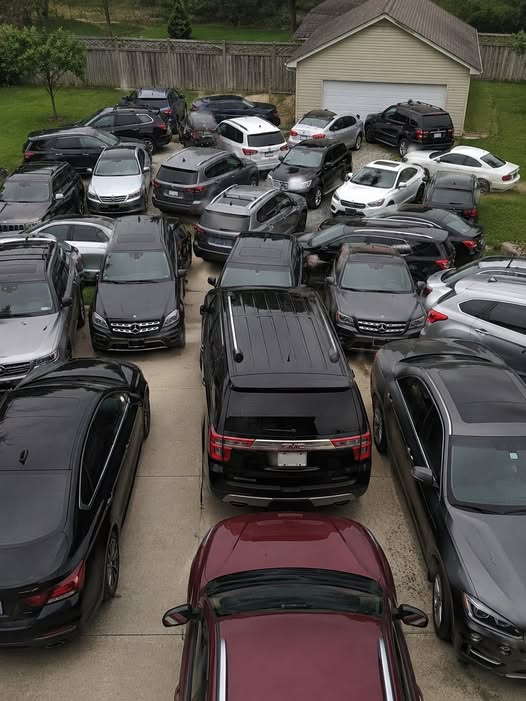
By 7:30 there were eighteen vehicles lined up in my driveway and starting down the gravel lane. I kept losing count and starting over. By eight o’clock, there were thirty. Thirty cars, nose to tail, filling every inch of the driveway and stretching all the way down the private lane behind my house, the lane Robert used to rake smooth, exactly the way they used to fill it on the best mornings of my old life.
And every single person who climbed out was carrying something. Thermoses of coffee. Folding aluminum lawn chairs. Foil-covered breakfast casseroles still warm from somebody’s oven. Boxes of donuts from the good bakery two towns over. A cooler full of orange juice. One enormous man I didn’t recognize, new to the club since Robert’s time, carried in what must have been three pounds of bacon and announced to no one in particular that he’d brought two cast-iron skillets because he trusted absolutely no one else present to cook it properly.
Nobody was leaving. That was the thing. Every one of them was walking, arms full and faces bright, toward my backyard, toward the smell of coffee and the sound of a griddle warming up on the patio, and my quiet, dead, roped-off house was suddenly loud and warm and alive in a way it hadn’t been since the last time I heard Robert’s voice.
I was in the kitchen pouring a fresh pot when I heard Linda.
“What the hell is this?!”
I stepped out onto my porch with my mug in both hands, calm as anything.
“Morning,” I said, as pleasant as if it were any ordinary day.
She was standing beside her SUV in a bathrobe and slippers, her hair still flat from the pillow, staring at the wall of chrome and steel that had materialized around her vehicle.
“Move these cars!”
“I can’t,” I said pleasantly.
“What do you mean, you can’t?”
“People are eating, Linda. It’d be rude to interrupt.”
“I have work!”
I took a slow sip of my coffee. “You barely use your car anyway.”
Her face went a deep, satisfying red. “Are you serious right now?”
“Very.”
“You did this on purpose!”
“I invited some friends over for breakfast,” I said. “It’s a free country.”
“Thirty friends?!”
“Robert was popular.”
She looked past me at the backyard, where three dozen people were unfolding chairs and cracking eggs and laughing, and I watched it dawn on her that not one of them was going anywhere.
“I’m blocked in!” she said, pointing at her SUV.
“Yes,” I agreed. “You are.”
“You need to tell them to move their cars.”
“Eventually.”
“Eventually? I have to leave now!”
“That’s unfortunate,” I said, and took another sip.
“Carol!”
I know I shouldn’t have enjoyed it. I am not, by nature, a person who takes pleasure in other people’s misery. I spent thirty-one years teaching third graders to share and take turns and be kind, and I meant every word of it. But standing there on my own porch in the morning sun with a good hot cup of coffee in my hands, watching Linda finally, finally understand from the inside what it feels like to be trapped and helpless because someone else simply couldn’t be bothered to care about your morning, I have to be honest with you.
I enjoyed it. Thoroughly. I enjoyed every single second of it, and I have made my peace with that.
And then Linda’s gaze drifted toward the last car pulling slowly into the gravel lane, and everything on her face changed.
It was the powder-blue Cadillac. It eased to a stop, and the driver’s door opened, and an elderly man climbed out, tall and thin and moving with great care, steadying himself with a polished wooden cane.
The instant Linda saw him, she went absolutely still. Her coffee mug slipped right out of her hand and dropped into the grass with a soft thud, spilling in a brown fan across the lawn. She didn’t even look down at it.
“No,” she said quietly. “No, no.”
I recognized him at once, and my heart lifted.
“Arthur!”
He raised one hand off the cane in greeting. “Morning, Carol. Wouldn’t have missed it.”
Arthur was eighty-two years old, and he had lived in this neighborhood since long before Robert and I ever arrived. In fact, decades earlier, Arthur’s family had owned most of the land along our whole side of the street, farmland once, back when this was the edge of town instead of the middle of it. Over the years he had divided it up, carved it into the separate lots the houses now sat on, and eventually he’d sold the house next door, Linda’s house, to Linda herself. He knew every property line on this street the way I knew the rooms of my own home, because he had drawn most of them. He was also one of the oldest and most beloved members of Robert’s car club, and the two of them had spent countless hours together over the years, heads under one hood or another.
Arthur made his way up to the edge of the driveway and stopped, taking in the whole scene with those sharp old eyes. He looked at Linda standing there in her robe and slippers. He looked at her SUV, sitting square in the middle of my driveway. Then he looked at the long line of gleaming classic cars boxing it in, and then back at Linda, and his white eyebrows drew slowly together.
“Linda?”
She said nothing at all.
He lifted his cane and pointed it at the SUV. “Don’t tell me that’s your vehicle. Sitting there in Carol’s driveway.”
“It’s complicated, Arthur.”
He looked around at the thirty cars, the crowd of people, the breakfast unfolding on the patio. “Not really. Doesn’t look the least bit complicated to me.”
Linda crossed her arms tightly over her robe. “I parked here for a little while. That’s all it is.”
“Why?” Arthur asked, genuinely, as if he couldn’t imagine the reasoning. “You’ve got a perfectly good driveway of your own not thirty feet away.”
“It’s being landscaped this morning. There’s a crew.”
“So?” he said. “A crew for an hour. You couldn’t park on the street like everybody else?”
Linda shot a quick glance at me, then away. “It’s not like Carol needs all this space.”
And Arthur’s whole expression shifted then. For the first time I saw something genuinely stern come into that kind, weathered old face, the look of a man who has run out of patience for something he considered settled long ago.
“I showed you the property line myself,” he said quietly. “The very day you came to look at that house.”
Silence. A long, heavy one, with only the sound of laughter drifting over from the backyard.
I turned and looked at Linda. “You knew?”
She wouldn’t meet my eyes.
Arthur kept going, his voice low but hard as the brass head of his cane. “When you were buying that house, you asked me specifically about overflow parking. You were worried about where your visitors would leave their cars, remember? And I told you, plain as day, standing right about where you’re standing now, that this driveway and this gravel lane belong to the property next door. To Robert and Carol. I walked you to the line and I pointed it out to you with this very cane.”
Linda’s face had gone tight with fury now, all the wounded-innocent act stripped away. “I know whose driveway it is.”
And there it was. Out loud, at last, in front of witnesses.
For six whole months, some small, stubbornly charitable part of me had kept wondering whether Linda genuinely, honestly believed that the gravel lane was some kind of shared neighborhood common space, whether this whole miserable business was just an innocent misunderstanding that I had somehow failed to clear up properly.
She didn’t believe that. She never had, not for a single day. She had known exactly whose property it was from the moment she signed her closing papers. She had simply decided that my ownership didn’t count for much, because I wasn’t using the land in a way she personally judged sufficient. She’d known the whole time, and she just hadn’t cared, and now everyone standing in my driveway knew it too.
Arthur shook his head slowly, disappointment heavy in it. “Then why in the world are we even having this conversation?”
“Because she blocked me in!” Linda snapped, jabbing a finger toward the wall of cars.
Arthur turned and looked at her SUV, sitting there in the middle of my driveway exactly where she had left it, uninvited, that very morning. Then he looked back at her, and the corner of his mouth twitched upward.
“Seems to me,” he said, “you blocked yourself in.”
I had to lift my mug to my face to hide my smile.
Linda did not appreciate that. “I’m calling the police,” she announced, drawing herself up.
“Okay,” I said simply, and took another sip of coffee.
That stopped her cold. She’d clearly been expecting me to panic at the word police, to fold, to start hurriedly waving my arms and telling everyone to move their cars and clear out. That was, I think, what always used to happen with Linda. People folded. She counted on it.
“What?” she said, thrown.
“I said okay. Go ahead and call them. I’ve got nothing to hide and a driveway full of proof.”
So she did. She pulled her phone out of the pocket of her robe and called the police right there on my front lawn, in her slippers, and then she stormed back into her house to change out of her robe while she waited for them to arrive, muttering the whole way.
Meanwhile, breakfast went on.
I walked back into my own backyard, and for the first time in two years, it sounded like one of Robert’s mornings. People laughing in little clusters. Car doors thumping shut. Somebody in a heated but entirely friendly argument about the correct firing order of a V8 engine. The clink of forks on paper plates, the hiss of the griddle, the low music of a couple dozen people who genuinely liked each other and had all shown up in the same place.
George was hunched over a portable propane griddle on my patio, attempting to fry a dozen eggs at once while three different men stood around him offering loud, contradictory, completely unsolicited advice.
“You’ve got the heat up too high, George, you’re gonna ruin ’em!”
“Leave him be, the heat’s fine, it’s his flipping that’s all wrong.”
“Nobody asked either one of you two!”
I laughed. I really laughed, from somewhere down deep in my chest that hadn’t opened up in two years, and the sound of it caught me completely by surprise, the way you’re startled by a sneeze. I honestly couldn’t remember the last time laughter had come out of me like that, unguarded and involuntary and real.
George glanced up from his eggs, spatula in hand. “There she is.”
“There who is?” I said.
“That laugh.” He pointed the spatula at me across the patio. “That right there. We’ve missed that, Carol. All of us have. More than you know.”
And I understood exactly what he meant, and my eyes filled before I could stop them.
One of the club members, a woman named Diane who Robert had always spoken of warmly, a widow herself for many years, came over and pressed a warm paper cup into my hands.
“Robert’s coffee,” she said simply.
I looked down into it. Black, with exactly one sugar.
“He would have complained,” I said, and my voice wobbled, “that you put the sugar in before you handed it to him. He was very particular about that. He liked to stir it in himself, said it never dissolved right otherwise.”
“I know he would have,” Diane said, smiling, her own eyes bright. “That’s precisely why I did it that way. Somebody ought to give him something to complain about, even now.”
My throat closed up entirely.
Then Diane reached into the canvas bag slung over her shoulder. “I brought something along to show you. I’ve been meaning to for the longest time, honestly, but I could never quite find the right moment. I think this is it.”
She handed me a photograph. A real printed one, glossy, a little faded and soft at the corners from being handled. It had been taken right here in this driveway, maybe eight years earlier. Robert stood beside his old Pontiac with both hands thrown up in the air and his mouth wide open, clearly caught mid-sentence in the act of directing traffic, bossing the entire club into their proper places. Cars filled every inch of the frame behind him. The early light was pure gold, the way it only ever is right after sunrise. He looked so alive, so utterly and completely and unmistakably himself, that for a moment I genuinely forgot to breathe. I could hear his voice coming out of that open mouth. I could hear exactly what he was yelling.
I touched the little white border of the photo with the tip of one finger, gently, as if it might bruise. “I’d forgotten this one even existed.”
“We haven’t,” Diane said softly. “None of us have forgotten a thing, Carol. That’s rather the point of all this.”
Arthur appeared at my other side, leaning on his cane, and he looked out over the crowded, noisy, joyful yard, at the steam rising off the griddle and the cars gleaming in the morning sun and all those familiar faces.
“Robert would be happy,” he said, “to see this driveway full again. Happier than about almost anything, I’d wager.”
I swallowed hard against the ache in my throat. “Yeah,” I managed. “He would.”
For six months, Linda had kept telling me that I barely used my driveway, and the truth is she wasn’t entirely wrong about the plain facts of the matter. What she never understood, what she couldn’t possibly have understood standing on the outside of my life, was the why of it.
My driveway hadn’t gone empty because it stopped mattering to me. It went empty because Robert did. Every single time I looked out at that stretch of asphalt, I saw the exact shape of his absence standing there on it, and it was easier, for two long and shapeless years, to simply not look at all. To keep the curtain half drawn. To let it sit quiet and let the weeds come up in the gravel lane he’d kept so perfectly graded. The emptiness was never neglect. It was grief, wearing the plain gray costume of neglect so I wouldn’t have to call it by its real name.
Around nine o’clock, a police car pulled up to the curb, its lights off, in no particular hurry. Linda came hurrying out of her house immediately, dressed now in real clothes, ready to make her case to the authorities.
The officer, a calm younger man with an unhurried way about him, spoke with her first for a few minutes, nodding along as she gestured emphatically at the cars and at my house and at the whole impossible situation. Then he made his way across the lawn to me, taking in the breakfast, the crowd, the gleaming rows of classic cars, with what I could have sworn was a flicker of amusement.
“Are you the property owner, ma’am?”
“I am. Thirty years this house has been mine and my husband’s.”
“And all these folks are your invited guests this morning?”
“Every one of them. It’s a breakfast. Old friends of my late husband’s.”
He glanced back over his shoulder at the driveway. “Do you happen to know the owner of that SUV there, the one in the middle?”
“That’s my neighbor, Linda. She lives right there.”
“Did you give her permission to park in your driveway?”
“No, officer. I did not. I never have.”
His eyes traveled to the PRIVATE DRIVEWAY sign standing plain as day at the foot of the drive. “Have you asked her not to park here before? In the past?”
“Repeatedly,” I said. “For six straight months. I put that sign up myself, and she’s parked underneath it more than once.”
Linda cut in, her voice sharp and rising. “That’s not the issue here. The issue is that she is deliberately blocking my vehicle in. On purpose. That has to be against something.”
The officer turned to her with a patience I genuinely admired. “Ma’am, is your vehicle currently parked on your own property?”
Linda hesitated. “No, but it’s not…”
“Did the property owner give you permission to park where you’re parked today?”
“No,” she admitted, “but she’s…”
He turned back to me before she could build any momentum. “Can these vehicles here be moved enough to let her get her SUV out, once your event is finished?”
“After breakfast,” I said, “absolutely. Happy to. It won’t be long now.”
Linda exploded. “After breakfast? I have to be at work! I’m already hours late!”
The officer held up one steady, unbothered hand. “Ma’am, I’m trying to resolve this the simple way, without anybody having to make it more complicated than it needs to be. From where I’m standing, you parked on private property you’d been told to stay off of, and now you’re boxed in by the owner’s guests. That’s a civil matter at best, and not one that’s going to go the way you’re hoping.”
And the truth was, I had no interest in dragging it out into some legal battle either. I’m not a cruel woman. I had made my point, thoroughly, in front of the one person on earth who could confirm every word of it. That was enough. That was more than enough.
I found George and two others and asked them to move their cars, and within ten minutes there was a clear path for Linda to back her SUV out onto the street.
Before she left, the officer took her aside and spoke to her privately for a minute or two. I didn’t catch all of it, and I didn’t try to. But I caught enough, drifting across the lawn in pieces.
“…been explicitly told not to park here…”
“…this is private property, ma’am…”
“…need to make other arrangements going forward…”
Linda got into her SUV and drove away without once looking in my direction.
The breakfast lasted until nearly noon. People lingered over their coffee long after the food was gone, told stories about Robert I’d never heard in twenty-seven years of marriage, laughed until the eggs went cold on the griddle and nobody minded. Somebody found the old horseshoe pit in the back corner of the yard and cleared the leaves off it, and for an hour the ring of metal on metal mixed with the arguing and the laughter. And when the very last car finally rumbled off down the street and I stood alone in my driveway in the flat midday sun, for the first time in two long years, it didn’t look empty to me at all.
It just looked like a driveway. A good one. A well-used one. Mine.
That felt like something. After two years of fog, that felt like solid ground under my feet.
Three days later, there was a knock at my door. I opened it to find Linda standing there on my step, and she didn’t bother with hello.
“You made me look like an idiot,” she said.
“I didn’t park your car in my driveway, Linda. You did that. All by yourself, at quarter to seven in the morning.”
“You invited thirty people knowing full well I was parked there.”
“Yes,” I said, evenly. “I did.”
“That is unbelievably childish.”
“Possibly,” I agreed. “In my defense, I’ve done worse in my seventy-odd years, and I’ll probably do worse again.”
“You could have just asked me to move it. Like a normal person.”
I looked at her for a long, level moment, letting the question sit.
“I did ask you to move it,” I said finally. “I asked you to move it for six months, Linda.”
Her mouth opened, and then it closed again.
“I asked you politely,” I went on, keeping my voice quiet and steady, which I could see unsettled her more than shouting would have. “Every time, at first. Then I asked you firmly. Then I went to the hardware store and I bought a sign and I mounted it on a post, an actual sign, that you then parked directly underneath, more than once, like it was a personal joke. You ignored every single bit of it. Every polite word, every firm word, every time.”
“I never thought it was that serious,” she said, and some of the fight had gone out of her voice.
“I missed a doctor’s appointment because of you,” I said. “One I had waited two months for. And then had to wait three more weeks after that, not knowing.”
“I apologized for that.”
“You told me I should have warned you in advance that I might one day need to use my own driveway. That was your apology, Linda. Word for word.”
Her jaw tightened, and for a second I braced for her to come back swinging. But then something in her shoulders dropped.
“You didn’t need thirty cars to make your point,” she said, but there was almost no heat left in it now.
“Apparently,” I said, “one sign, and six months of asking, and one missed doctor’s appointment weren’t quite enough to make it. So I went with thirty cars and a lot of bacon. It seemed to land better.”
That finally silenced her completely.
And then I asked her the question I’d been turning over in my mind ever since Arthur climbed out of that powder-blue Cadillac and named it out loud.
“You knew this was private property when you bought your house, didn’t you. The whole time. From the very beginning.”
Linda looked away from me, off toward the driveway, and was quiet for a moment.
“Yes,” she said.
“Then why, Linda? Six months. Why?”
“Because,” she said, and I could see it genuinely cost her something to force the words out into the open air, “you weren’t using it. It was just sitting there, empty, every single day. It seemed like such a waste.”
I shook my head slowly. “You don’t get to decide that a thing belongs to you just because someone else isn’t using it the way you’d like them to. That’s not how any of it works, Linda. Not driveways. Not land. Not anything a person owns.”
“I know that,” she muttered.
“No,” I said, not unkindly, because I could see she was closer to understanding than she’d ever been. “I don’t think you did. Not really. Not until this week.”
She was quiet for a moment, staring at the asphalt.
“Fine,” she said at last, quietly. “I do now.”
It wasn’t an apology. Not really, not the kind you’d want. She never once said the word sorry and meant it, never acknowledged the missed appointment or the six months or any of the rest of it. But it was, I suspected, about as close to an admission as Linda had in her, a small crack of daylight in a wall she’d spent her whole life building, and standing there in my doorway I decided to accept it as the coin it was rather than hold out for a currency she didn’t carry.
She never parked in my driveway again. Not once, not ever, not for ten minutes. Whatever the officer said to her privately that morning by her car, combined with the sight of Arthur pointing that cane at her in front of thirty witnesses, seemed to have settled the matter for good and all.
A few months later, when the weather turned fine again and the mornings had that first soft warmth to them, I hosted another car-club breakfast. Only fourteen cars came that time, a smaller, gentler, easier gathering, not a statement to anyone, just friends. As the first few pulled up the street, I saw Linda come out onto her own front step with a mug in her hand, and I braced myself out of pure habit for whatever might be coming.
She looked at the cars rolling up. Then she looked across the two lawns at me.
And then, without saying a single word, she set down her mug, got into her SUV, and pulled it farther up her own driveway, tucking it neatly out of the way, so that Arthur would have more room to swing his big powder-blue Cadillac around near the street.
Arthur noticed. Of course he noticed. Arthur noticed absolutely everything, always had. When he’d parked and climbed carefully out with his cane, he looked over at Linda’s considerately tucked-away SUV, and then over at me, and one white eyebrow climbed toward his hairline.
“Progress?” he said.
“Don’t you dare jinx it,” I told him.
He laughed, that warm dry rasp of his, and a few minutes later he looked over toward my driveway, full again with its rows of chrome and its little crowd of old friends holding paper plates.
“Well now,” he said. “Looks to me like you’re using it after all.”
I smiled. “Turns out I am.”
But that wasn’t quite the whole truth, and I knew it even as the words left my mouth.
The fact is, I had always been using that driveway. Even in the two silent years when it sat empty and weed-lined and roped off in my mind, untouched, I had been using it. I’d been using it to hold something. To keep a space in the world exactly the shape and size of a life I wasn’t yet ready to fold up and put away.
Because sometimes an empty space still belongs to someone. Sometimes it isn’t empty at all, no matter how it looks from the street. Sometimes it’s full right up to the brim with things nobody else walking past could ever see, a whole vanished world of golden sunrise mornings and coffee going cold on a fender and a man standing in the middle of it all with both hands thrown up in the air, yelling instructions that nobody could hear over the engines and nobody needed to.
And sometimes you don’t realize just how much of your own life you’ve quietly boarded up and stopped living in, until somebody else’s carelessness comes along and shoves you, almost against your own will, into taking it back.
I thought those thirty cars were going to teach Linda a lesson about property lines and respect. And maybe they did. She never parked in my driveway again, so something must have gotten through.
But they taught me a far bigger lesson than anything they taught her.
I had spent two years keeping part of my own life deliberately empty, cordoned off, because Robert wasn’t here anymore to fill it, and filling it myself had felt like a kind of betrayal, or maybe just like more grief than I could safely hold in my two hands at once. I had mistaken a closed door for loyalty. I had thought that letting the driveway stay empty was how I kept faith with him.
That Monday morning, thirty cars rolled up my driveway and down the old gravel lane that Robert used to rake smooth every spring, and the whole place filled up with noise and coffee and laughter and the good honest smell of exhaust.
And for the first time since the day I lost him, I stood there in the middle of all of it and looked out at that beautiful, deafening chaos, and I did not think about everything I had lost.
I thought about every single person who was still, after all this time and all that silence, so glad to show up.