The last echoes of my company’s year-end party were still in my head when I pulled into my driveway that night. My company badge still hung around my neck, my lipstick had faded, and everything outside looked painfully ordinary, from the buzzing porch light to the little American flag Eli had tucked into the planter beside the steps.
The moment I entered the house, however, I knew something was wrong. The silence wasn’t peaceful or familiar, and before I could call Eli’s name, my heel touched something soft near the entrance.
I looked down and found my nine-year-old son collapsed on the tile. His cheek rested against the floor, one hand curled near his throat, his breathing was shallow, and a dark bruise marked his jaw where there had been nothing when I’d kissed him goodbye that morning.
“Eli.”
I dropped beside him and touched his shoulder. He was warm, but frighteningly limp, and when I begged him to open his eyes, his lashes barely fluttered.
“Baby, open your eyes. Eli, look at me.”
Then I realized we weren’t alone. My brother Ryan stood against the hallway wall watching us with the same detached expression he’d worn whenever someone else’s suffering became inconvenient, while my parents emerged from the living room looking disturbingly composed.
“About time.”
I stared at Ryan.
“What did you do?”
He gave a casual shrug.
“Just disciplined him.”
My mother answered from behind him without the slightest hesitation.
“He deserved it.”
Something inside me became terrifyingly clear. I’d spent my childhood being taught that Ryan’s cruelty was strength and that questioning him made me difficult, but motherhood erased those old rules the moment I saw my son lying helpless on the floor.
I pulled out my phone and dialed 911.
“Who are you calling?”
“Help.”
Ryan pushed away from the wall and immediately tried to minimize what had happened.
“Don’t be ridiculous. He’s fine.”
“No, he’s not.”
I gave the dispatcher my address and clearly explained that my child was unconscious, bruised, and struggling to breathe. Ryan tried using the same language he’d always used to justify himself, but this time I refused to let him rewrite what was happening in front of me.
“Hannah, you’re overreacting. You don’t know how to raise a boy. Somebody has to be firm.”
For one moment, I wanted to turn around and unleash every ounce of anger I felt on him. Then Eli’s breathing hitched beneath my hand, reminding me that my son needed me more than Ryan needed my rage.
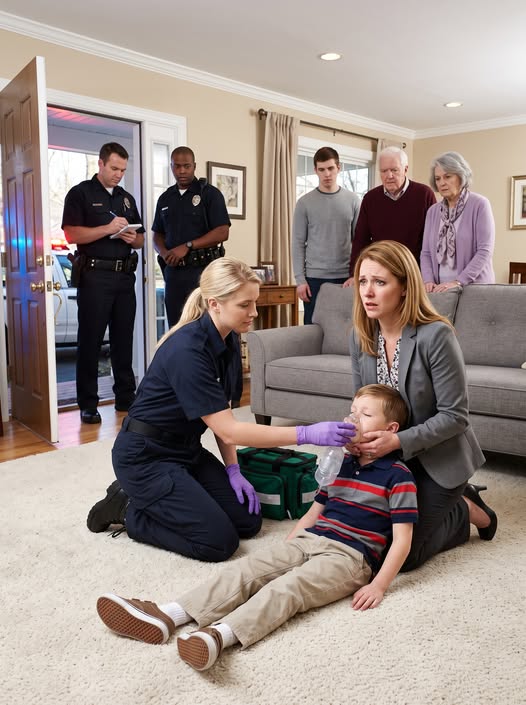
Paramedics arrived with a police officer minutes later and immediately began examining Eli. While one paramedic fitted oxygen over his face, the other checked his pulse, eyes, and ribs until Eli made a weak sound that nearly broke me.
Then something strange happened.
The male paramedic looked up and saw Ryan.
His entire expression changed.
For less than a second, he simply stared at my brother, but there was no confusion in his eyes. It was unmistakable recognition, sharp enough that Ryan went still and even my parents suddenly seemed uneasy.
The paramedic leaned closer to me.
“Ma’am, is that really your brother?”
“Yes.”
He swallowed and looked at Ryan again.
“Because actually…”
He stopped himself.
“No. Never mind. We need to move your son now.”
At the hospital, doctors confirmed that Eli had suffered a concussion, significant bruising, and fractured rib cartilage. A nurse carefully used the phrase “non-accidental trauma,” while police and a social worker began taking statements from me about Ryan and my parents.
Around three that morning, I suddenly remembered the security cameras I’d installed months earlier after noticing that Eli sometimes became frightened whenever Ryan visited. I opened my laptop beside my son’s hospital bed and loaded the hallway footage.
The recording showed Ryan entering my home with the spare key my mother had insisted family should possess. Moments later, Eli appeared in the hallway, and what happened next destroyed every excuse my family had ever made for my brother.
Ryan struck him.
Then he did it again before shoving him and dragging him toward the door. What disturbed me most wasn’t uncontrolled rage but how calmly he did everything, while Eli folded inward as though this wasn’t the first time he’d learned how to survive his uncle.
When Eli finally woke the next morning, he didn’t look at me first. His frightened eyes immediately moved toward the hospital-room door.
“Mom…”
“I’m here.”
“Is Uncle Ryan coming?”
“No.”
The relief on his face made my stomach twist.
I carefully took his hand.
“Has he hurt you before?”
Eli began crying.
“Sometimes.”
“When?”
His next words changed everything I thought I knew about my family.
“When you were at work. Grandma said it was for my own good. He said if I told you, you’d get mad at me. Like she does.”
That was when I understood this hadn’t begun the night of my company party. It was simply the first night I’d arrived home early enough to discover it.
I handed the security footage to police and repeated everything Ryan and my mother had said. But while investigators began building the case, I couldn’t stop thinking about the paramedic’s reaction when he’d first seen my brother.
He hadn’t looked at Ryan like a stranger who seemed vaguely familiar.
He had looked at him like someone he’d seen before.
Later that afternoon, the paramedic returned to the hospital and introduced himself as Mark. He asked to speak with me privately because there was something he could no longer keep to himself.
“I need to tell you why I reacted the way I did.”
Years earlier, Mark had worked as an EMT in a neighboring county where one case had haunted emergency workers for decades. A newborn boy had disappeared from a hospital during the night, and although investigators had pursued several leads, the baby had never been found.
“When I saw your brother, I thought I was looking at one of those images grown up.”
My mouth went dry.
“Do you remember the baby’s name?”
Mark nodded.
“Noah Turner.”
Suddenly, Ryan hurting my son was no longer the only secret threatening to tear my family apart.
Because the paramedic wasn’t suggesting that he’d merely recognized my brother.
He was suggesting that Ryan might never have been my brother at all.

Part 2: The Secret Behind Ryan’s Identity
Mark’s words followed me long after he left the hospital. That night, while Eli slept beside me, I searched through old news archives and found the case he had described: Noah Turner, a newborn who disappeared from a hospital less than twenty miles from where my parents had been living at the time.
The dates made the coincidence even harder to ignore. Noah disappeared in March, while Ryan’s birth certificate claimed he had been born in May, leaving only two months between the disappearance of one baby and the supposed arrival of another.
I started remembering details from childhood that had never made sense. There was a missing period in our family photographs, my parents always avoided telling stories about Ryan’s birth, and whenever anyone commented that he looked nothing like us, my mother responded with the same rehearsed phrases instead of actual memories.
“He was perfect from the beginning.”
“He was meant for us.”
“God gave him to us when we needed him.”
Desperate for answers, I called my Aunt Celia and told her what Ryan had done to Eli. She became frighteningly quiet before saying something that made my fingers tighten around the phone.
“Oh God. So it finally reached a child.”
“What do you mean finally?”
Celia hesitated before explaining that my mother had supposedly lost a baby before Ryan arrived, but nobody in the family had ever understood the timeline. My mother disappeared for months, my father aggressively discouraged questions, and then suddenly they had a baby everyone was expected to accept without explanation.
“Are you saying Ryan might not be…”
“I’m saying your parents built their lives around secrets. And secrets don’t stay buried. They just wait for a child to get hurt.”
The following morning, I took everything to Detective Alvarez: the security footage showing Ryan hurting Eli, Mark’s statement, Aunt Celia’s account, the old article about Noah Turner, and the suspicious timeline surrounding Ryan’s supposed birth. The detective listened carefully, and instead of dismissing the theory as impossible, his expression became more serious with every detail.
“We can pursue the assault immediately. And we will start digging into the identity question.”
“Do it.”
That evening, my mother arrived at my house while my father waited in the car. She stood beneath the porch light expecting me to open the door simply because she’d always believed being my mother gave her unlimited access to my life.
“Hannah, we need to talk.”
I kept the door locked.
“No. You need to leave.”
Her expression hardened immediately.
“Ryan was correcting him. Boys need discipline.”
“He fractured my son’s ribs.”
My father climbed out of the car and approached the porch with the same authority he’d used to intimidate me since childhood.
“You’re making a spectacle. Dragging police into family matters.”
For the first time, his disapproval meant nothing to me.
“You made it a police matter when you let a grown man beat a child in my house.”
My mother lowered her voice.
“You can’t keep Eli from us.”
“Watch me.”
Then I finally said what I’d spent years being too frightened to admit.
“You don’t know what love is. You know possession.”
My father’s expression changed, and the carefully controlled mask I’d known all my life briefly disappeared.
“If you continue with this, you’ll regret it.”
Normally, that threat would have been enough to make me question myself. This time, I simply raised my phone and reminded him that I had security footage, hospital records, police documentation, copies of everything, and a protective order already being pursued.
Ryan was arrested the following Tuesday. Detective Alvarez called to tell me officers were at my parents’ home with a warrant connected to Eli’s assault and potentially falsified records, and I drove there because I needed to see for myself that my family could no longer protect him from consequences.
Ryan initially appeared almost amused when officers brought him outside. He looked at me and silently mouthed a single word.
“Traitor.”
Then he noticed Mark standing beside one of the patrol vehicles giving a formal statement. For the first time in my life, genuine fear appeared in Ryan’s eyes.
My mother rushed forward.
“He’s our son!”
Detective Alvarez answered without raising his voice.
“That remains to be seen.”
Even my father froze.
Over the following days, investigators began pulling apart a family history my parents had spent decades keeping sealed. Old hospital logs were requested, neighbors were interviewed, records were reopened, and investigators eventually discovered the name of a retired nurse connected to the original disappearance.
Then Detective Alvarez located Lydia Turner.
Noah’s mother was still alive.
She had spent decades wondering what had happened to the newborn taken from her, and before agreeing to DNA testing, she asked to meet me. We chose a quiet coffee shop halfway between our towns, where two women who had never met sat across from each other because of a secret neither of us had created.
“You’re telling me the man who hurt your son may be the baby they stole from me.”
“Yes.”
Lydia closed her eyes briefly. When she opened them again, tears filled them, but her voice remained steady.
“Then your boy saved the truth by surviving it.”
I told her everything: what Ryan had done to Eli, how my parents had always defended him, how they called cruelty discipline, and how Ryan had grown up believing consequences were something other people faced.
After listening quietly, Lydia asked me something I hadn’t expected.
“Was he ever kind?”
The question forced me back into childhood. I remembered Ryan carrying me on his back, telling me family was the safest place in the world, and moments when I’d genuinely believed he loved me.
“Sometimes. But I don’t know anymore whether it was kindness or practice.”
Three days later, DNA samples were collected. While we waited for the results, Eli finally came home from the hospital and began therapy, slowly trying to understand why people he’d been taught to trust had hurt him and then blamed him for it.
One night, he looked at me carefully.
“Are Grandma and Grandpa mad?”
“Yes. But that’s not your problem anymore.”
He remained quiet for several seconds.
“You picked me.”
Those three words nearly broke me.
“Always.”
Three weeks later, Detective Alvarez arrived at my house carrying a folder. The expression on his face told me the waiting was over, and when he placed the file on my kitchen table, I saw a name printed across the first page.
It wasn’t Ryan. It was Noah Turner.
The detective looked directly at me before explaining what the DNA results had confirmed.
The man I’d called my brother my entire life was the missing child Lydia Turner had spent decades searching for.
And now investigators had to determine exactly how Noah Turner had become Ryan.

Part 3: The Truth, the Consequences, and Healing
The DNA results confirmed what had once sounded impossible. Ryan was biologically Lydia Turner’s missing son, Noah, the newborn taken from a hospital decades earlier, which meant the man I’d grown up calling my brother had entered our family through a secret my parents had protected for most of my life.
Knowing his real identity didn’t excuse what Ryan had done to Eli, and it didn’t magically transform him into a different person. The assault case continued first, while the investigation into Noah’s disappearance moved more slowly because detectives had to reconstruct events buried beneath decades of missing records, silence, and fear.
Investigators questioned my parents and reopened old files connected to the hospital. The retired nurse who had surfaced earlier became increasingly difficult for them to explain away, and every recovered document seemed to pull another thread from the story my parents had spent years carefully maintaining.
Lydia received the truth she’d waited decades to hear, but there was nothing simple or joyful about it. She had finally found her missing child, yet Noah was now an adult named Ryan, shaped by another family and facing consequences for hurting my son.
The truth didn’t return the baby Lydia had lost, nor did it erase the person Ryan had become. My parents didn’t suddenly acknowledge the damage they’d caused simply because DNA had exposed what they had hidden, and I eventually understood that discovering the truth wasn’t the same thing as repairing everything.
My responsibility was no longer to repair them anyway.
It was Eli.
After leaving the hospital, he began therapy and stayed close to me while ordinary things slowly became safe again. For a while, he slept in my bed, startled easily, and watched doors more carefully than any nine-year-old should have needed to.
One evening, he returned to the question that mattered most to him.
“Are Grandma and Grandpa mad?”
“Yes. But that’s not your problem anymore.”
He studied my face for a moment.
“You picked me.”
“Always.”
That conversation changed something between us. For most of my life, my parents had taught me that protecting family meant tolerating whatever family did, but Eli showed me the opposite: sometimes protecting your family means refusing to give dangerous people another opportunity to hurt them.
Recovery didn’t happen dramatically. There was no morning when Eli woke up completely fearless or when everything that happened suddenly stopped mattering; instead, progress arrived through tiny decisions that probably looked meaningless to everyone except me.
At first, Eli couldn’t sleep unless my bedroom door remained open. Eventually, he returned to his own room and slept with his door open, and then, months later, he quietly closed it himself.
That was when I knew something inside him was beginning to heal.
A closed door had once meant danger because adults could hide terrible things behind family authority. Now my son could close one because it simply meant privacy, and that small act mattered more to me than any public confrontation or courtroom victory ever could.
The little American flag Eli had brought home from school remained in the planter beside our porch long after its paper edges began fading. He had put it there because, in his words, every house should have something outside reminding people that whoever lived inside was supposed to be safe.
For months, looking at that flag brought me back to the night I’d returned from the company party and found Eli collapsed near the door. I remembered Ryan watching from the hallway, my mother saying Eli deserved what happened, and my father behaving as though protecting the family reputation mattered more than protecting his grandson.
But eventually the flag began meaning something different.
It reminded me that the cycle had stopped at my front door.
Ryan might spend the rest of his life trying to understand how Noah Turner became the man he was. Lydia might spend hers grieving the childhood with her son that someone stole from her, while my parents would have to face whatever consequences came from the secret they’d spent decades protecting.
None of that belonged to Eli.
His future didn’t have to be built around their choices.
One evening, I stood on the porch watching him through the window as he worked on his homework. He looked ordinary again, which after everything we’d survived felt extraordinary.
I thought about something I’d understood the night I found him on the floor: a family can teach someone to apologize even while they’re the one being hurt. Mine had spent years teaching me exactly that.
Motherhood untaught me in a single night.
And whenever I remembered Eli looking at me with that careful expression and whispering those three words, I knew exactly what the rest of my life needed to prove.
“You picked me.”
Yes.
I had.
And I always would.