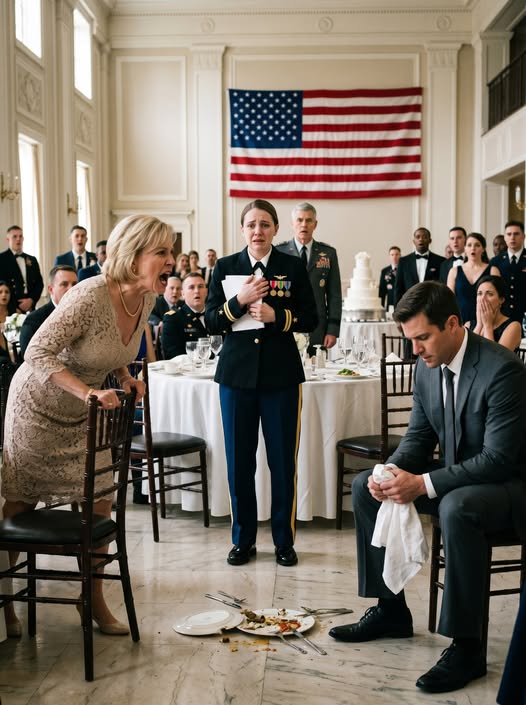
My mother-in-law shattered my dinner plate against the floor at my father-in-law’s retirement gala, publicly declaring, ‘You don’t belong at this table.’ While my husband cowardly turned his gaze away, I calmly stood up, straightened my military dress uniform, and dropped a three-word response that struck the entire room dead silent. The next morning, the tables had turned, and they were all begging at my doorstep.
Part 1: The Plate on the Ballroom Floor
The plate struck the ballroom floor so hard that every conversation died before the china stopped spinning. Roast chicken slid across the polished tile, green beans scattered beneath my chair, and mashed potatoes landed near my black dress shoes.
My mother-in-law, Celeste Whitaker, stood above the mess with her chin lifted, pearl earrings shining beneath the hotel lights. Then she said loudly enough for every officer, spouse, veteran, and waiter to hear, “You don’t belong at this table.”
For one second, I forgot where I was. I forgot the flags behind the stage, the deployment photos on the walls, and the weight of the medals pinned over my heart. All I could do was look at my husband, Evan Whitaker.
He sat beside me with his hands folded near his water glass. His jaw tightened. His eyes flicked toward his mother, then toward the staring guests, then down at the table.
He looked away.
That small movement cut deeper than Celeste’s words.
I had survived worse than public embarrassment, but something inside me changed when my husband chose silence in front of two hundred witnesses. Not anger. Not tears. Stillness. The kind that comes when a storm has already made its decision.
I slowly pushed back my chair. The scrape echoed through the ballroom. A waiter froze by the double doors with iced tea in his hands. At the head table, my father-in-law, Colonel Raymond Whitaker, sat motionless beside the major general who had come to honor him.
Celeste’s mouth curved as if she expected me to apologize.
I stood, smoothed my Army dress uniform, straightened one ribbon, and looked past her toward the stage.
“Read my orders.”
The room went so quiet I could hear ice settling in water glasses.
Celeste blinked.
Evan finally turned toward me. Confusion crossed his face, then fear. Not fear of me. Fear that there was something he did not know.
There was.
The night had been announced as Colonel Raymond Whitaker’s retirement banquet after thirty-six years in the United States Army. A Northern Virginia hotel ballroom. White linens. Brass lantern centerpieces. Old photographs from Germany, Kuwait, Iraq, and Fort Bragg. A screen looping images of Raymond shaking hands with soldiers whose names he still remembered.
Celeste had planned the event for months. She controlled the seating chart like a military operation, inspected the flowers twice, and told Evan that my deployment schedule was “a convenient excuse.” I had returned from overseas three days earlier, exhausted and still half in another time zone, but Raymond had called me himself.
“Captain Hayes,” he said, “I would consider it an honor if you attended in uniform.”
So I came quietly, respectfully, determined to get through one evening without drama.
Celeste had other plans.
She saw my name card beside Evan’s. She saw me near the head table instead of hidden near distant cousins. Her face hardened, and ten years of polished resentment finally stepped into public view.
Now the whole room stared at the woman she had tried to reduce to a stain on the floor.
The major general turned toward the podium.
“Command Sergeant Major,” he said, voice calm but sharp, “bring me Colonel Whitaker’s ceremony folder.”
A retired command sergeant major crossed the stage and lifted the dark leather folder that had been waiting there all night.
Celeste looked at Raymond.
Raymond did not look away from me.
And then I understood.
He had known this moment might come.

Part 2: The Lessons I Carried
Before the folder opened, my mind pulled me back to a porch in rural Ohio, where my father taught me how to stand when people tried to make me small.
My father, Isaac Hayes, was not a loud man. He had served in Vietnam and came home with a limp, a toolbox, and a habit of waking before sunrise. He raised me outside Dayton in a farmhouse that smelled of coffee, motor oil, cut grass, and wood smoke.
When my mother died, people said he should remarry quickly because a little girl needed “a woman’s touch.”
Dad ignored them.
He taught me to change a tire, write thank-you notes, polish shoes, cook eggs without burning the pan, and look people in the eye when they spoke.
“Marin,” he used to say, “you can’t control who respects you. But you can control whether you abandon yourself trying to earn it.”
Back then, I thought it was just something fathers said while fixing fences. Years later, I understood it was survival.
There was no college fund waiting for me. No family name opening doors. So I earned an ROTC scholarship, worked weekends, studied late, and commissioned as an Army officer with my father in the front row, wearing his old suit and wiping his eyes.
I met Evan Whitaker during a joint training exercise in Georgia. He was not military, but he understood the world around it. His father was Colonel Raymond Whitaker. His childhood had been shaped by base housing, moving boxes, farewell ceremonies, and welcome-home signs taped to windows.
Evan made me laugh. That mattered more than I admitted. He knew service could be lonely. He understood why I checked my phone during dinner when soldiers were in the field. He understood why I woke up at 0500 even on vacation.
When he proposed, I thought I was not only marrying a man. I thought I was joining a family that understood duty. Celeste Whitaker corrected that belief the first time she met me. She looked me up and down in the foyer of their brick colonial house, taking in my simple navy dress and practical heels.
“You’re from a farm?” she asked.
“Yes, ma’am. Outside Dayton.”
Her smile did not reach her eyes.
“How humble.” Evan squeezed my hand under the table that night, as if to say, Ignore it. She doesn’t mean anything by it. That became the family motto.
Celeste didn’t mean anything when she seated me beside a cousin’s teenage son while Evan sat near her. She didn’t mean anything when she introduced me as “Evan’s Army wife” instead of by name. She didn’t mean anything when she told neighbors, “Marin is very committed to her career. Some women are just built differently.”
She didn’t mean anything when Thanksgiving invitations disappeared, or when she told Evan, “A marriage can’t survive if the wife keeps choosing the uniform over the home.” Every time I tried to talk about it, Evan sighed.
“Mom is old-fashioned.”
“She’s stressed.”
“She respects you in her own way.”
“Please, Marin, can we just have one peaceful holiday?”
Peaceful. That word became a cage.
To keep peace, I swallowed insults. To keep peace, I smiled through dinners where I was treated like a visitor. To keep peace, I let Evan convince me that defending me would “only make things worse.” What I did not know was that Raymond Whitaker had noticed everything.
Raymond was not warm in the usual way. He did not hand out compliments or fill uncomfortable silence. But when I returned from hurricane relief on the Gulf Coast, he asked, “Your soldiers hold up?” When I came back from a humanitarian mission overseas, he asked, “Everyone make it home?”
When I said yes, he nodded once. “Figured they would with you watching them.”
That was the closest thing to praise I had ever received from him. I carried it quietly. Like my father’s letters. Like every swallowed hurt. Like the sealed truth waiting inside the ceremony folder.

Part 3: The Orders
The command sergeant major handed the folder to the general with both hands. No one in the ballroom moved.
Celeste still stood beside the food she had knocked onto the floor. A smear of gravy marked the tile near her shoe. Her face had shifted from triumph to calculation, as if she were trying to decide whether to laugh before anyone took me seriously.
The major general opened the folder.
Paper whispered.
That sound changed the room.
“This is the approved retirement ceremony program for Colonel Raymond Whitaker,” he said. “Final version submitted and signed six months ago.”
Six months.
Evan’s head snapped toward his father.
Celeste’s lips parted.
The general continued, “Per Colonel Whitaker’s personal request, the presentation of his retirement flag and the reading of his final citation are to be conducted by Captain Marin Hayes Whitaker.”
Someone near the back whispered, “Oh, Lord.”
The general’s eyes moved across the page.
“Colonel Whitaker further stated that Captain Whitaker was selected because she represents, in his words, ‘the discipline, sacrifice, humility, and moral courage I spent my career trying to teach.’”
The room did not applaud at first.
It absorbed.
There are silences that feel empty, and silences that feel full. This one carried every comment Celeste had ever made, every awkward laugh from relatives, every time Evan had looked down at his plate instead of standing beside me.
Raymond rose from the head table.
He was seventy, but still stood like the uniform had never left his bones. His shoulders squared. His expression remained controlled, but his eyes were wet.
“I requested Captain Whitaker myself,” he said. “I did not tell my wife because I wanted the honor to be clear during the ceremony, not debated at home.”
Celeste flinched.
Raymond looked at me.
“I have commanded many fine soldiers. I have served beside men and women braver than I knew how to thank. But I have never watched anyone carry disrespect with more restraint than my daughter-in-law.”
My daughter-in-law.
He had never called me that in public before.
A retired officer stood.
Then another.
Then a woman at the next table rose with one hand pressed to her chest. Within seconds, nearly every veteran and service member in the ballroom was standing.
Not cheering.
Not clapping wildly.
Standing.
Respectfully.
Deliberately.
The kind of honor that cannot be demanded.
The kind Celeste had tried to deny me.
My throat tightened, but I kept my face composed.
Raymond stepped down from the stage and crossed the tile until he stopped beside the broken plate. He looked down at it, then at Celeste, then back at me.
“Captain Whitaker,” he said, “on behalf of this family, I owe you an apology.”
Celeste made a small sound, like she might protest.
Raymond lifted one hand without looking at her.
She stopped.
“I asked you here tonight because I wanted my final ceremony in uniform to include the officer in this family who has lived the values people like to praise in speeches,” he said. “Instead, you were humiliated in front of guests I invited. That happened in my presence. So I will correct it in my presence.”
Evan stared at his father as if seeing him for the first time.
Raymond faced Celeste.
“You will not speak to her that way again.”
The words were quiet.
They landed like a door locking.
Celeste’s face drained of color. She looked around for support, but every relative at her table suddenly became fascinated by napkins, silverware, or the floor.
Nobody rescued her.
For years, she had ruled private rooms.
Tonight, she had chosen a public one.
The general stepped beside me.
“Captain Whitaker,” he said, gentler now, “if you are still willing, we would be honored to proceed.”
I looked at the flag waiting on the stage. Then at Raymond. Then at my husband, who still had not stood.
I nodded.
“Yes, sir.”
As I walked toward the stage, I knew two things clearly.
I would complete the ceremony.
And then I would stop pretending my marriage had survived the silence.
Part 4: After the Ceremony
I read Raymond Whitaker’s citation without my voice breaking.
That may sound small.
It was not.
Every word on the page carried two meanings. Duty. Sacrifice. Leadership. Integrity. The Army words we place on plaques and programs, the same words families forget to practice when the doors close.
Raymond stood at attention as I read.
The major general presented the Legion of Merit. I handed Raymond his folded flag. The room rose again, this time with applause that filled the ballroom.
When the ceremony ended, Raymond pulled me into a hug.
Not stiff.
Not ceremonial.
A real one.
“I should have done more sooner,” he whispered.
I closed my eyes for one second.
“Yes, sir,” I said softly. “You should have.”
His arms tightened once, then he let me go.
That was the thing about truth. It could hurt and heal in the same breath.
The rest of the evening moved strangely. Guests approached in careful waves. Some thanked me for my service. Some apologized for what they had witnessed. A colonel’s wife with silver hair touched my elbow and said, “I watched her do little things for years. I’m ashamed I never said anything.”
I thanked her.
I did not comfort her.
That was new for me.
Evan hovered nearby, pale and shaken, waiting for a moment alone. Celeste had disappeared into the hallway after Raymond spoke to her near the ballroom doors. I did not hear the words, but I saw her face afterward.
Small.
Furious.
Exposed.
On the drive home, Evan kept both hands on the steering wheel. Highway lights slid over his face in white streaks.
“I’m sorry,” he said finally.
I watched the dark trees pass outside the window.
“For tonight?” I asked.
He swallowed.
“For all of it.”
I wanted those words to matter more than they did.
For years, I had imagined Evan finally understanding. I thought an apology would unlock relief, or love rushing back, or the urge to repair everything.
Instead, I felt tired.
So tired I could feel it behind my eyes.
When we reached home, I went upstairs, changed out of my uniform, and hung it carefully in the closet. My father had taught me never to treat a uniform carelessly, no matter what kind of day I had in it.
Evan waited in the kitchen.
The house smelled faintly of coffee grounds and lemon dish soap. Our wedding photo sat on the sideboard near a bowl of unopened mail. In the picture, Celeste stood beside Evan with one hand on his shoulder, smiling like she had already won something.
I looked at it longer than I meant to.
Evan followed my gaze.
“I thought keeping quiet kept the family together,” he said.
I turned toward him.
“No. It kept your mother comfortable.”
His face crumpled.
I did not soften the truth.
“You watched her exclude me. You watched her insult me. You watched her turn my service into something selfish. And every time I asked you to stand with me, you asked me to make myself smaller.”
“I know.”
“Do you?” My voice stayed calm. “Because tonight shocked you. It didn’t shock me. That’s the difference.”
He sat down like his knees had lost strength.
“I can change.”
“Maybe.”
He looked up.
I slipped my wedding ring off my finger.
His breath caught.
I placed it on the kitchen table between us. The small sound against the wood felt final.
“I’m not filing anything tonight,” I said. “I’m too tired to make permanent decisions at midnight. But I am done living as a guest in my own marriage.”
Tears filled his eyes.
“Marin.”
“No,” I said. “You don’t get to say my name like that now.”
He closed his mouth.
I went upstairs and slept in the guest room for the first time in our marriage.
At 8:57 the next morning, three firm knocks hit our front door.
Through the window, I saw Raymond on the porch.
He was not alone.
Celeste stood behind him.
So did half the family.
Part 5: The Apologies
I opened the door wearing jeans, a gray T-shirt, and my father’s old Army field jacket.
Nobody spoke at first.
Raymond stood on the top step with his cap in both hands. Celeste wore sunglasses even though the porch was shaded. Evan’s sister, Mara, stood beside her with red eyes. Uncle Nolan, a retired Marine who had laughed at Celeste’s comments for years, stared at the welcome mat like it had answers.
There were cousins too. People who had watched. People who had smiled awkwardly. People who had let me be the cost of their comfort.
Raymond cleared his throat.
“May we come in?”
I almost said no.
The word sat ready on my tongue, deserved and clean.
Then I stepped aside.
“Living room,” I said.
They filed in like mourners.
Evan came down the stairs as they entered. His hair was rumpled. His face looked older than it had the night before. When he saw his mother, something hardened in him, but I did not know yet whether it was courage or embarrassment.
No one sat until I did.
That told me more than any apology.
Raymond remained standing.
“I failed you,” he said.
He did not decorate it. He did not say he was sorry if I felt hurt.
“I saw more than I admitted. I told myself Celeste’s behavior was unpleasant but private. I told myself Evan needed to handle his own marriage. I told myself silence was restraint.”
His voice roughened.
“It was cowardice.”
Celeste shifted, but Raymond kept going.
“I asked you to stand beside me publicly because I respected you. But respect offered only at ceremonies is not enough. I should have offered it at dinner tables, holidays, and every ordinary room where my wife made you feel unwelcome.”
I nodded once.
“Thank you for saying it.”
Uncle Nolan spoke next.
“I owe you one too,” he said. “I laughed when I should’ve shut things down.”
Mara wiped her cheek.
“I repeated things Mom said because it was easier than questioning her.”
One cousin admitted she knew I had been left out of a Christmas trip on purpose. Another confessed that Celeste had told relatives I “didn’t value family” because I deployed too often.
Each confession entered the room like cold air.
Useful.
Uncomfortable.
Late.
Then Celeste removed her sunglasses.
Her eyes were swollen.
“I never meant for last night to happen,” she said.
I raised one hand.
She stopped.
“That is not where you begin.”
Her mouth trembled.
I leaned forward.
“You don’t begin with what you meant. You begin with what you did.”
The room went still.
For once, nobody interrupted me.
“You knocked my plate onto the floor in front of two hundred people. You said I didn’t belong at the table. But last night was not the beginning. It was just the first time you made everyone else watch what you’ve been doing for years.”
Celeste looked down.
“I was jealous,” she whispered.
Raymond closed his eyes.
She continued, voice shaking.
“Raymond admired you. Evan chose you. People respected you without you asking for it. And I hated that. I told myself you were cold, proud, too military, too plain, too different. But the truth is, you made me feel unnecessary in my own family.”
I stared at her.
There it was.
Not an excuse.
A root.
Ugly and small.
“I thought if I could make people see you as less,” she said, “I would feel like more.”
Mara covered her mouth.
Evan looked sick.
Celeste’s tears spilled over.
“I am ashamed.”
For ten years, I had imagined an apology. I had imagined feeling satisfied.
But hearing the truth did not repair the damage. It only gave the damage a name.
“I believe you’re ashamed,” I said.
Hope flickered in her face.
I let it live for one second.
“But shame is not accountability. Tears are not repair. And I am not available to make you feel forgiven just because you finally told the truth.”
Her face folded.
Raymond nodded slowly, as if I had said exactly what he expected.
Evan stood near the doorway, silent again.
This time I looked straight at him.
“And you,” I said, “need to understand something. Your mother opened the wound. You kept handing her the knife.”
Part 6: Distance
Evan flinched as if I had slapped him.
I had not.
I had only said what his silence had done.
His mother started to speak, but Raymond said, “Celeste, don’t.”
For once, she listened.
Evan stepped into the living room.
“I thought I was protecting everyone,” he said.
“No,” I replied. “You were protecting yourself from discomfort.”
He nodded slowly.
“I know that now.”
I wanted to ask why now was the only time that ever mattered. Why love so often arrived with flowers after the funeral. Why apologies sounded so sincere only when the audience had already seen the injury.
But I was tired of giving speeches in rooms where I had once begged for basic loyalty.
So I stood.
Everyone else stood too, awkward and uncertain.
“I appreciate the apologies,” I said. “I do. But I need all of you to hear me clearly.”
I looked at Celeste.
“I am not coming to family dinners for a while.”
She nodded quickly, like agreement might save her.
I looked at Raymond.
“I respect you. What you did last night mattered. What you said this morning matters. But I need distance from this family.”
His face tightened with pain, but he did not argue.
“Yes, ma’am.”
Then I looked at Evan.
“And I need distance from you.”
The room seemed to inhale.
Evan’s eyes widened.
“Marin, please.”
“No,” I said. “Not because I hate you. Not because one night destroyed us. Because ten years did.”
He pressed his lips together, fighting tears.
“I’ll go to counseling. I’ll set boundaries. I’ll do whatever it takes.”
“I hope you do,” I said. “But you’ll do it because it’s right, not because you’re trying to keep me from leaving.”
Celeste cried harder.
For once, I did not feel responsible for it.
That afternoon, I packed one duffel bag. Not dramatically. Not while throwing clothes into suitcases or slamming drawers. I folded jeans, uniforms, socks, workout clothes, my father’s letters, and the small framed photo of him from my commissioning day.
Evan stood in the bedroom doorway.
“Where will you go?”
“Temporary lodging near base.”
“You don’t have to leave. I can go.”
“I know.”
He looked confused.
I lifted the strap over my shoulder.
“That’s the problem, Evan. I know you’re willing to make a gesture now. But I need to choose something for myself before everyone turns my pain into a family project.”
He followed me downstairs.
The house looked painfully normal. Shoes by the door. Mail on the table. A coffee mug in the sink. Ordinary evidence of a marriage that had been quietly cracking for years.
At the front door, Evan asked, “Do you still love me?”
I kept my hand on the knob.
“Yes.”
His face broke.
“But love without loyalty is just a memory asking for rent.”
I left before he could answer.
The next months were not cinematic. There were no revenge scenes, no instant romance, no triumphant montage where I became untouchable by Friday.
There was work.
Early runs in cold air. Counseling sessions where I finally admitted how lonely I had been. Nights I almost called Evan because grief has muscle memory. Mornings I woke relieved that no one expected me to shrink.
Raymond sent one letter.
Only one.
It was handwritten, formal, and brief.
Captain Hayes,
I will not ask you to return to a table that failed you. I only want you to know there will always be a place for you in my respect, whether or not you ever sit in my home again.
Respectfully,
Raymond Whitaker
I kept the letter.
Celeste sent three.
I returned the first unopened.
The second stayed in a drawer.
The third came with no perfume, no dramatic language, no request to meet. Just one sentence on plain paper.
I am working on becoming someone who would have protected you instead of competing with you.
That one I read twice.
Then I put it away.
Part 7: The Choice Not to Return
By November, Evan had changed in ways I could see from a distance.
Mara told me he had moved into an apartment across town. Raymond said he was attending counseling every week. A cousin mentioned Evan had corrected Celeste at a family birthday when she started criticizing someone’s wife.
I was glad.
I did not go back.
That part matters.
People love stories where pain is repaired neatly, where the person who was hurt returns to the same table, everyone cries over pie, and the family photo looks whole again.
Real healing is less photogenic.
Sometimes healing means not returning to the room that taught you to disappear.
Thanksgiving came cold and bright.
I spent the morning volunteering at a veterans center, serving turkey and coffee beside a retired nurse named Odessa, who called everyone “baby” whether they were twenty or ninety. The room smelled like gravy, paper plates, aftershave, and burnt coffee.
It was the first holiday in years where I did not brace myself before entering a dining room.
That evening, I drove to my small rented townhouse, changed into sweatpants, and reheated leftover stuffing Odessa had wrapped for me in foil.
At 6:14, Evan called.
I let it ring.
Then I answered.
“Happy Thanksgiving,” he said softly.
“Happy Thanksgiving.”
A pause.
“I won’t keep you. I just wanted to say I’m sorry for every holiday I made harder for you.”
I leaned against the kitchen counter.
“Thank you.”
“My mother asked if she could invite you today,” he said. “I told her no.”
That surprised me.
He continued, “Not because I speak for you. Because she wanted to make herself feel better, and you deserve more than being used as proof that things are fine.”
For the first time in a long while, I smiled.
“That was the right answer.”
His breath shook.
“I’m learning late.”
“Yes,” I said. “You are.”
There was no cruelty in it.
Only truth.
A month later, I met Evan for coffee.
Neutral place. Public. My choice.
He looked different. Thinner. Tired. More present.
He did not reach for my hand. He did not ask when I was coming home. He told me about counseling, about learning how fear of his mother’s anger had shaped him, about the first time he told Celeste he would leave dinner if she insulted anyone in his presence.
“She cried,” he said.
“I imagine she did.”
“I left anyway.”
I stirred my coffee.
“That matters.”
He looked at me for a long time.
“Is there any chance for us?”
I had expected the question. I had rehearsed answers in my head, some gentle, some sharp.
When the moment came, I told the truth.
“I don’t know if there is a marriage left. I know there is respect now that wasn’t there before. I know I care about you. I also know I am happier living somewhere no one asks me to make peace with disrespect.”
He nodded.
Tears gathered in his eyes, but he did not make them my responsibility.
“That’s fair.”
“It’s painful,” I said. “But yes. It’s fair.”
We separated legally in January.
Quietly.
No courtroom war.
No screaming.
No family ambush.
Evan did not fight me over money, furniture, or the house. In fact, he insisted I take back every cent I had put toward renovations after deployments, every account contribution from my pay, every piece of my father’s furniture Celeste had once called “too country.”
When I signed the papers, I cried in my car for twenty minutes.
Not because I regretted it.
Because even the right decision can grieve.
Raymond called that evening.
“I’m proud of you,” he said.
I closed my eyes.
“Thank you, sir.”
“You don’t have to call me sir anymore.”
“I know,” I said.
But I still did.
Some habits are respect.
Some are distance.
Mine was both.
Part 8: My Own Door
A year after the banquet, I received an invitation in the mail.
Cream envelope.
My name handwritten.
Captain Marin Hayes.
Not Mrs. Whitaker.
Not Evan’s wife.
My name.
Inside was an invitation to Raymond Whitaker’s veterans scholarship dinner. He had started a fund for enlisted soldiers pursuing college degrees after service. At the bottom of the card, in Raymond’s square handwriting, was a note.
No family table. No pressure. I would be honored if you attended as my guest speaker.
I went.
Not because everything was healed.
Because I wanted to.
The dinner was held in a community hall near Arlington, bright with white lights and crowded with veterans, spouses, students, and folding tables covered in navy cloth. I wore my dress uniform again.
This time, no part of me trembled.
Raymond greeted me near the entrance.
“Captain Hayes.”
“Colonel Whitaker.”
He smiled faintly.
“Fair enough.”
Celeste was there too. She stood beside the registration table, holding a stack of programs with blank backs and careful hands. When she saw me, she did not rush over, cry, or perform regret.
She waited until I approached.
“Marin,” she said quietly. “Thank you for coming.”
“Thank you.”
“I won’t keep you. I only want to say I’m glad you’re well.”
That was all.
No demand.
No plea.
No attempt to turn one polite exchange into forgiveness.
For the first time, I believed she might actually be changing.
Evan arrived later. He looked nervous but steady. We spoke for five minutes beside the coffee urns. He told me he had stayed in counseling. I told him I was transferring to a new assignment in Colorado.
His eyes flickered with sadness.
“That sounds good for you.”
“It is.”
“I’m glad.”
And I believed him.
During the program, Raymond introduced me as “one of the finest officers I have ever known.” I walked to the podium beneath bright lights, with my father’s old words sitting warm in my chest.
I looked out at the room: young soldiers, spouses, and families trying to understand what service asks from people.
Then I said, “The night many of you heard about started with a broken plate. But it did not really start there. Most painful moments don’t. They start years earlier, in rooms where someone chooses silence and calls it peace.”
The hall went still.
I did not tell every detail.
I did not need to.
“I learned that dignity is not something a family grants you. It is something you refuse to surrender. I learned that apologies matter only when they become changed behavior. And I learned that forgiveness does not always mean returning to the place that hurt you.”
My voice stayed steady.
“Sometimes forgiveness means putting down the anger and still walking away.”
In the front row, Evan lowered his head.
Raymond’s eyes shone.
Celeste held her program against her chest.
I finished with my father’s lesson.
“We can’t control how people treat us. But we can always control how we carry ourselves.”
Afterward, people lined up to speak with me. A young wife whispered that she needed to hear the part about silence. A retired sergeant told me his daughter was learning the same lesson. Odessa appeared out of nowhere and hugged me so hard my ribbons pressed into my ribs.
On my way out, Celeste stopped several feet away.
“May I say one thing?”
I nodded.
“I’m sorry I taught you that my table was something worth begging for.”
The words landed softly.
I studied her face.
Then I said, “I’m sorry I believed it for so long.”
She cried then, but quietly.
I left the hall alone.
Outside, the air was cool and clean. Parking lot lights glowed white against the dark pavement. I sat in my car for a moment before starting the engine, looking at my reflection in the windshield.
I was not Mrs. Whitaker anymore.
I was not the unwanted daughter-in-law at someone else’s table.
I was Captain Marin Hayes.
Isaac Hayes’s daughter.
An officer.
A woman who had finally stopped confusing endurance with belonging.
By morning after that banquet, they had all come to my door.
But the ending of my story was not that they asked to let me back in.
It was that I realized I had the right to decide who came through mine.
THE END