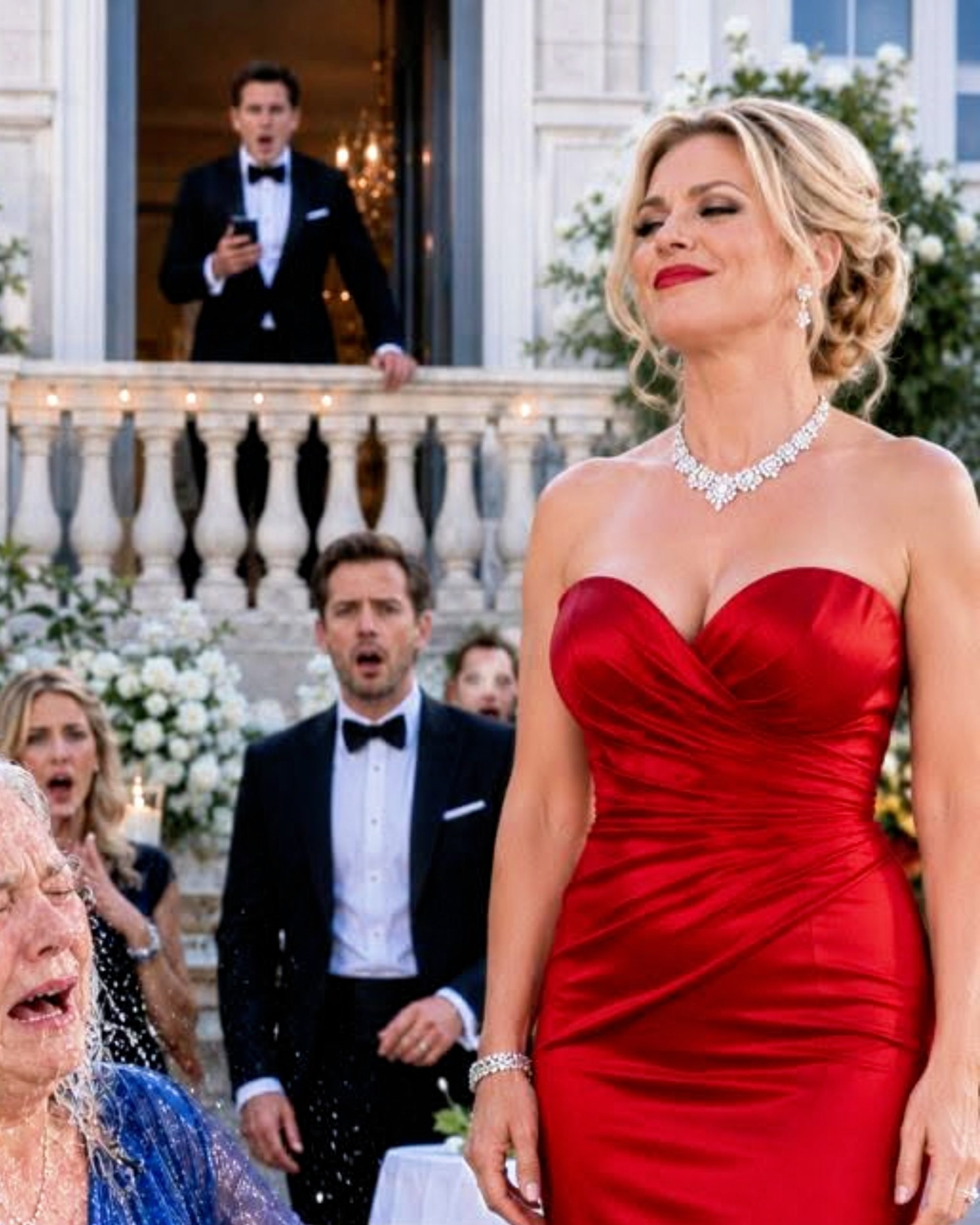
My fiancée shoved my mother into a fountain at our own engagement party because her dress did not match the photographs. Two hundred wealthy guests watched, and the woman I was supposed to marry laughed like my mother’s humiliation was part of the entertainment.
The splash swallowed the orchestra for half a second.
Then Celeste Monroe’s voice rose over the strings, bright and cruel.
“Your cheap clothes are ruining my aesthetic.”
Her friends laughed behind jeweled fingers, the kind of laughter people use when they know money has already protected them from consequences. Champagne glasses paused halfway to painted mouths. A waiter froze near the dessert table with a tray of gold-rimmed flutes. Even my future father-in-law, Victor Monroe, only looked toward the fountain long enough to decide whether the scene was bad for optics.
I stood on the balcony above them, one hand on the marble rail.
Below me, my mother, Elena, gripped the edge of the decorative fountain. Water ran down her face and neck. Her gray hair clung to her cheeks. Her blue dress, simple and carefully pressed, had turned dark and heavy against her body.
That dress had history.
She wore it the night I received my first business award, sitting in the back row because she was afraid her thrift-store heels would embarrass me. She had altered it three times herself, taking in the waist with the same patient hands that once scrubbed office floors at two in the morning so I could study under a working lamp.
Celeste saw me coming down the staircase and smiled before I reached the last step.
Not worried.
Not sorry.
Confident.
“Adrian, darling,” she said, smoothing one silver-gloved hand over her gown. “Your mother slipped.”
My mother lifted her eyes to mine.
She did not cry. She did not plead. She never had.
Not when we slept above a laundromat with rats scratching inside the walls. Not when rent was late and she sold her wedding ring for groceries. Not when rich men with soft hands told me boys from our block did not build companies. She had survived too much to beg for dignity in a room full of people renting theirs.
I removed my jacket and stepped into the shallow edge of the fountain.
The cold water soaked through my shoes.
I wrapped the jacket around her shoulders.
“Did you slip?” I asked.
The room seemed to hold its breath.
My mother’s fingers tightened once around my sleeve. Then she looked past me at Celeste.
“No,” she said softly.
One woman near the floral arch lowered her phone. A man near the bar stopped smiling. Somewhere behind me, a violinist missed a note.
Celeste’s face hardened.
“Oh, please,” she said. “She was crowding the photographs. This party cost three million dollars, Adrian. Standards matter.”
Victor Monroe gave a low warning cough, as if I were a dog being reminded not to bite at the dinner table.
“Son,” he said smoothly, “let’s handle this privately.”
Son.
I almost smiled.
Men like Victor only used family words when they wanted ownership.
Three hours earlier, in a private study upstairs, I had signed documents creating a ten-million-dollar trust in Celeste’s name, contingent on our marriage. It was meant to guarantee her independence. She had called it “a charming beginning,” like I had offered her a bracelet instead of security most people would never touch.
The papers were still in my attorney’s secure portal.
I reached into my pocket and pulled out my phone.
Celeste’s expression changed at once. Relief softened her mouth. She thought I was calling someone to remove my mother quietly, dry the floor, save the evening, protect the Monroe name.
Instead, I opened the secure thread with my chief counsel.
Liquidate the trust assets. Revoke her interest. Begin full audit of Monroe Holdings. Quietly.
I pressed send.
Celeste leaned closer, her perfume sharp over the smell of fountain chlorine.
“Do not make a scene,” she whispered. “You know what my family can do to your reputation.”
I looked at my mother standing under my jacket, water dripping from the hem of her dress onto imported marble.
Then my phone vibrated.
Done.
I slid it back into my pocket and turned toward Celeste, calm enough that the room leaned in to hear me.
“Get my mother a chair,” I said.
For a second, nobody moved.
That was the part that stayed with me later. Not the shove. Not the laughter. The hesitation.
Two hundred people in formalwear stood under chandeliers and waited to see which side was safer.
Then a young server stepped forward. He could not have been more than twenty-two. His hands trembled as he pulled a chair from a nearby table and set it behind my mother.
“Thank you,” I told him.
He nodded once and looked quickly at the floor, as if kindness itself might get him fired.
My mother sat down slowly, my jacket wrapped tight around her shoulders. The soaked blue dress clung to her knees. A single pearl button at her cuff hung loose by a thread, swinging whenever her hand shook.
Celeste noticed me looking at it.
“Oh, for God’s sake,” she snapped. “Are we really going to turn one wet dress into a tragedy?”
One of her bridesmaids, Talia, whispered, “Celeste.”
Celeste whipped her head toward her. “What?”
Talia took half a step back.
That small retreat told me everything. Celeste had not become cruel tonight. She had simply stopped hiding it from me.
Victor moved in with his polished smile, the one I had watched him use on senators, bankers, and reporters.
“Adrian,” he said, lowering his voice. “Emotions are high. Your mother is embarrassed. Celeste is embarrassed. Let’s not damage two families over a misunderstanding.”
“My mother is wet,” I said. “Celeste is embarrassed because witnesses exist.”
His smile thinned.
Across the room, people shifted. Silk rustled. Ice clicked in glasses. No one wanted to be caught listening, but no one wanted to miss the moment the billionaire from the wrong neighborhood remembered where he came from.
Celeste folded her arms. “You are being theatrical.”
I looked at her.
The woman I had planned to marry was beautiful in the way expensive things are beautiful under perfect lighting. Silver gown, diamond earrings, hair arranged in loose waves that had taken three stylists to make look effortless. But underneath it all, her face had the pinched irritation of someone whose property had spoken out of turn.
“My mother needs to go upstairs and change,” I said.
“Fine,” Celeste said. “Send someone with her.”
“I’m taking her.”
Her eyes widened. “During our engagement party?”
“Our engagement party ended when you put your hands on my mother.”
A few people inhaled at once.
Victor’s voice sharpened. “Careful.”
I turned to him. “I am.”
That was when Celeste laughed again, but there was no music in it this time.
“You think you can humiliate me in my own circle?” she said. “You may have money now, Adrian, but these people knew my family before anyone knew your name.”
“My name is on the building they’re standing in,” I said.
The silence after that was ugly and clean.
The hotel ballroom belonged to one of my companies. Celeste had chosen it because she liked the rooftop garden and the marble fountain. Victor had praised the venue all evening without once mentioning my ownership. In his world, money was acceptable only after it had aged long enough to stop smelling like work.
My mother touched my wrist.
“Adrian,” she said softly. “Take me home.”
Not upstairs.
Home.
Something in my chest tightened.
Celeste heard it too. Her eyes flashed, not with shame but with calculation.
“Elena,” she said, suddenly sweet. “I’m sorry you’re upset. But maybe this is also a lesson in boundaries. Tonight is about Adrian and me.”
My mother looked at her for a long moment.
Then she reached up and unfastened my jacket from around her shoulders. Her hand was still shaking, but her voice was steady.
“No,” she said. “Tonight showed me exactly who you are.”
Celeste’s cheeks colored.
Before she could answer, my phone vibrated again.
This time it was not my attorney. It was my head of security.
Need you in the west corridor. We found something.
I stared at the message.
Victor noticed.
“What is it?” he asked.
I did not answer him.
I helped my mother stand. “Stay with Daniel,” I said, nodding to my driver near the side entrance. “Do not leave with anyone else.”
She studied my face. Mothers know when sons are becoming dangerous. Not loud. Not reckless. Dangerous.
“Adrian,” she whispered.
“I’m not going to yell,” I said.
“That is what worries me.”
I kissed her forehead.
Her skin was cold from the fountain water.
As Daniel guided her toward the side corridor, Celeste stepped in front of me.
“Where are you going?”
“To check something.”
“We are not finished.”
“No,” I said. “We are not.”
I walked past her.
Behind me, her heels struck the floor in quick angry taps as she followed. Victor followed too. So did half the room, pretending not to. There is a particular kind of crowd that forms around public humiliation. Everyone tells themselves they are concerned, but they move like people smelling smoke.
The west corridor was quieter. The music faded behind us. Near a service door, my head of security, Marcus Reed, waited with a tablet in his hand and a look I had seen only twice in ten years.
Controlled disgust.
“What did you find?” I asked.
He glanced at Celeste.
She stopped walking.
“Say it,” I told him.
Marcus tapped the tablet. Security footage appeared from a camera angled over the fountain.
There was Celeste, smiling for photographs.
There was my mother, standing a few feet away, trying to step out of frame.
There was Celeste turning, saying something with that bright little smile.
Then her hand.
A deliberate shove to my mother’s shoulder.
Hard enough to send a sixty-four-year-old woman backward into marble and water.
The corridor went still.
Someone behind me whispered, “Oh my God.”
Celeste’s mouth opened.
Victor spoke first. “That footage is private property.”
I looked at him. “So is the hotel.”
His jaw worked once.
Celeste recovered quickly. She always did when the first lie failed.
“It was an accident,” she said. “I barely touched her.”
Marcus swiped again.
The video replayed. Slower.
Her hand. The shove. The laughter after.
No accident survives slow motion.
Talia stood in the corridor with one hand pressed to her throat. Her face had gone pale.
“Celeste,” she said. “You told us she tripped.”
Celeste turned on her. “Stay out of it.”
That was the mistake.
People can excuse cruelty when it is pointed downward. They call it stress, pressure, a misunderstanding. But when cruelty turns sideways, toward people who thought they were safe beside it, they start recalculating.
Talia stepped away from Celeste.
Then another friend did.
Then a man from Victor’s table slipped his phone into his pocket and moved toward the exit.
Victor saw the shift and changed tactics.
“Adrian,” he said, voice low and smooth again, “we can compensate your mother. Public apology, private settlement, whatever number makes this disappear.”
My mother had been pushed into a fountain in front of strangers, and he was trying to buy silence like he was replacing damaged linens.
I looked at Marcus. “Save copies.”
“Already done.”
Victor’s eyes hardened.
Celeste took one step closer to me. “You are not going to ruin me over this.”
“No,” I said. “You did that without my help.”
Her composure cracked.
“You owe me,” she hissed. “Do you have any idea how much I improved your image? Before me, you were just some aggressive investor with a sad childhood story. I made you acceptable.”
There it was.
Not anger.
Truth.
The sentence landed in the corridor like a glass dropped on stone.
I remembered the first charity dinner she took me to, how she corrected the way I held a wine glass. The first weekend at her family’s estate, when Victor asked whether my mother still worked “service jobs.” The way Celeste gently suggested Elena skip certain events because “some rooms are hard for people who aren’t used to them.”
At the time, I had mistaken polish for care.
Now I recognized training.
She had been trying to domesticate me.
I opened my phone again.
Celeste watched my thumb move across the screen.
“What are you doing?” she demanded.
“Checking the trust.”
Her expression flickered.
“You already signed.”
“I signed a conditional instrument.”
Victor went very still.
Celeste looked between us. “What does that mean?”
“It means no marriage, no trust.”
Her lips parted.
“And since you assaulted my mother before the marriage,” I said, “there is nothing for you to claim.”
“You can’t just take back ten million dollars,” she said.
“I didn’t take it back. I never gave it to you.”
Victor stepped forward. “Adrian, listen carefully. Monroe Holdings has business with three of your lenders. You start a war, and you will discover old families know how to close doors.”
I nodded.
“I was counting on you saying that.”
For the first time all night, Victor looked uncertain.
My attorney, Samuel Brooks, called before he could ask what I meant.
I put him on speaker.
“Adrian,” Samuel said, voice clipped. “Revocation is complete. Also, our preliminary review found irregularities in Monroe Holdings’ bridge financing. Related-party transfers, inflated collateral, and at least two shell vendors tied to Celeste’s discretionary accounts.”
Celeste went white.
Victor’s face lost its expensive warmth.
Samuel continued, “I recommend freezing all pending joint ventures immediately.”
“Do it,” I said.
Victor lunged for the phone. “This is privileged information.”
I lifted it out of reach.
“You threatened my reputation in a hallway full of witnesses,” I said. “Now everyone gets to hear what kind of reputation you were hiding behind.”
Celeste grabbed my arm.
Her nails dug into my sleeve.
“Adrian, stop.”
That was the first time she sounded afraid.
I looked down at her hand until she released me.
“Do not touch me again.”
She stepped back as if I had slapped her.
I had not raised my voice once.
That seemed to frighten her more than anger would have.
Behind us, guests were no longer pretending not to watch. Phones were visible now. Not raised high, not openly recording, but angled with the careful cowardice of people who wanted proof without involvement.
Victor saw it too.
His posture changed. Shoulders back. Chin lifted. The old-family armor sliding into place.
“Ladies and gentlemen,” he announced, turning to the corridor crowd, “this is a private family matter.”
A voice answered from the back.
“No, it isn’t.”
Everyone turned.
The young server stood there, the same one who had brought the chair for my mother. His face flushed red, but he held his ground.
He lifted one trembling hand.
“I saw her do it,” he said. “Mrs. Elena was trying to move away. Ms. Monroe pushed her.”
The silence after his words felt different.
Before, people had been waiting for power to tell them what had happened.
Now someone without power had told the truth.
Celeste stared at him with pure hatred.
“You’re fired,” she said.
Marcus stepped between them.
“He doesn’t work for you.”
The server swallowed.
I asked him his name.
“Ryan, sir.”
“Ryan,” I said, “you still have your job. And you have my thanks.”
His eyes shone for half a second before he looked away.
That was the moment the room finally turned.
Not all at once. Wealth rarely has the courage for sudden moral movement. It happened in inches.
Talia removed the diamond bracelet Celeste had given the bridal party and placed it on a side table. Another bridesmaid followed. Victor’s largest donor excused himself with a stiff nod. An older woman in emerald silk walked to my mother near the side corridor and offered her shawl.
Celeste watched her world loosen one clasp at a time.
“You’re all ridiculous,” she said, but her voice shook.
I turned to Marcus. “Have Daniel bring my mother to the private lounge. No one enters without my approval.”
Then I faced Celeste.
“The engagement is over.”
Her eyes flooded, but I knew better than to mistake that for remorse.
“You are embarrassing me,” she whispered.
“You pushed my mother into a fountain.”
“She looked like staff.”
The words came out before she could stop them.
Even Victor closed his eyes.
There are sentences no lawyer can repair.
I let the silence hold her.
Then I removed the engagement ring from my pocket. She had taken it off earlier to have it cleaned for close-up photographs, trusting that it would be returned to her before the toast. Twelve carats, custom cut, insured for more than the laundromat building my mother and I once slept above.
Celeste’s gaze locked onto it.
For the first time that night, she looked at something with real grief.
Not my mother.
Not me.
The ring.
I handed it to Marcus.
“Return it to the vault.”
Celeste made a small sound.
“Adrian.”
I walked away.
She followed me two steps, then stopped when no one followed her.
In the private lounge, my mother sat wrapped in a hotel robe, her wet blue dress folded carefully across a chair. Even after everything, she had smoothed it flat so it would not wrinkle.
That nearly broke me.
I knelt in front of her.
“I’m sorry,” I said.
She touched my face with one cold hand.
“For what?”
“For bringing you into that room.”
She shook her head. “You did not shame me. She tried to.”
Tried.
That one word steadied me.
For years, I had believed success meant building walls high enough that the past could not enter. But my past was sitting in front of me in a hotel robe, dignified after being humiliated, still worried about whether her dress could be saved.
“Mom,” I said, “I should have seen who she was.”
“You saw what you hoped she could be.”
I closed my eyes.
Outside the lounge, the party unraveled without us.
Contracts froze before midnight. By morning, Samuel’s audit had reached two banks, one federal investigator he trusted, and three board members at Monroe Holdings who had been waiting for a reason to stop pretending Victor’s books made sense.
The video of Celeste pushing my mother never came from me.
It came from someone in the crowd.
People always think silence means loyalty. Sometimes it just means better lighting is needed.
By noon the next day, Celeste’s friends had issued careful statements about being “disturbed by what they witnessed.” Victor called me seventeen times. I answered none of them.
Celeste came to my penthouse that evening wearing no makeup and a cream sweater chosen to make her look wounded.
Daniel did not let her past the lobby.
She left a voice message.
At first, she cried.
Then she blamed stress.
Then alcohol.
Then my mother.
By the end, she was herself again.
“You will never belong with people like us,” she said. “No matter how much money you make.”
I saved the message and sent it to Samuel.
Not because I needed revenge.
Because documentation had built my life, and documentation would protect it.
Three weeks later, Monroe Holdings collapsed under its own weight. Not because I attacked it, no matter what Victor told the papers. I simply removed my support, froze the deals tied to my companies, and let auditors look where Victor had spent years telling everyone not to look.
Celeste lost the trust before she ever touched it.
Victor lost lenders he thought were loyal.
Their circle, the one they believed would defend them forever, did what circles like that always do when money starts burning.
They stepped back and claimed they had smelled smoke all along.
My mother recovered quietly.
She refused interviews. She refused settlement offers. She refused every designer dress I tried to send her.
But one afternoon, I found her at her kitchen table with the blue dress spread in front of her. The pearl button was still hanging loose.
“I can have someone repair that,” I said.
She threaded a needle.
“I know.”
I sat across from her and watched her sew it back on herself.
Her hands were slower now, but steady.
When she finished, she held up the cuff and smiled.
“There,” she said. “Still mine.”
A month later, I hosted a dinner at the same hotel.
No orchestra. No champagne tower. No imported floral arch.
Just the employees who had worked that night, their families, and my mother at the center table in her blue dress.
Ryan was there too. I had promoted him to guest services manager after learning he had been covering shifts to help his younger sister through community college.
During dessert, my mother stood.
The room quieted immediately.
She looked uncomfortable with attention, but not afraid of it.
“I spent most of my life cleaning rooms I was not invited to sit in,” she said. “So tonight, I want to thank my son for finally giving me a chair.”
People stood before she finished.
This time, no one was pretending.
I looked at my mother beneath the warm lights, pearl button fastened, shoulders straight, and understood something success had almost made me forget.
The point had never been to enter their world.
The point was to build one where she could never be pushed aside again.