PART 1
The first sign that something was wrong wasn’t the conversation.
It was the cake.
For forty-seven birthdays, my late husband Walter had never forgotten one simple tradition. No matter how tight money became or how exhausted he was after work, he always came home with a coconut cake from the same neighborhood bakery. He believed love survived through the little rituals people refused to abandon.
Walter had been gone for two years.
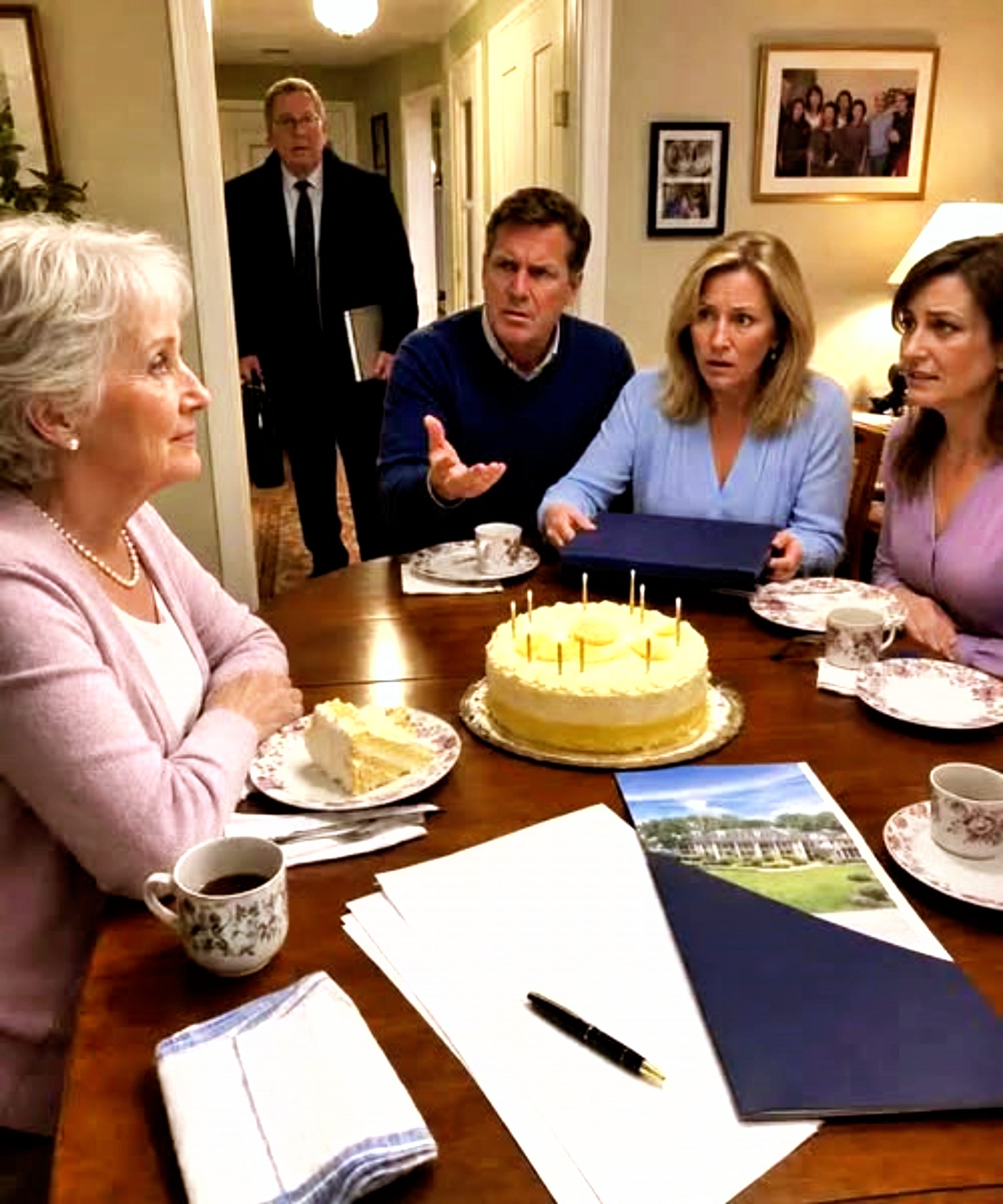
This birthday, my children walked into my dining room carrying a lemon cake.
Most people would call it a harmless mistake.
I knew it wasn’t.
Everything else on the table had been arranged with perfect care. The expensive glasses. The embroidered napkins. Even the seating felt deliberate. Then I noticed a blue folder resting beside the cake, positioned where I couldn’t possibly ignore it.
That was when I understood.
They hadn’t forgotten.
They had replaced the tradition because it reminded them of someone whose wishes stood in the way of theirs.
Patrick, my oldest son, sat confidently at the head of my table as though the house already belonged to him. His wife, Kendra, wore her usual sympathetic smile—the one she used whenever she planned to say something unpleasant while pretending it was kindness.
Across from me, my daughter Renee kept tapping the folder with one finger.
After everyone finished singing, Patrick cleared his throat.
“Mom, we need to discuss something.”
I smiled politely.
“Tonight? On my birthday?”
Kendra reached over and squeezed my hand.
“That’s exactly why we chose tonight. Families should handle difficult decisions together.”
I slowly pulled the brochure hidden beneath my dinner plate.
Golden Oaks Senior Residence.
A smiling elderly woman held a teacup beside a sunny window while the cover promised the perfect place for your next chapter.
I looked up.
“What exactly is this?”
Patrick leaned forward.
“It’s a wonderful community. We think you’d be happier there.”
“I asked what it is,” I replied. “Not whether you like it.”
Renee sighed dramatically.
“Please don’t make everything into an argument.”
Then came the speech they had obviously rehearsed.
I had supposedly become forgetful.
I missed medications.
Forgot appointments.
Left the stove on.
Needed help managing my finances.
Every sentence sounded polished.
Too polished.
“When did I forget my medicine?” I asked.
Patrick hesitated for only a second before answering.
“Last month.”
“No,” I said calmly. “I didn’t.”
Renee immediately interrupted.
“We’re not here to debate every little detail.”
That sentence told me everything.
People only dismiss details when the truth hides inside them.
For nearly six months, strange things had happened around my house.
Bills disappeared before mysteriously turning up somewhere else.
Appointments were blamed on me even though reminders had never reached my phone.
My reading glasses kept moving.
Once, my car keys vanished completely before reappearing exactly where I usually kept them.
The second time it happened, I noticed something different.
They were damp.
Someone had hidden them inside my freezer.
Then quietly returned them before I found them.
That wasn’t forgetfulness.
That was planning.
At first, I questioned myself.
Maybe I really had become absent-minded.
Maybe age was finally catching me.
For a few terrifying mornings, I doubted my own memory more than anything another person could possibly say.
But I had spent decades raising three children while managing a household on one income.
I knew what careful observation looked like.
And I knew when someone was trying to create a pattern that didn’t exist.
So instead of arguing…
I started documenting everything.
PART 2
The more evidence I collected, the clearer the picture became.
Every missing bill.
Every misplaced key.
Every accusation that I had forgotten something.
None of it happened by chance.
I wrote down dates, photographed my medication every morning before taking it, and recorded every unusual incident. Then I asked my longtime friend and neighbor, Marjorie Bell, for help.
Marjorie had spent thirty-five years as a schoolteacher.
She could spot dishonesty before most people finished telling the lie.
Together, we installed a small security camera overlooking my kitchen—the place where so many mysterious “accidents” seemed to happen.
“If someone is trying to convince you you’re losing your memory,” Marjorie said, “they’ll eventually forget they’re being watched.”
She was right.
The recordings showed exactly what I expected.
Someone moved my belongings.
Someone hid my bills.
Someone rearranged my kitchen while I wasn’t looking.
I saved every clip.
Then I scheduled appointments with two different specialists.
Both doctors performed complete cognitive evaluations.
Memory.
Reasoning.
Decision-making.
Every result came back normal.
I wasn’t losing my mind.
Someone wanted me to believe I was.
Back in the dining room, Patrick slid the blue folder closer.
“This is only temporary,” he insisted. “A power of attorney would let Renee and me help with your finances and medical decisions.”
“And the house?” I asked.
He answered too quickly.
“Only if it ever becomes necessary.”
There it was.
The real reason behind the birthday dinner.
Walter and I had bought this house more than forty years earlier. We raised our children here, celebrated holidays, buried beloved pets beneath the maple tree, and filled every room with memories.
To me, it was home.
To them, it had become equity.
I looked at the papers.
My name had already been typed across the top.
All they needed was my signature.
“No,” I said.
Patrick frowned.
“Mom… don’t make this difficult.”
“For who?”
Kendra forced another gentle smile.
“We’re trying to protect you.”
“If that’s true,” I replied, “why are these documents already prepared?”
No one answered.
The silence lasted only a moment before my nine-year-old grandson Caleb wandered into the dining room holding his tablet.
“Grandma,” he said innocently, “Mom told me after you move out, I can use the bedroom with the big window whenever we visit.”
The room froze.
Patrick immediately snapped.
“Caleb, go back to the living room.”
The poor boy looked confused.
I smiled warmly.
“It’s alright, sweetheart. Would you like another piece of cake?”
He glanced at the dessert.
“I don’t like lemon.”
I laughed softly.
“Neither do I.”
After he walked away, I turned back toward the adults.
“So,” I said quietly, “this wasn’t really a conversation. It was already decided.”
Patrick stood.
“You’ve become paranoid since Dad died.”
Then he used the one sentence he knew would hurt most.
“Dad would be ashamed of how you’re acting.”
For just a second, Walter’s name caught me off guard.
Then I remembered something far more important.
Walter had always planned ahead.
So had I.
I looked at the untouched lemon cake and smiled.
Patrick frowned.
“What’s so funny?”
“I was just thinking,” I answered calmly, “how strange it is that everyone forgot what kind of cake your father always brought me.”
Before anyone could respond…
The doorbell rang.
Patrick looked toward the hallway.
“Are you expecting someone?”
“Yes.”
“Who?”
“My witnesses.”
A moment later, Marjorie walked through the front door carrying a fresh coconut cake.
Walking directly behind her was attorney Lillian Graves, the lawyer who had handled Walter’s legal affairs for years.
Patrick’s confident expression disappeared instantly.
Lillian placed her briefcase on the table.
“Helen asked me to arrive at exactly seven-thirty,” she said calmly. “She believed her children might present legal documents during an emotional family gathering.”
No one said a word.
For the first time that evening…
The people who thought they were in control realized they weren’t.
PART 3
Lillian opened the blue folder and reviewed every page in silence.
Then she looked up.
“This is not simple support. These papers would give Patrick wide authority over Helen’s bank accounts, medical decisions, and the possible sale of her house.”
Renee whispered, “Only if necessary.”
Lillian turned to her.
“Who decides when it becomes necessary?”
No one answered.
That was when I pulled a red folder from the sideboard.
“The part you didn’t plan for,” I said.
Inside were my medical evaluations, bank alerts, property records, video evidence, and updated legal documents.
“I had two cognitive tests,” I told them. “I passed both. I also recorded what had been happening in my kitchen.”
Kendra shot to her feet.
“You recorded us?”
Marjorie set the coconut cake down.
“In her own kitchen,” she said. “Where people kept sneaking around like raccoons in jewelry.”
Patrick’s face darkened, but Lillian kept reading.
Then she placed one document on the table.
“Helen has updated her estate plan.”
The room changed instantly.
“My home is now protected,” I said. “I can live here as long as I choose. No one can force me out, sell it, or use my age against me.”
Patrick stared at me.
“What happens after you’re gone?”
Lillian answered.
“The property will go to the Whitcomb Community Library Fund, unless Helen chooses otherwise.”
Kendra’s first question was exactly what I expected.
“So we get nothing?”
I looked at her.
“You came here with lemon cake and a pen, hoping I would sign away my home at my own birthday party. What did you think would happen?”
Patrick tried once more.
“Dad would never have wanted this.”
This time, his father’s name didn’t hurt me.
“Actually,” Lillian said, “Walter suggested these protections before he died. He hoped Helen would never need them.”
Renee began to cry.
Patrick looked down.
Kendra said I had turned against my own family.
“No,” I replied. “You brought the trap. I brought witnesses.”
They left one by one.
After the door closed, I sat at my table beside the untouched lemon cake while Marjorie cut me a slice of coconut.
I was not okay.
But I was safe.
Over the next few weeks, everything uncomfortable began surfacing.
Golden Oaks sent a follow-up letter addressed to Patrick.
A real estate agent contacted me about my property.
My bank flagged an unfamiliar login attempt.
I forwarded everything to Lillian.
Patrick came back alone a month later, carrying the right cake this time.
He admitted the dealership was failing. He admitted he had looked at my life and imagined it could solve his problems.
I didn’t forgive him that day.
But I let him sit down for coffee.
Renee later sent a handwritten apology. She admitted she had been afraid of losing me after Walter, but she had let fear turn into control.
Kendra never apologized.
That didn’t surprise me.
Two years later, the county library opened the Walter Whitcomb Reading Room, funded in part with money Walter and I had saved for something meaningful.
There was a small bronze plaque near the door:
*Tradition is how love remembers.*
I still live in my house.
I still drink coffee on the porch.
And every year, I buy myself coconut cake.
Because at seventy-two, I have learned something important.
People may expect older women to become easier to move, easier to manage, easier to talk over.
But a woman who has spent her life running a home knows how to read a room.
She knows when concern has a price.
She knows when a smile hides a plan.
And she knows never to sign legal papers at her own birthday dinner.
Especially when they bring the wrong cake.