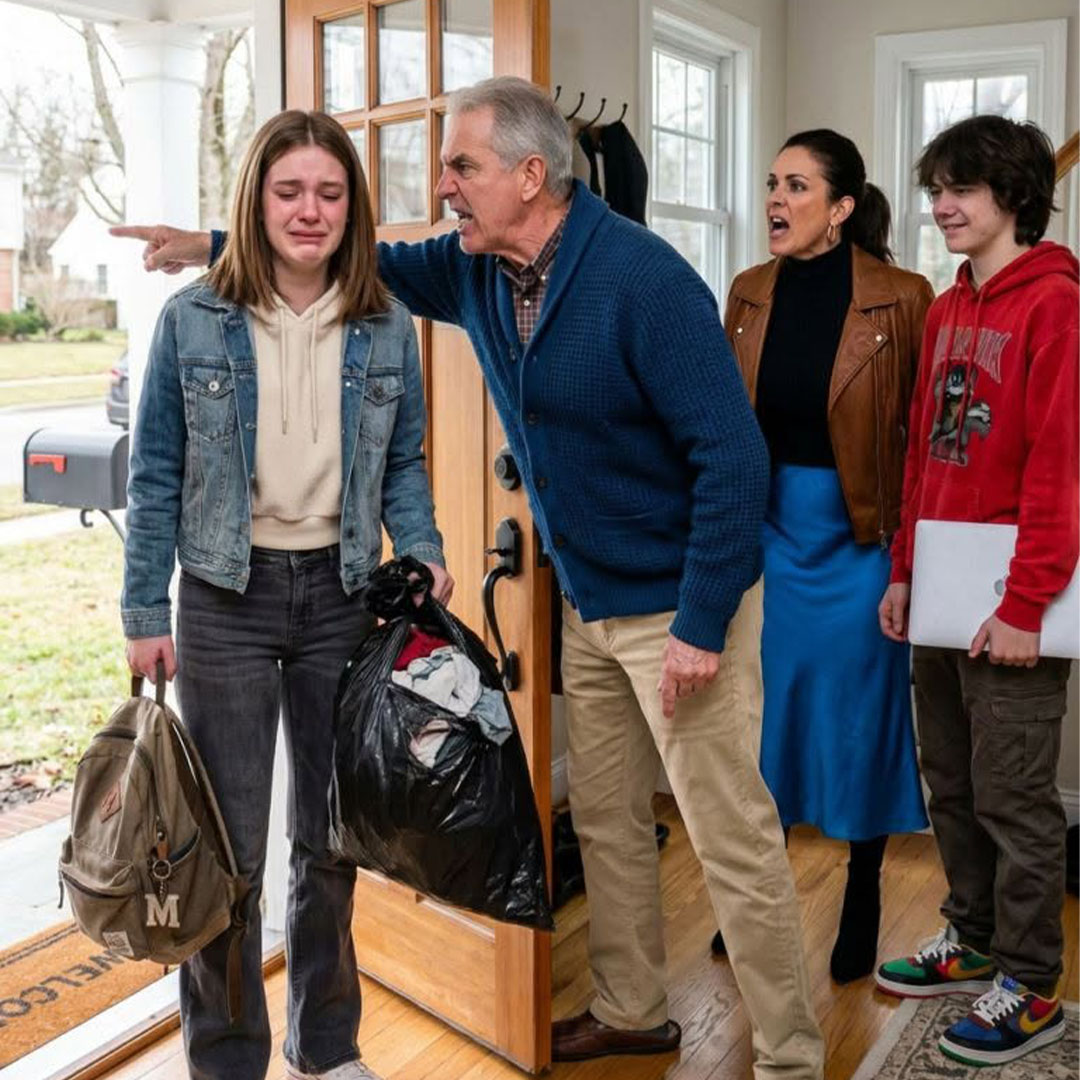
My father-in-law barked at my 16-year-old daughter, “Get out! Your room belongs to your cousin now,” and forced her into the night with nowhere to go. When my husband found out what his family had done, he sent them one message—and their lives began falling apart.
The night Daniel Mercer’s daughter was forced out of his father’s home, the air in suburban Ohio was cold enough to burn against her cheeks.
Sixteen-year-old Emma Mercer stood barefoot in the hallway, holding her school backpack tight to her chest as her grandfather, Richard Mercer, aimed one finger at the front door.
“Get out,” Richard barked. “Your room belongs to your cousin now.”
Emma stared at him, convinced she could not have heard him correctly. Behind him, her aunt Denise stood with her arms folded, her face unreadable, while Denise’s son, Cody, rested against the staircase with Emma’s old gaming headset already hanging around his neck.
“But Grandpa, Dad said I could stay here until he and Mom got back from Chicago,” Emma whispered.
Richard’s expression turned rigid. “Your father doesn’t run my house.”
Three days earlier, Daniel and his wife, Rachel, had gone to Chicago after Rachel’s mother suffered a stroke. Emma had remained with Richard because Daniel believed family meant protection. Richard had promised she would be safe.
Now her suitcase was open on the porch, half-filled by someone else’s hands. Her winter coat was nowhere to be found. Her charger was missing. The small silver necklace her mother had given her was twisted into a pile of clothes Cody had thrown into a trash bag.
Denise moved closer. “Cody needs stability. He’s had a rough semester. Your father can afford hotels. Call him.”
“My phone’s dead,” Emma said.
“Then walk to a gas station,” Richard snapped.
It was 12:43 a.m.
Emma looked at the framed pictures lining the wall. Her father at seventeen, grinning beside Richard. Her parents on their wedding day. Emma as an infant held in Richard’s arms. None of those photos shifted. None of them came to her defense.
When Richard pulled the door open, freezing wind swept into the house. Emma lifted her backpack and the trash bag of clothes. She wanted to scream. Instead, she stepped out onto the porch.
The lock clicked behind her.
For twenty minutes, she walked beneath streetlights, trembling so hard her teeth ached. At a closed pharmacy, she discovered an outdoor outlet and connected her phone with the emergency cable she always kept in her backpack.
When it powered on, she called her father.
Daniel answered on the second ring. “Em? What’s wrong?”
She heard the hospital machines beeping behind him. Then she fell apart.
By 2:10 a.m., Daniel had arranged a rideshare to take her to a hotel, contacted the police for a welfare report, and sent one message to the Mercer family group chat.
“You put my minor daughter out in the cold at midnight. You have thirty minutes to return every item you took from her room. After that, I will handle this legally, financially, and publicly. Do not test me.”
Richard read it.
Then their lives began to unravel.
Part 2
After that message, Daniel did not raise his voice again. That was what scared the family the most.
Richard expected his son to call screaming, to plead, to bargain, and eventually to cool down the way he always had after family fights. Daniel had spent nearly his entire life trying to earn his father’s approval. He had ignored insults, paid overdue bills, supported Denise after her divorce, and quietly covered Richard’s property taxes twice without telling Rachel.
But that night, Daniel went silent.
At 6:30 a.m., Emma sat wrapped in a hotel blanket while a police officer recorded her statement in the lobby. Her eyes were puffy from crying, but her voice stayed firm. She explained that her grandfather had ordered her to leave, that her aunt had helped remove her belongings, and that her cousin had taken the room she had been promised.
The officer’s face shifted when Emma said her phone had been dead and she had been made to walk alone at night.
By 8:00 a.m., Daniel had rented a car and left Chicago. Rachel stayed at the hospital with her mother, furious and shaking, calling Emma every hour until Daniel reached her.
Meanwhile, Richard attempted to appear unaffected. He drank coffee at his kitchen table while Denise paced beside him.
“He’s bluffing,” Richard said.
Denise glanced toward the stairs, where Cody was still asleep in Emma’s room. “Daniel has money, Dad.”
“He won’t use it against family.”
But Daniel already had.
The first call was to the attorney who handled his small construction company. The second was to the bank. The third was to Richard’s homeowner’s insurance agent, because Daniel’s name remained listed as guarantor on a renovation loan Richard had taken out two years earlier.
By noon, the bank had frozen Richard’s line of credit pending review.
By two, Denise received an email from Daniel’s company accountant. The monthly “family assistance” payments he had been sending for Cody’s private tutoring and her car note would end immediately.
By four, Richard received certified notice that Daniel was ending all informal financial support arrangements and requesting records for every dollar previously described as “temporary help.”
Then came the final hit.
Daniel arrived at Richard’s house at 6:15 p.m. with two police officers, Emma beside him, wrapped in a new coat. He did not enter until Richard opened the door.
“You brought cops to my home?” Richard growled.
Daniel looked directly at him. “No. I brought witnesses.”
Emma went upstairs with one officer while Daniel remained in the foyer. Cody tried to stand in front of her bedroom door, but the officer told him to move. Inside, Emma found her diary beneath Cody’s pillow, her jewelry box open, and her laptop missing.
Denise turned pale.
“Where is it?” Daniel asked.
Cody muttered, “I borrowed it.”
“No,” Emma said, her voice cracking. “You stole it.”
That word hit the room hard.
Daniel faced Richard. “You gave away my daughter’s room. You let her belongings be searched. You sent her into the street. Now you’re going to learn the difference between family loyalty and evidence.”
Richard’s jaw clenched, but for the first time, he said nothing.
PART 3
The laptop was discovered in Cody’s backpack, beneath several comic books and a hoodie that still had its store tag attached. He insisted he had only taken it because Emma “never used it anyway,” but Emma’s school files, personal photos, and messages were stored on it. Daniel did not argue. He photographed everything. So did the officer.
Denise started crying in the hallway.
“He’s a kid,” she said. “Don’t ruin his life over a laptop.”
Daniel looked at her with a calmness that only made her cry harder.
“My daughter is a kid,” he said. “That didn’t stop you from putting her outside at midnight.”
Richard struck the banister with his palm. “Enough. You’re not dragging this family through the mud.”
Daniel turned slowly. “You already did.”
For years, the Mercer family had revolved around Richard’s anger. He yelled, and people adjusted. He demanded, and people paid. He chose who mattered most, and everyone else learned how to live around that choice. Daniel had always been the dependable son, the one with a steady business, a patient wife, and a habit of cleaning up every disaster Richard and Denise caused.
That Daniel disappeared on the phone with Emma, while his child stood alone outside a closed pharmacy in the cold.
Emma collected what was left of her belongings. Her hands trembled when she touched the necklace her mother had given her, but she clasped it around her neck by herself. She did not look at Cody. She did not look at Denise. When she passed Richard, he tried to speak.
“Emma, you know I didn’t mean—”
“Yes, you did,” she said.
The foyer fell silent.
Daniel rested one hand on her shoulder and guided her outside.
Over the following week, Richard’s house filled with ringing phones and sealed envelopes he refused to open. The bank wanted updated income information. The renovation loan, which Daniel had guaranteed because Richard had once insisted it was “just paperwork,” had suddenly become a crisis. Without Daniel’s cooperation, refinancing was impossible.
Richard had retired early and lived mostly on a pension, pride, and Daniel’s quiet help. He had told neighbors he was doing well. He had told Denise she and Cody could move in because “Daniel owed the family.” But the numbers told another story.
Denise’s troubles arrived faster.
Her car payment bounced first. Then Cody’s tutoring center called about unpaid balances. Then the private school emailed to say his account was overdue. Denise had assumed Daniel’s monthly transfers would go on forever. She had built her life on money she never admitted she was receiving.
When she called Daniel, he answered only once.
“You can’t just cut us off,” Denise said.
“I can,” Daniel replied.
“Cody needs support.”
“So did Emma.”
“She had a hotel!”
“She had a hotel because I answered the phone. What was your plan if she couldn’t reach me?”
Denise had no reply.
Daniel ended the call.
Richard tried a different route. He called Rachel.
Rachel was standing in her mother’s hospital room when his name appeared on her screen. She stepped into the hallway and answered in a voice colder than Richard had ever heard from her.
“You have five minutes,” she said.
Richard released a heavy sigh, as though he were the one who had been harmed. “Rachel, this has gone too far. Daniel is angry, and I understand that, but he’s punishing everyone. Families don’t do this.”
Rachel looked through the glass at her sleeping mother. She thought of Emma walking alone beneath streetlights. She thought of Richard eating breakfast the next morning like nothing had happened.
“Families don’t throw sixteen-year-old girls out at midnight,” she said.
“I was frustrated. Cody needed space. Emma was being dramatic.”
Rachel’s breath caught. “She was afraid.”
“She’s fine now.”
“No, Richard. She is safe now. That is not the same thing.”
He tried to cut in, but Rachel kept going.
“You will not call Emma. You will not visit our house. You will return anything still missing. And if you tell one person that my daughter lied, I will make sure they see the police report.”
Richard hung up first, but his hands were shaking.
Two days later, the story reached the extended family. Not through Daniel, at least not at first. Cody complained to a cousin online that Emma had “snitched” and gotten everyone into trouble. The cousin asked questions. Cody, angry and careless, admitted enough. Screenshots moved faster than apologies.
Aunt Marlene called Richard and asked whether it was true.
Richard said Emma had been disrespectful.
Marlene asked, “Was she put outside after midnight?”
Richard said, “That’s not the point.”
Marlene replied, “That is exactly the point.”
By the end of the week, Thanksgiving plans had been canceled. A niece removed Richard from a family reunion group chat. Denise’s ex-husband, Mark, heard about the laptop and requested an emergency custody review, arguing that Cody’s living situation was unstable and that Denise had encouraged harmful behavior. Denise called Daniel repeatedly, but he did not pick up.
Then Richard made the mistake that changed everything.
He went to Daniel’s house.
It was a Saturday morning. Emma was in the kitchen with Rachel, making pancakes for the first time since everything happened. She had hardly slept all week. Every nighttime sound made her sit upright. She kept her phone charged beside her pillow. Daniel had installed a new lock on her bedroom door, not because she needed protection from him, but because she had asked for it.
When the doorbell rang, Emma froze.
Daniel checked the camera and saw Richard on the porch in his dark wool coat, his face red from the cold.
Rachel moved Emma behind her instinctively.
Daniel opened the door but did not invite him in.
“You need to stop this,” Richard said.
Daniel stepped onto the porch and shut the door behind him. “You need to leave.”
“I am your father.”
“And I am hers.”
Richard’s expression flickered.
For a moment, Daniel saw the old pattern trying to return. Richard expected obedience. He expected guilt. He expected the son he had trained to swallow insults and call it respect.
But Daniel did not step aside.
Richard lowered his voice. “You’re embarrassing me.”
Daniel almost laughed. Not because it was funny, but because after everything, that was still the thing Richard cared about most.
“You embarrassed yourself,” Daniel said.
“I made one decision.”
“You abandoned a child.”
Richard glanced toward the window, where he could see a narrow glimpse of Emma’s face before Rachel gently pulled her away.
“She’s turning you against me,” Richard said.
That was when Daniel’s calm finally cracked, not into yelling, but into something heavier.
“Say that again, and this conversation ends with another police report.”
Richard stared at him.
Daniel continued, “Emma did not turn me against you. You did that when you chose Cody’s comfort over her safety. Denise did that when she watched. Cody did that when he stole from her. Every consequence you’re facing belongs to the person who earned it.”
Richard swallowed. His anger faded just enough for fear to appear.
“The bank called,” he said. “They may force the sale.”
Daniel’s face remained unchanged.
“I know.”
“You’d let me lose my home?”
“You made it clear it was your house when you threw my daughter out of it.”
Richard seemed older then. Smaller. But Daniel did not confuse that with remorse. Richard was not grieving what he had done to Emma. He was grieving what it had cost him.
“I need help,” Richard said.
“No,” Daniel replied. “You need accountability.”
He went back inside and locked the door.
Within two months, Richard put the house up for sale. The renovation loan and unpaid bills made keeping it impossible. Denise and Cody moved into a two-bedroom apartment across town after Mark won temporary primary custody during the school week. Cody had to formally return Emma’s laptop, apologize in writing, and complete community service through a juvenile diversion program after Daniel agreed not to pursue harsher consequences as long as Cody complied.
The apology letter arrived in a plain envelope.
Emma read it once.
Cody wrote that he was sorry for taking her things and for laughing when she left. He said he had believed the room should belong to him because his mother told him Daniel’s family had “more than enough.” He admitted he had heard Richard tell Denise Emma was “too soft” and needed to learn that family did not revolve around her.
Emma folded the letter and placed it in a drawer.
She did not forgive him that day.
No one asked her to.
That was one of the first decisions Daniel and Rachel made together. Emma would not be pushed into healing on anyone else’s timeline. She began therapy in January. She changed her phone wallpaper to a photo of the three of them at Lake Erie. She painted her bedroom deep blue and placed a small brass sign on her desk that Rachel bought for her. It said: Safe Here.
Spring arrived slowly.
By April, Emma joined the school newspaper. Her first article was about student safety during family emergencies. She did not identify herself. She did not name Richard. But Daniel cried when he read it in the school parking lot.
One evening in May, Emma found him in the garage sorting through old boxes. He was holding a photo of himself as a teenager, standing beside Richard in front of the same house that was now sold.
“Do you miss him?” Emma asked.
Daniel took a slow breath. “I miss who I needed him to be.”
Emma leaned against the workbench. “That’s not the same.”
“No,” Daniel said. “It isn’t.”
She stayed quiet for a moment. “Do you regret cutting them off?”
Daniel looked at his daughter. She was taller than Rachel now, with tired eyes that were beginning to brighten again. She still checked the locks at night, though not every night. She still hated sudden shouting, but she laughed loudly when something was funny. She was healing in fragments, and every fragment mattered.
“No,” Daniel said. “I regret not doing it sooner.”
Emma nodded, as though that answer settled something inside her.
The family did not become whole again the way people expect around holidays. Richard moved into a small rental outside Dayton. Denise worked two jobs and stopped posting about loyalty on social media after too many relatives asked what she meant by loyalty. Cody, away from his mother’s constant excuses, started behaving better at Mark’s house, though Emma kept her distance.
Daniel did not rejoice in their downfall. He simply stopped holding it back.
That was the part no one in the Mercer family had understood. Daniel had not wrecked their lives out of revenge. He had only taken away the money, silence, protection, and forgiveness that had been keeping their bad decisions suspended above the ground.
Without those things, everything landed exactly where it had always been headed.
On Emma’s seventeenth birthday, Rachel baked a lemon cake, and Daniel gave Emma a new laptop. Inside the box was a note.
“No one gets to decide where you belong except you.”
Emma read it twice, then hugged him so tightly he closed his eyes.
Later that night, after her friends had gone home and the kitchen was quiet, Emma stood near the front door. Snow was falling again, soft and soundless beneath the porch light. For one second, she remembered the cold street, the dead phone, and the locked door behind her.
Then Daniel appeared beside her.
“You okay?” he asked.
Emma looked at the lock, then at the warm hallway behind her.
“Yeah,” she said. “I’m home.”
And this time, no one could make her leave.