Part 1:
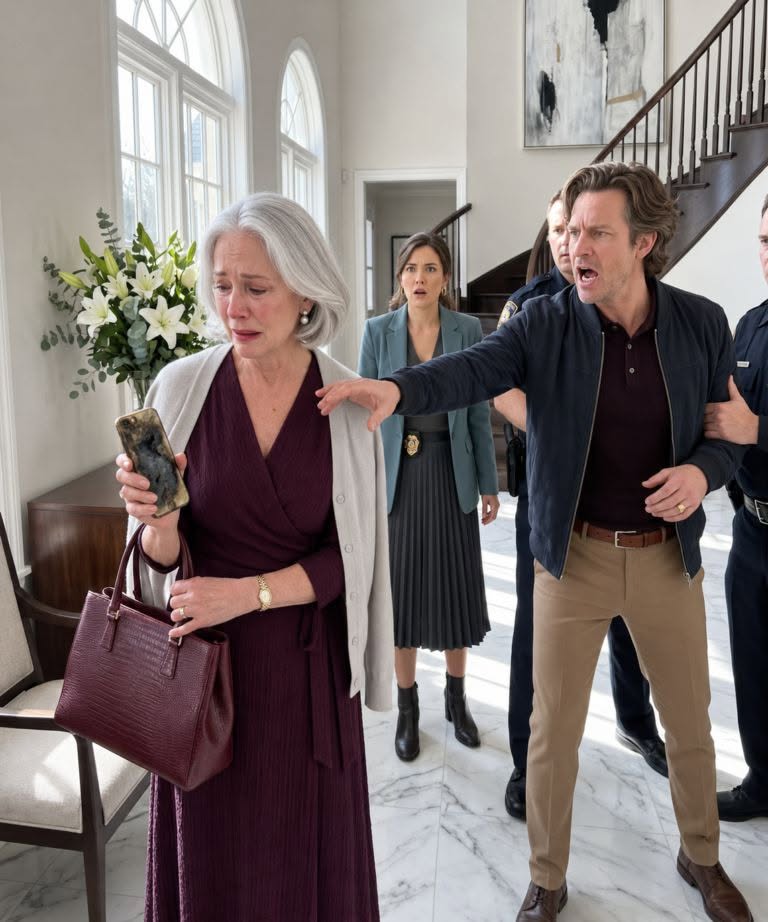
My son, Miles Carter, gripped my arm as if I were too frail to stand on my own. Then he looked at the detectives in my foyer and said calmly, “My mother killed my father for the inheritance.”
I lowered my gaze and let him enjoy his little stage.
Detective Nora Bell stood near the entrance of Carter House, rainwater dripping from her coat onto the marble floor my husband had chosen nearly three decades earlier. Two officers stood behind her, watching me with the cautious expressions people often reserve for wealthy widows.
They expected secrets.
Miles was ready to give them some.
“My mother has not been well for years,” he said in a soft, wounded voice. “My father planned to change his will before the accident. She found out. Then the lake house burned down with him inside.”
Detective Bell studied him. “Your father died thirty years ago.”
Miles swallowed at just the right moment. “Some crimes take decades to uncover.”
I finally looked at him.
He was forty-two now, with gray beginning to touch his temples, yet he still wore the same injured expression he had perfected as a child whenever he broke something and blamed the staff. He had his father’s blue eyes, but none of his kindness.
Detective Bell turned toward me. “Mrs. Carter, did your husband ever tell you he intended to change his will?”
“Yes,” I said.
Miles blinked.
He had expected denial.
“He told me many things before he died,” I added.
The detective’s eyes narrowed. “What kind of things?”
I reached into my purse.
Miles’s hand tightened around my arm. This time, it was not support. It was a warning.
From my purse, I removed an old black phone sealed inside a plastic evidence sleeve. The screen was cracked, the edges darkened by fire. For thirty years, it had been locked away in a safe-deposit box beside a cassette tape, several photographs, and a letter I had written to myself on the night my husband died.
Miles stared at it.
For the first time that morning, he looked afraid.
“This was my husband’s phone,” I said. “It was recovered near the boathouse before the fire reached the main cabin.”
“That’s impossible,” Miles whispered.
Detective Bell took it carefully. “You kept this for thirty years?”
“I was waiting.”
“For what?”
I looked at my son. “For the day he accused me.”
Miles forced a laugh, but it sounded thin. “This is ridiculous. She could have put anything on that phone.”
“No,” I said. “Your father did.”
The detective connected the phone to a portable forensic battery. The screen flickered once, then again. A voicemail notification appeared.
Miles took one step back.
Detective Bell pressed play.
My husband’s voice filled the foyer, rough with smoke and panic.
“Eleanor, if you hear this, don’t trust Miles. He locked me in. He said no one would believe a nine-year-old could plan it. He was wrong.”
The entire house went silent.
Miles did not move. His face stayed arranged in the same wounded mask he had shown the police, but his jaw began to tremble.
“That is not my father,” he said.
Detective Bell replayed the message.
Again, Thomas’s voice came through the static.
“Eleanor, if you hear this, don’t trust Miles. He locked me in. He said no one would believe a nine-year-old could plan it. He was wrong.”
One officer looked at Miles.
The other looked at me.
I had imagined this moment for thirty years. In my imagination, truth arrived clean and powerful. Real life was much uglier. It arrived through an old burned phone, a rain-soaked foyer, and a detective with tired eyes.
Miles finally spoke. “She made him record that before she killed him.”
“He says your name,” Detective Bell said.
“He was confused.”
“You just said it was not his voice.”
Miles snapped, “I said she faked it.”
“No,” I said quietly. “You said it was impossible.”
He turned toward me, and hatred flashed across his face.
“You should have kept quiet,” he said.
“I did,” I replied. “For thirty years.”
Detective Bell looked at me. “Why didn’t you bring this to the police when it happened?”
“Because Miles was nine.”
“That does not explain hiding evidence.”
“It explains a mother making the worst mistake of her life.”
Miles gave a bitter laugh. “There. She admits it.”
Part 2:
“I admit I loved you,” I said. “That was my mistake.”
His expression changed for one brief second. The boy inside him surfaced—not innocent, never innocent, but furious that I had mentioned love in front of strangers.
I continued, “Your father called me that night before the line went dead. He told me you had taken the key. He told me you were outside the lake house, watching him through the window. I drove there as fast as I could. By the time I arrived, the boathouse was already burning.”
“You left him there,” Miles said.
“No,” I answered. “You did.”
Detective Bell stopped writing.
Miles moved toward me. One officer immediately stepped closer.
I opened my purse again and removed a brittle cream envelope with my name written across the front in Thomas’s handwriting.
“This is what your father wanted to discuss that weekend,” I said. “He had realized you were not just lying, stealing, or misbehaving. You were hurting people and enjoying it. He had spoken to a child psychiatrist. He wanted to get you help.”
Miles’s eyes hardened. “He wanted to throw me away.”
“He wanted to save you.”
“He loved you more.”
There it was.
Not grief.
Not justice.
Not inheritance.
A child’s jealousy had survived inside a grown man for three decades, feeding on money, silence, and resentment.
Detective Bell took the envelope. “This needs to be entered into evidence.”
Miles straightened his jacket, forcing his mask back into place. “You have an old phone, an old letter, and the story of an aging woman. That is all.”
“No,” I said. “There is one more thing.”
He froze.
From the side pocket of my purse, I removed a small silver recorder.
Miles stared at it.
“You accused me in my sitting room before the police arrived,” I said. “You explained exactly how you planned to destroy me. How you found an investigator to reopen the fire. How you spread rumors with the estate board. How you intended to have me declared incompetent once I was arrested.”
Detective Bell looked at the recorder. “Is it recording now?”
“It has been recording since breakfast.”
Miles lunged.
The officers caught him before his hands reached me.
The first sound he made was not a shout. It was a laugh.
Small at first.
Then louder.
It echoed through the foyer and seemed to shake every ghost Carter House had kept hidden for thirty years. Detective Bell stepped back, alert now in the way experienced detectives become when a mask finally slips.
“You recorded me?” Miles asked.
“Yes.”
“You let me talk?”
“I have been letting you talk since you were five.”
His laughter stopped.
The officers held him firmly, but he no longer struggled. He only stared at me, breathing hard, his expensive hair falling across his forehead. In that moment, he did not look like a businessman or a grieving son. He looked like the little boy I had once found behind the greenhouse with a dead bird in his hand and a perfect excuse already prepared.
Detective Bell held out her hand. “Mrs. Carter, the recorder.”
I gave it to her.
Miles turned to the detective. “That was a private conversation. She manipulated me.”
“We’ll let the district attorney decide that,” Bell said. “For now, you accused your mother of murder, and we have evidence contradicting your statement.”
“My father’s death was ruled accidental.”
“And you just tried to take evidence from her by force.”
“I was upset.”
“You were quick.”
His mouth closed.
Bell nodded to one of the officers. “Read him his rights.”
As the officer began, Miles stared only at me.
“You think this ends with me in handcuffs?” he asked.
“No,” I said. “I think this began when you watched your father die.”
For the first time, something like pain crossed his face.
Not remorse.
Only pain at being seen.
They took him into the library while Detective Bell remained with me in the foyer. Outside, the rain grew heavier. Through the closed doors, I could hear Miles speaking again, his voice steady and polished. He was already building a new version of the truth.
Detective Bell watched me carefully. “This will not be simple.”
“I have not had a simple day since 1996.”
“Why now?”
“Because he came for me.”
“You could have gone to the police years ago.”
“I tried.”
Her expression shifted.
I looked toward the staircase, where family portraits lined the wall. Thomas Carter stared down from the largest frame, wearing a navy suit and a hopeful smile. The artist had made him look softer than he was. Thomas had been kind, but he was not weak. He built homes, donated to hospitals, remembered birthdays, and refused to believe evil could sit at his own breakfast table eating pancakes.
“After Thomas died,” I said, “I told the county sheriff about the call. I told him Thomas said Miles had locked him in.”
“What happened?”
“He asked if I had been drinking. Then he asked if I understood what shock could do to a grieving woman. Then he told me no jury would believe a nine-year-old boy carried gasoline from the toolshed, jammed a chair under a door handle, and stood outside while his father died.”
Bell looked down at the phone. “But the voicemail—”
“The phone disappeared before investigators finished searching the scene. I found it two days later in an old rain barrel behind the boathouse. Miles must have thrown it there when he panicked.”
“And you hid it.”
“Yes.”
“Why?”
I could have lied.
I had spent most of my life lying through silence.
But once truth enters a room, it does not like being asked to wait outside.
“Because when I found the phone, I also found Miles sitting inside Thomas’s closet, wearing his father’s watch. He looked up at me and said, ‘Now you only have me.’”
Detective Bell said nothing.
“I was not brave,” I continued. “I was terrified. I had already lost my husband. I thought if I gave them the phone, I would lose my child too. Maybe not to prison, because he was only nine, but to doctors, courts, headlines, institutions. I thought I could manage him. Watch him. Love him into becoming human.”
The detective’s face softened briefly, but she did not let sympathy replace duty.
“Did he hurt anyone else?” she asked.
I closed my eyes.
Memories came quickly: a stable boy thrown from a horse after a saddle strap was cut; a classmate whose scholarship letter vanished; a college girlfriend who once called me in fear, then denied everything the next morning; Miles’s business partner, Julian Voss, who drowned after accusing him of moving money through shell companies.
“Not always in ways I could prove,” I said.
Bell understood. “We will need names.”
“You will have them.”
From the library, Miles’s voice rose.
“This is elder abuse. My mother is confused. Ask her doctors. Ask her lawyer. She has been paranoid for years.”
Detective Bell opened the library door.
Miles sat at the long walnut table where Thomas used to review blueprints. His hands were cuffed in front of him now. His face was controlled, but his eyes moved too fast. One officer stood near the window. Another photographed the phone, the envelope, and the recorder.
Bell pressed play.
My voice came first, thin and tired.
“You don’t have to do this, Miles.”
Then his voice, calm and almost amused.
“I do. The board is nervous. The foundation trustees still listen to you. As long as you are alive and competent, I am just your son instead of Carter Holdings.”
“You already have money,” I said on the recording.
“I have allowances disguised as executive pay.”
“You have more than most people could spend in several lifetimes.”
“And still less than what should be mine.”
On the recording, I asked, “So you will tell the police I killed your father?”
Miles laughed softly.
Part 3:
“I will tell them what they already want to believe. Rich wife. Dead husband. Fire. Estate. Hidden grief. The story writes itself.”
“And if I defend myself?”
“You won’t. You never did. You will lower your eyes, like always. People mistake silence for guilt, Mother. That has always been your most useful quality.”
The room remained frozen as the recording continued.
“You killed him, Miles,” my recorded voice said.
There was a pause.
Then Miles answered, lower this time.
“He was going to send me away.”
“You were nine.”
“I was old enough to understand betrayal.”
“He was your father.”
“He chose you.”
Three slow taps sounded in the background. His spoon against his coffee cup.
“He screamed for a while,” Miles said on the recording. “That surprised me. I thought the smoke would make him sleep. But he shouted your name first. Then mine. Mine sounded better.”
One officer cursed under his breath.
Detective Bell stopped the recorder.
Miles stared at the table.
Some confessions come from guilt. Others come from pride. Miles had never been able to resist correcting the record. He needed someone to know he had chosen, planned, and won.
That need had always been stronger than caution.
Bell leaned over the table. “Miles Carter, you are under arrest pending investigation into the homicide of Thomas Carter and related offenses.”
Miles slowly raised his head. “You think that recording saves her?”
“It helps.”
“My lawyers will destroy it.”
“They can try.”
Then he looked at me. “Tell her.”
I stayed silent.
“Tell her about the settlement with the stable boy’s family. Tell her about the college girl. Tell her about Julian. Tell her how you paid people, called attorneys, and cleaned up after me. Tell her what kind of mother you really were.”
The words struck cleanly.
Detective Bell turned toward me.
Miles smiled. “There she is. Saint Eleanor, with blood under her rings.”
I walked closer to the table. The officers shifted, but Bell allowed it. I stopped across from my son.
“You are right,” I said.
His smile faded.
“I paid people who should have gone to the police. I believed families could be repaired with money and silence. I let your name open doors after you had slammed them on others. I told myself I was preventing scandal. Then I told myself I was protecting you. Eventually, I stopped telling myself anything at all.”
Miles watched me carefully.
“But I did not kill your father,” I said. “And I will not bury another truth for you.”
His eyes narrowed. “You will bury yourself with me.”
“Probably.”
That surprised him more than anything.
I turned to Detective Bell. “There is a gray ledger in the wall safe behind Thomas’s portrait. The code is 0917, our anniversary. It contains payments, names, dates, and attorneys involved. Some of those records implicate me.”
Bell held my gaze. “Do you understand what you are saying?”
“Yes.”
Miles slammed his cuffed hands against the table. “Shut up.”
The sound cracked through the room.
For thirty years, those two words had ruled Carter House.
Shut up, Mother.
Do not say his name.
Do not look at me like that.
Do not make me remember.
I had obeyed in a thousand quiet ways.
I was done.
Detective Bell sent an officer to Thomas’s portrait. He lifted the frame, opened the hidden panel behind it, and found the safe. Inside were ledgers, photographs, old evaluations, bank copies, legal letters, and a sealed folder marked J.V.
Julian Voss.
Miles’s face lost its color.
Bell opened the ledger with gloved hands. She read only one page before closing it. Her expression did not show shock. It showed confirmation.
“This house is now part of an active investigation,” she said.
Miles whispered, “Mother.”
The word sounded almost pleading.
I looked at him, and for one strange second, I saw every version of my son at once: six years old with a fever, refusing medicine unless I promised Thomas would not leave; nine years old with soot on his cuffs, claiming he had been asleep; twenty-one, charming donors at a gala while a frightened girl stood across the room.
“Yes,” I said. “I am.”
That was the last private thing I gave him.
They walked him out through the front doors. Rain struck his face and darkened his suit. Reporters had already gathered beyond the gates. Cameras flashed through the iron bars.
Before entering the cruiser, Miles turned back toward the house.
I knew that look.
He was not asking for forgiveness.
He was calculating.
Even in handcuffs, even with his own voice preserved on tape, he was searching for a future where someone else paid.
Then Detective Bell guided him into the back seat.
The door closed.
The sound was small, but it moved through me like the end of a long season.
Over the next seven months, Carter House became a map of buried crimes. Detectives searched the lake property where Thomas had died. Fire specialists reconstructed the scene and found what the original investigation had missed: marks near the back door lock, signs of an accelerant pattern that did not match an accident, and a melted key ring beneath collapsed floorboards outside the room where Thomas had been trapped.
The voicemail was authenticated. Thomas’s voice matched old business recordings. The phone showed no sign of later tampering. The sitting-room recorder triggered a legal battle, but it led investigators to evidence that could stand on its own.
The ledger did more damage than anything.
It opened doors I had kept locked for decades.
Aaron Pike, the former stable boy, testified that Miles had threatened him after the riding accident and that my attorney had offered his family money before they could ask questions. Rebecca Lyle, the college girlfriend, gave a sealed statement about years of intimidation. Julian Voss’s widow produced emails showing her husband had planned to report Miles for financial crimes days before he drowned.
Not every accusation became a charge. Life rarely arranges justice neatly. Some witnesses were gone. Some evidence had vanished with time. Some people had accepted money and built new lives they did not want dragged back into court.
But Thomas’s murder held.
The trial was moved to Baltimore because the Carter family’s influence in our county was too strong. Miles arrived each day in dark suits, wearing humility like another costume. His defense called me controlling, unstable, and desperate to protect my reputation. They brought in experts to discuss memory, trauma, age, and grief. They asked why any mother would hide evidence for thirty years unless she had something to hide.
I answered.
“Because I was ashamed,” I said on the stand.
The prosecutor asked, “Ashamed of what?”
“Of loving my son more than I loved the truth.”
Miles did not look at me.
He was convicted of second-degree murder, evidence tampering, and obstruction connected to Thomas’s death. Later financial investigations added years to his sentence. He did not give people the dramatic ending they expected. No apology. No breakdown. No final confession.
When the judge asked if he wished to speak, Miles stood, buttoned his jacket, and said, “My mother has always needed an audience. I hope she enjoyed this one.”
Then he sat down.
That was Miles.
Even defeated, he tried to leave a stain.
As for me, I did not walk away clean. The ledger made certain of that. I was charged for concealing evidence and for my role in earlier cover-ups. My attorneys advised silence, strategy, careful wording.
I ignored most of it.
I pleaded guilty to what belonged to me and denied what did not.
At seventy-one, I spent fourteen months in a federal medical facility and surrendered control of the Carter Foundation. The estate was broken apart by lawsuits and settlements. Some people called it justice. Others called it too late.
Both were true.
When I was released, I did not return to Carter House. It had been sold to a university, which planned to turn it into a center for law and ethics. Thomas would have found that sadly funny.
I moved into a small brick townhouse near Annapolis, with narrow stairs, a leaking kitchen window, and no portraits on the walls.
Detective Nora Bell visited once, not as a detective, but as a woman carrying pastries in a paper bag.
“Do you miss it?” she asked.
“The house?”
“All of it.”
I watched two children ride bicycles along the wet sidewalk outside. One shouted, and the other laughed. The sound no longer frightened me.
“I miss who I was before I learned what I was capable of excusing,” I said. “But I do not miss the silence.”
Bell nodded.
On the first anniversary of the verdict, I received a letter from Miles. The prison had scanned it before forwarding a copy. His handwriting was still elegant.
Mother,
You look smaller on television. I suppose truth does that to people. You should know I do not hate you. Hate requires surprise, and you have only surprised me once — in the foyer.
I kept that sentence.
Not because it hurt.
Because it was honest.
He had thought I was weak. For most of his life, I helped him believe it. I mistook endurance for goodness, secrecy for protection, and motherhood for surrender.
In the end, the only way to love my son was to stop saving him from himself.
I did not write back.
Instead, I placed Thomas’s old phone in a small wooden box with the recorder, a copy of the ledger, and the last photograph of the three of us together. In the photo, Miles was nine. Thomas had one hand on his shoulder. I had one hand on Thomas’s arm.
We looked like a family.
Maybe, for that one instant, we were.
Or maybe photographs only prove that light touched something before it disappeared.
I keep the box in my closet now, neither hidden nor displayed. Some mornings, I open it. Most mornings, I do not.
The dead do not speak forever.
They speak once, if someone is brave enough to press play.
For thirty years, I was not.
Then my son held my arm like I was too fragile to stand, smiled at the police, and accused me of murder.
He wanted a performance.
So at last, I gave him the truth.