PART 1:
“I went to rest at my quiet Malibu beach house at 70, but found my daughter-in-law already there with her entire family like it was a vacation rental, and when she looked at me with pure contempt and said, “what is this old parasite doing here—there’s no place for you,” I just smiled… because she didn’t realize she’d just started a war she couldn’t win.
I Went To Rest At My Beach House, But Found My Daughter-In-Law There With Her Entire Family. She Looked At Me With Contempt And Said: “What Is This Old Parasite Doing Here? We Have No Place For You!” I Just Smiled. But What I Did Next. Turned Her Life INTO A NIGHTMARE.
“We Don’t Have Space Here—Leave!” My Daughter-in-Law Threw Me Out of My Own House
At 70 years old, I found myself standing at the entrance of my own beach house in Malibu, the keys trembling in my hands.
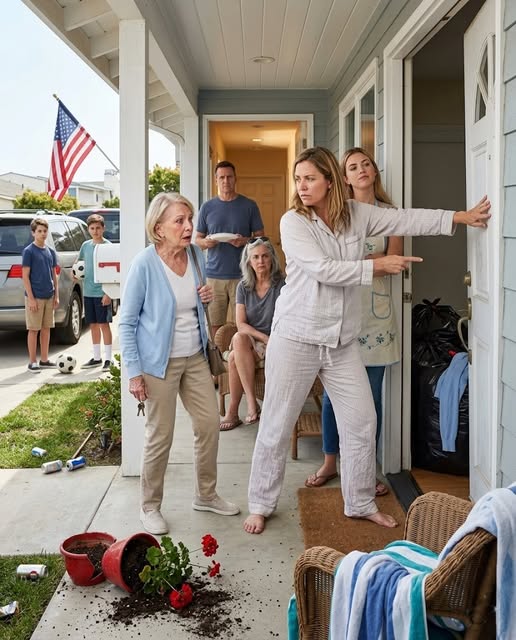
“What is this unwanted guest doing here? There’s no room for you,” my daughter-in-law, Jessica, shouted at me from the terrace.
I had arrived early that morning, expecting to find my house empty as usual. My home had been invaded by her family. My furniture was ruined, my garden destroyed.
But before I continue, make sure you are subscribed to the channel and write in the comments where are you watching this video from. We love to know how far our stories reach.
That Friday morning, I drove to my beach house in Malibu, as I had done hundreds of times over the last 20 years. The route was familiar—the curves of the coastal highway, the smell of salt in the air, the sight of palm trees swaying against the blue sky.
This house represented everything I had achieved in my life. Every brick, every tile, every plant in the garden had been bought with the money I earned working as a seamstress ever since I was widowed.
When I turned into the driveway, I noticed something strange. There were cars I didn’t recognize parked in my garage. Loud music echoed from the property—a festive sound that seemed out of place in the quiet refuge I had created.
As I parked, I felt a tightness in my chest, that sixth sense that warns us when something isn’t right.
When I got out of the car, the impact of what I saw took my breath away.
My beautiful garden, which I tended to myself every weekend, was devastated. Empty beer cans dotted the perfectly cut lawn. Children were running across the terrace, kicking a ball against my pots of red geraniums that I cultivated with so much love.
The wicker chairs I had bought the previous year were covered with wet towels and dirty clothes.
I walked slowly toward the entrance, the keys weighing in my hands as never before.
That’s when I saw her.
Jessica, my daughter-in-law, standing in the main doorway as if she owned the place. She was wearing my favorite apron, the one I had embroidered myself a decade ago. Her eyes had that cold look I knew so well.
“Jessica, I didn’t know you were here,” I said, trying to stay calm despite the chaos around me. “This is my house. I come here every holiday weekend for the last 20 years.”
She laughed.
It wasn’t a normal laugh. It was a sound loaded with cruelty that made me feel small and insignificant, as if I were the intruder on my own property.
“Oh, please,” she scoffed. “Robert told me we could use the house whenever we wanted. Besides, we’re doing something productive here. You just come to complain and ruin our family plans.”
Before I could answer, more people began to appear behind her.
Veronica, her sister, with her two teenage sons. Her gray-haired mother, who looked at me with disdain. An older man in a Hawaiian shirt. A young woman with a baby in her arms. And another man smoking calmly on my porch.
They all looked at me as if I were the problem.
“Is this the famous mother-in-law you talk about so much?” Jessica’s mother asked, sizing me up from head to toe. “I thought she’d be more imposing. She seems rather common.”
The snickers that followed hit me like arrows.
There I was at 70 years old, in my simple travel clothes, being ridiculed by strangers on the property I built with the sweat of my labor.
“Where is Robert?” I asked, feeling my heart race. “My son needed to be there to explain this absurd situation.”
“Robert is working as always,” Jessica replied, crossing her arms. “Unlike you, he has real responsibilities.”
Then she tilted her chin, as if she was issuing a rule.
“Look, Eleanor, there’s no room for you here. The bedrooms are all occupied. The kitchen is being used to prepare food for the whole family. And frankly, your presence is only going to create unnecessary tension.”
I stood there, paralyzed.
She was actually forcing me out of my own house—the house I built brick by brick after my husband’s death, the house I worked days and nights as a seamstress to pay for.
“Besides,” Jessica continued with a venomous smile, “I already spoke with Robert, and we agree that this house needs to be used more. It makes no sense for it to be empty most of the time while you live comfortably in Chicago. We have children who need space to grow.”
Her words hit me like stones.
Twenty years building this place after my husband died. Twenty years paying every cent of the mortgage with the money I earned sewing clothes for other people’s families. Twenty years tending to every detail, every plant, every corner of this place that had become my personal sanctuary.
“This house is mine, Jessica,” I managed to say, though my voice sounded weaker than I would have liked. “I have the deeds. I pay all the bills. I—”
“Oh, that’s enough,” she interrupted, raising her voice. “It’s always the same thing—that it’s yours, that you pay. Robert is your son, isn’t he? What’s yours is also his, and what’s his is also mine. That’s how normal families work.”
The children stopped playing, and everyone watched me in silence.
I could feel their eyes judging me, waiting for my reaction.
Humiliation burned my cheeks like fire, but something inside me refused to break.
One of the teenagers, who seemed to be Jessica’s niece, came closer and looked at me insolently.
“Why don’t you just go to a hotel? There’s no space for anyone else here.”
“All right, dear,” I finally said, with a smile that came from my soul, but which I knew didn’t reach my eyes. “I understand the situation perfectly.”
Jessica smiled triumphantly, believing she had won. The others seemed satisfied, as if they had witnessed a just victory.
They had no idea what they had just unleashed.
I walked back to my car with slow, dignified steps.
As I drove away to find a hotel, my mind traveled to the past—to when this property was nothing more than a vacant lot full of weeds and dreams.
I was 50 years old back then, Robert barely 25. It was just the two of us against the world, and I had made the most important decision of my life: to build a refuge for our family.
The Pacific View Inn cost me $285 a night—money I hadn’t planned on spending because I was supposed to be sleeping in my own bed.
But there I was, checking in like any other tourist while my house was occupied by invaders who felt entitled to my property.
That night, sitting on the hotel balcony, looking at the lights of my house in the distance, I felt something I hadn’t felt in decades.
A cold, calculated anger beginning to form inside me.
It wasn’t that impulsive anger that makes you scream and lose control.
It was something much more dangerous.
It was the intelligent anger of a woman who had survived poverty, widowhood, and decades of hard work.
Jessica had made a fatal mistake.
She had underestimated Eleanor Vance.
The next morning, I woke up at 6:00 in the morning after a night of restless sleep. Every time I closed my eyes, I saw Jessica’s arrogant smile and heard her venomous words echoing in my mind.
I had a quick coffee in the hotel restaurant and decided to go back to the house to try for a calmer conversation.
Maybe it had been a misunderstanding.
Maybe Robert would show up and put an end to this absurd situation.
When I arrived at 8:00 in the morning, I found the front door locked—my own door. I had to ring the doorbell as if I were a visitor.
Veronica, Jessica’s sister, opened it, still in her pajamas and with an angry face.
“What do you want now?” she asked without even greeting me.
I explained that I needed to pick up some personal things and talk to Jessica.
Her response left me stunned.
“Jessica is sleeping, and your things aren’t here anymore. We put them in bags in the garage so they wouldn’t be in the way.”
My things in bags in the garage”

PART NEXT:
My things in bags in the garage.
For a moment, the entire house seemed to tilt.
I heard the ocean beyond the back terrace, the steady crash of waves against the Malibu shore, but the sound came from far away, as if I were listening from underwater. Veronica stood in the doorway with one hand on the frame, blocking me like a guard at a nightclub, her bare feet planted on my welcome mat.
My welcome mat.
The one I had bought in Santa Monica after saving grocery money for three weeks because it had tiny blue shells sewn into the border.
I looked past her shoulder and saw my hallway.
My walls.
My framed photographs.
My late husband’s black-and-white picture near the entry table had been turned face down.
Something inside me went still.
Not weak.
Not afraid.
Still.
“Move,” I said.
Veronica blinked, surprised by my voice.
“Excuse me?”
“I said move.”
Her mouth opened, but I stepped forward before she could gather herself. I was seventy years old, yes. My knees hurt when it rained. My hands ached after too much sewing. But I had carried bolts of fabric heavier than that woman’s arrogance. I had buried a husband. I had raised a son alone. I had worked until my fingertips split and still smiled at customers who treated me like furniture.
Veronica moved.
Not because she respected me.
Because something in my face told her I was no longer asking.
The air inside my house smelled wrong. Beer. Fried food. Sunscreen. Someone’s heavy perfume. The clean lavender scent I always kept in the linen closet was buried beneath the odor of strangers treating my sanctuary like a cheap rental.
I walked down the hall slowly.
Every step revealed another wound.
A wet swimsuit hung over the back of my antique chair. Potato chips were crushed into the rug I had brought home from a small shop in Ojai. A child had drawn a crooked sun in blue marker on the side of my white storage cabinet. On the coffee table, someone had left a glass ring directly on the polished wood Frank had refinished with his own hands before he died.
Then I saw the bags.
Black trash bags.
Stacked in the open garage.
My clothes. My toiletries. My framed embroidery samples. My old sewing kit. A shoebox of letters tied with ribbon. All shoved together like garbage.
The shoebox had split open.
A letter lay on the concrete floor.
Frank’s handwriting stared up at me.
Ellie, don’t forget to rest today.
The breath left my body.
I bent slowly, my knees protesting, and picked it up with both hands. The paper was dusty now. Someone had stepped on one corner. The small crease looked more intimate than any slap.
Behind me, Veronica said, “We didn’t throw anything away, so don’t be dramatic.”
I turned.
She took one step back.
“Where is Jessica?” I asked.
“She’s sleeping.”
“Wake her.”
“She was up late hosting everyone.”
“In my house.”
Veronica folded her arms, trying to recover her smugness.
“You keep saying that like it matters. Robert said family could use it.”
“Robert does not own one square inch of this property.”
A voice came from the staircase.
“God, are we doing this again?”
Jessica stood halfway down the stairs in my robe.
My robe.
White cotton with blue trim, embroidered with my initials on the sleeve.
E.V.
Seeing her in it hurt more than the broken pots, more than the beer cans, more than the bags in the garage. It was not just theft. It was mockery. She had wrapped herself in my life and still looked at me as though I were the trespasser.
Jessica yawned, then smiled when she saw my face.
“Oh, you found your stuff.”
I held Frank’s letter against my chest.
“You put my personal belongings in garbage bags.”
“They were cluttering the closets.”
“My closets.”
“Our guests needed space.”
“Your guests are trespassing.”
The word changed the room.
Veronica’s arms dropped.
Jessica’s smile thinned.
From the living room, two teenagers went quiet. Somewhere in the kitchen, a spoon stopped clinking against a bowl.
Jessica descended the remaining stairs slowly, tying my robe tighter around her waist.
“Careful, Eleanor,” she said. “You don’t want to sound unstable.”
There it was.
The old weapon.
Make the older woman emotional, then call her unreasonable. Hurt her, then describe her bleeding as drama.
I looked at her for a long second.
Then I reached into my purse and took out my phone.
Jessica laughed.
“What are you doing? Calling Robert? Go ahead. He’ll tell you the same thing.”
“No,” I said. “I’m calling my attorney.”
The first crack appeared in her face.
Tiny.
But visible.
I had known Martin Bell for seventeen years. He had handled my property documents, my will, my insurance updates, and every legal paper I had signed since Frank died. He answered on the second ring.
“Eleanor?”
“Martin,” I said, my eyes still on Jessica. “I am standing inside my Malibu property. There are unauthorized occupants here. My belongings have been removed from my bedroom and placed in garbage bags in the garage. Personal items have been damaged. I want you to begin eviction and trespass proceedings immediately.”
Jessica’s mouth fell open.
“Also,” I continued, “send the security company. I want the locks changed today.”
Jessica lunged toward me.
“You can’t do that!”
I stepped back, not from fear, but to let everyone see her reach for my phone.
Martin’s voice sharpened through the speaker.
“Eleanor, are you safe?”
Jessica froze.
I turned the phone slightly so she could hear.
“I am safe for the moment.”
“For the moment?” Jessica repeated, her voice rising. “You’re making this sound like we attacked you.”
“You attacked my home.”
Veronica stepped in. “This is ridiculous. We’re family.”
I looked at her.
“You are Jessica’s family. Not mine.”
The words cut cleaner than I expected.
Jessica’s mother appeared from the kitchen wearing one of my linen napkins tucked into her blouse like an apron. The old woman narrowed her eyes at me.
“You should be ashamed,” she said. “At your age, fighting young people over a vacation house.”
I looked at the napkin, then at her face.
“At my age, I know the difference between guests and invaders.”
The older man in the Hawaiian shirt stepped out behind her, holding my ceramic coffee mug.
“Look, lady, nobody wants trouble.”
“Then pack.”
He blinked.
Jessica laughed again, but now the sound came out sharp and forced.
“No one is packing. Robert said we could stay through the week.”
I looked back at her.
“Then Robert can explain that to the police.”
I ended the call.
The silence that followed was thick enough to touch.
Outside, gulls cried over the ocean. Children whispered near the terrace doors. Someone turned the music down until only a bass thump remained, faint and embarrassed.
Jessica’s eyes darkened.
“You are going to regret humiliating me.”
I almost smiled.
“No, Jessica. I regret tolerating you.”
That was when my son called.
His name appeared on the screen.
Robert.
For one heartbeat, the old mother in me rose up.
The mother who used to answer before the second ring because he might need something. The mother who drove through storms for school projects and fevers. The mother who still kept his childhood drawings in a drawer he never opened.
Then I looked at the garbage bags.
I let the phone ring twice.
Three times.
Then I answered.
“Robert.”
His voice came rushed, irritated.
“Mom, what are you doing? Jessica called me crying.”
Jessica’s eyes filled instantly, perfectly, as if summoned by script.
“She said you threatened everyone.”
“I called my attorney.”
“Why would you do that?”
“Because your wife removed my belongings from my bedroom and put them in trash bags.”
A pause.
Then, quieter, “She said they needed closet space.”
That pause told me everything.
He knew.
Maybe not all of it.
But enough.
“Robert,” I said, “did you tell Jessica she could use my house whenever she wanted?”
He sighed.
“Mom, it’s a family property.”
“No. It is my property.”
“You always make everything legalistic.”
Legalistic.
Such a polished word for boundaries when someone wants what is yours.
I walked toward the living room. Everyone watched me now.
“I am going to ask you one more time,” I said. “Did you give Jessica permission to occupy my home without telling me?”
He was silent too long.
My fingers tightened around the phone.
Finally he said, “I didn’t think it would be a big deal.”
The old wound opened fully.
Not because Jessica was cruel.
Cruel people are easy to understand.
But Robert had been my baby.
The boy who slept with a flashlight after Frank died because he was afraid death could come back through the window. The young man I helped through college, the son I had loved more carefully than I loved myself.
He had handed my house to someone who despised me.
And called my pain a big deal.
“It is a big deal,” I said.
“Mom, please don’t embarrass me at work over this.”
There it was.
Not Are you okay?
Not What did she do?
Not I’m coming.
Don’t embarrass me.
I looked at Jessica. She had stopped crying now. She was watching me with satisfaction, believing my son would pull me back into obedience.
Instead, I made the hardest choice of my life.
“Robert,” I said, “you have two hours to get your wife, her relatives, and every item they brought out of my house.”
“Mom—”
“If they are still here after that, I will file a police report and begin civil action for damages.”
“You wouldn’t do that to me.”
The words landed softly.
Like a child’s voice.
Like a trap.
“I wouldn’t,” I said. “But you did this to me.”
Then I hung up.
Jessica stared at me.
For the first time, she looked uncertain.
Not afraid yet.
But close.
“You think Robert will choose you over me?” she asked.
“No,” I said. “I think Robert will choose himself. He always does when it matters.”
Her mouth tightened.
“That’s a horrible thing to say about your son.”
“It is a horrible thing to learn.”
The next two hours became a slow public collapse.
No one packed at first.
They muttered. Complained. Called me bitter. Called me selfish. Jessica’s mother said widows became possessive because they had nothing else to control. Veronica filmed parts of the house with her phone as if she intended to prove I was unreasonable, accidentally recording the beer cans, broken plants, stained cushions, and trash bags full of my belongings.
I let her.
At 9:17, Martin arrived with two security technicians and a property manager I had used for repairs for years. He was sixty-two, silver-haired, and carried a leather folder that seemed to frighten Jessica more than my anger ever could.
“Mrs. Vance,” he said.
“Ms. Vance,” I corrected softly.
“My apologies. Ms. Vance.”
Jessica rolled her eyes.
Martin heard it.
He removed documents from the folder and placed them on my dining table.
The dining table had a scratch across it that had not been there the last time I visited.
He photographed it.
Then the rug.
Then the cabinet.
Then the broken pots.
Then the garbage bags.
Each click of his camera sounded like a nail sealing a box.
Jessica followed him, voice rising.
“You can’t just take pictures of us.”
“I am documenting property damage,” Martin said.
“We’re guests.”
“Guests leave when the owner asks.”
“My husband is her son.”
“Not the owner.”
She looked as if he had slapped her with the deed.
At 9:46, Robert arrived.
He came in a gray suit, tie loosened, eyes red from anger or exhaustion. For a second, when he stepped through the doorway, I saw him at twenty-five again, standing beside me when we first walked the empty lot this house would become.
“This is ours someday, Mom?” he had asked back then.
“No,” I had told him. “This is mine now. Someday, if love keeps us honest, it may shelter you too.”
I had forgotten that sentence.
Or maybe I had buried it because it hurt too much.
Robert looked around the damaged house.
His face changed.
Just slightly.
He saw the bags.
He saw my robe on Jessica.
He saw Frank’s photograph still turned face down.
That was the moment I thought he might come back to himself.
Then Jessica ran to him.
“She’s threatening us,” she cried. “Your mother is trying to throw my family into the street.”
Robert put an arm around her.
Not me.
Her.
The last fragile hope inside me folded quietly.
“Mom,” he said, “this has gone far enough.”
“Yes,” I said. “It has.”
He frowned.
“You need to calm down.”
Martin looked up from his folder.
“Mr. Vance, I advise you to be careful.”
Robert’s eyes flashed.
“This is a family matter.”
“No,” Martin said. “This is a property matter, a civil liability matter, and depending on Ms. Vance’s decision, potentially a criminal trespass matter.”
Jessica clutched Robert’s sleeve.
“Do something.”
Robert looked at me with the impatience of a man who had mistaken my love for weakness his whole life.
“Mom, sign the house into a family trust.”
The room went quiet.
Even Jessica froze.
There it was.
The hidden truth.
Not a misunderstanding.
Not a weekend mistake.
A plan.
My body went cold.
“What did you say?”
Robert swallowed, then pushed forward because pride would not let him retreat.
“It makes sense. You’re seventy. You live in Chicago most of the time. Jessica and I have kids someday to think about. The property taxes are high. Maintenance is expensive. If you transfer it into a family trust with me as trustee, we can manage it properly.”
Jessica’s eyes flicked toward Martin.
She knew.
Of course she knew.
I looked at my son.
“Is that why she came here? To establish use?”
Robert’s silence answered before his mouth did.
Martin’s voice became very quiet.
“Robert, tell me you did not move people into this residence to support a claim of beneficial family use.”
Robert looked away.
Jessica snapped, “That is not illegal.”
Martin turned toward her.
“No. But forging preliminary transfer paperwork is.”
The room stopped breathing.
Jessica’s hand fell from Robert’s arm.
Robert turned toward her.
“What?”
Martin opened his folder and removed three pages.
“Eleanor, I did not mention this on the phone because I wanted to confirm the source. Last week, my office received a digital request to prepare transfer documents for this property. The request used your name, Robert’s contact information, and an electronic signature authorization that does not match any signature we have on file.”
I stared at the papers.
The letters blurred.
Jessica took one step back.
Robert’s voice cracked.
“Jessica?”
She lifted her chin.
“I was trying to help.”
“Help who?” I whispered.
Her eyes cut to me.
“You were never going to use this place properly. It’s wasted on you.”
The words came like stones down a hill, each one loosening another truth.
Robert stared at her.
“You forged Mom’s authorization?”
Jessica’s face hardened.
“I filled out preliminary paperwork. Nothing was final.”
Martin said, “It would have become final if Eleanor had not come here today.”
Robert’s face drained.
For the first time, my son looked frightened not of embarrassment, but of consequences.
Jessica saw it and turned on him.
“Oh, don’t act innocent. You wanted this too. You said your mother was sitting on assets like a dragon on a pile of gold. You said if she really loved you, she’d make your life easier.”
Robert closed his eyes.
The sentence hit me so hard my hand reached for the table.
Martin moved closer, but I lifted one palm.
I wanted to stand.
I needed to stand.
“Is that true?” I asked.
Robert could not look at me.
“Mom…”
“Is it true?”
His throat worked.
“I said it during an argument.”
“With whom?”
He looked at Jessica.
The answer was everywhere.
Jessica laughed bitterly.
“Oh, spare me the wounded mother routine. You think he visits you because he enjoys hearing about your garden and your sewing? He visits because he’s waiting for you to finally admit everything you have should be his.”
Robert’s head snapped up.
“Shut up.”
“No,” she said. “You don’t get to hide behind me now. You married me because I pushed for the things you were too cowardly to ask for.”
Her mother hissed, “Jessica.”
But Jessica was past control. The mask had split, and what crawled out no longer cared about elegance.
“She has two homes. Money in accounts. Jewelry. That beach house. And she wants to die clutching it all while we rent and struggle and smile at her boring stories.”
The silence after that was terrible.
Not empty.
Full.
Full of broken trust.
Full of every meal I had cooked for them, every birthday check, every holiday invitation, every careful silence when Jessica insulted me softly enough that Robert could pretend not to hear.
I looked at my son.
He looked ruined.
But ruined was not the same as innocent.
I walked to the entry table and turned Frank’s photograph upright.
His face, younger and kind, looked back at me.
Then I turned to Martin.
“File everything.”
Robert whispered, “Mom, please.”
I did not turn.
“Everything?”
Martin asked.
I nodded.
“Trespass. Damages. Forgery. Attempted fraud. And I want every lock changed before sunset.”
Jessica’s mother gasped.
“You vindictive old woman.”
I faced her.
“No. A vindictive woman would have done this years ago. I am a patient woman who finally stopped being polite.”
The police arrived at 10:28.
Not with sirens.
Not dramatically.
Two officers in dark uniforms walked up my driveway while the Pacific glittered behind them as if the day had no idea it had become a battlefield.
The children were taken aside gently. Veronica’s teenagers suddenly looked very young. The man in the Hawaiian shirt put down my mug and raised both hands as though anyone had accused him of armed robbery. Jessica’s mother cried loudly about disrespect. Veronica kept saying they had permission.
Jessica said nothing.
Robert stood near the fireplace, both hands on his head, staring at the floor.
When the officers asked who owned the residence, Martin handed them the deed.
My name.
Only my name.
Eleanor Vance.
The officers asked me whether I wanted the unauthorized occupants removed.
That was the final choice.
Everyone looked at me.
Jessica’s family with resentment.
Jessica with hatred.
Robert with desperate hope.
My son’s eyes found mine.
For a moment, I saw the little boy who used to bring me seashells in both hands, asking if we could keep every single one because throwing them back seemed rude.
That boy was still somewhere inside him.
But he was not the only person in the room.
A grown man stood there too.
A man who had let his wife throw me out of my own home.
A man who had known enough and said too little.
A man who now needed to learn that love without boundaries becomes permission to destroy.
I inhaled slowly.
“Yes,” I said. “I want them removed.”
Robert closed his eyes.
Jessica made a sound like a laugh and a sob twisted together.
“You’ll regret this,” she said.
I looked at her.
“You keep confusing me with someone who still needs your approval.”
The removal took less than an hour.
Garbage bags were opened and repacked properly. My belongings were moved into the study under my direction. Jessica’s relatives dragged suitcases across my floors, muttering insults until one officer told them to stop. The teenagers avoided my eyes. The baby cried. Someone’s cooler leaked onto the driveway.
Jessica walked out last.
Still wearing my robe.
I stopped her at the door.
“That stays.”
She looked down as if she had forgotten.
Then slowly, with shaking fingers and furious eyes, she untied the robe and shoved it into my hands. Beneath it, she wore an expensive swimsuit and shame she had no idea how to carry.
“Enjoy your empty house,” she said.
I held the robe against my chest.
“I will.”
Robert remained.
The officers did not remove him because I had not asked them to.
He stood in the ruined living room while the locks were changed around us. Drill sounds echoed through the hallway. The old deadbolt came out. A new one slid in. Small mechanical noises, ordinary and final.
Robert looked at the floor.
“I didn’t know she forged anything.”
“I believe you.”
His head lifted slightly.
The hope in his eyes hurt.
Then I said, “But you knew she wanted the house.”
The hope died.
He nodded once.
“You knew she disrespected me.”
Another nod.
“You knew I was uncomfortable around her.”
His mouth trembled.
“Yes.”
“And you let me stand alone because it was easier.”
He pressed his fingers to his eyes.
“I’m sorry.”
The words were quiet.
Real, maybe.
But real words do not automatically repair unreal damage.
“I need you to leave too,” I said.
His hands dropped.
“Mom.”
“You may call me in one week.”
“One week?”
“Yes.”
“I’m your son.”
“I know exactly who you are. That is why this hurts.”
He took a step toward me.
I stepped back.
He stopped as if the distance had struck him.
For the first time in his adult life, I think Robert understood that I was not withholding punishment.
I was protecting what was left of myself.
He nodded.
His lips parted twice before sound came.
“I love you.”
My eyes burned.
“I love you too.”
He looked relieved for half a second.
Then I said, “But love is not a deed transfer.”
His face crumpled.
He walked out without another word.
By sunset, the house was mine again.
But not restored.
Not yet.
The garden looked trampled. The terrace smelled of spilled beer. My bedroom had been stripped of its quiet. Drawers were open. Hangers lay scattered. Someone had used my bathroom counter to hold makeup brushes, sunscreen, and a half-empty bottle of champagne.
I cleaned until midnight.
Not because I needed to.
Because my hands needed work while my heart figured out how to keep beating.
I washed the robe twice.
I turned Frank’s photograph upright in every room where it had been moved.
I gathered broken geraniums from the soil and placed the surviving stems in a glass of water.
At two in the morning, I sat on the terrace wrapped in a blanket, listening to the ocean breathe in the dark.
For the first time since arriving, I did not cry.
I watched the moon silver the water and felt the cold anger leave me.
Not forgiveness.
Not peace.
Something cleaner.
Resolve.
The following months became a slow unraveling of the life Jessica had tried to steal.
Martin pursued the forgery. Jessica denied everything until Veronica’s video, the one she had filmed to mock me, captured Jessica in the background bragging that “once Eleanor signs, this place will finally stop being wasted.” She had recorded her own downfall with perfect lighting.
The attempted transfer request had come from Jessica’s laptop. The electronic signature had been copied from a scanned holiday card I had sent Robert two years earlier. The forged authorization was enough to destroy her credibility, her marriage, and the image she had polished like silver.
She did not go to prison.
But she lost the war she started.
The settlement required restitution for damages, a written admission of misconduct, and a permanent restraining order from my Malibu house. Robert filed for separation three weeks later. Jessica’s family, so loud in my doorway, vanished from the story when bills arrived with their names attached.
Her mother called me once.
I let it go to voicemail.
“Eleanor,” she said, voice stiff and smaller than I remembered. “This has gone too far.”
I deleted it before she finished.
Some people think silence is weakness because they have never been cut off by it.
Robert did call after one week.
I did not answer the first time.
Or the second.
On the third call, I picked up.
Neither of us spoke immediately.
I could hear traffic on his end. He could probably hear the ocean on mine.
Finally he said, “I’m outside the house.”
I stood near the kitchen window and looked toward the driveway.
He was there.
Not at the door.
Not demanding entrance.
Standing beside his car with both hands visible, as if approaching a sacred place.
“I brought something,” he said.
“What?”
“Your sewing machine.”
My breath caught.
“My old Singer?”
“I found it in our garage. Jessica had put it behind storage bins. I think she meant to sell it.”
I closed my eyes.
That machine had bought school shoes, groceries, Robert’s textbooks, mortgage payments, and eventually the first set of curtains for this beach house.
“Leave it by the front door,” I said.
He was silent.
Then, softly, “Can I see you?”
The old answer rose automatically.
Yes, of course, come in, you’re my son.
But the new Eleanor stood beside it.
Stronger.
Kinder, because she was honest.
“Not today.”
I watched him nod from the driveway.
He carried the machine to the door slowly, both arms wrapped around it like it weighed more than metal.
Before leaving, he placed one hand on the top of the case.
His head bowed.
Then he walked back to his car.
When I opened the door later, there was a note taped to the handle.
Mom,
This machine built my life before I was old enough to understand what that meant.
I am sorry I treated what you built like something waiting to become mine.
I will not ask for the house again.
I will not ask for money.
I am asking, when you are ready, for a chance to earn one cup of coffee at your kitchen table.
Robert
I read it standing in the doorway while the ocean wind moved the paper against my fingers.
Then I carried the sewing machine inside and placed it in the room facing the sea.
Healing did not come quickly.
It came in small, stubborn pieces.
Robert started by paying for repairs he had not caused alone but had allowed. The garden. The rug. The scratched table. The cabinet with the marker drawing. He sent receipts, not announcements. He did not ask whether I was proud. He did not ask whether it was enough.
Good.
Enough would take time.
He began therapy. He told me so in a letter, not to earn sympathy, but because he said he was learning how much of his life had been shaped by entitlement disguised as fear.
Three months later, I let him sit on the terrace.
No coffee yet.
Just water.
He looked at the ocean for a long time.
“I used to think this house meant you had extra,” he said.
I watched his hands.
They were clasped between his knees, knuckles pale.
“Extra what?”
“Extra life. Extra comfort. Extra security. Things you could give away without feeling it.”
The wind lifted my hair.
“And now?”
He swallowed.
“Now I think it meant you survived.”
That was the first thing he said that reached me without asking for anything.
I nodded.
He wiped his eyes quickly, ashamed of the tears.
“Dad would hate me.”
“No,” I said.
He looked at me.
“Your father would be disappointed. Angry, probably. But hate was never one of his tools.”
Robert covered his mouth.
A sound broke from him, small and wounded.
“I miss him.”
“I know.”
“I miss who I was when he was alive.”
I looked out at the waves.
“You can’t go back to that boy.”
He nodded.
“But you can stop betraying him.”
His shoulders shook once.
Then again.
I did not touch him.
Not yet.
But I stayed.
Sometimes staying is the first mercy.
The final truth came in winter.
I had gone through Frank’s old storage trunk while reorganizing the sewing room. Beneath folded quilts and yellowed receipts, I found a sealed envelope addressed in his handwriting.
For Ellie, when the house finally becomes what it was meant to be.
My hands trembled before I opened it.
Inside was a letter and a small photograph.
The photograph showed the vacant Malibu lot twenty years earlier. Just dirt, weeds, sky, and me standing in the middle of it with my hands on my hips. I looked younger, tired, determined. Robert stood beside me at twenty-five, squinting into the sun. Frank had already been gone five years when that picture was taken, so someone else must have snapped it.
On the back, Frank had written words I did not understand at first.
A refuge is not a gift unless she gets to rest there.
I sat down on the floor.
The letter explained everything.
Frank had known about the lot.
Before he died, before I found it, before I convinced myself it was a foolish dream, he had seen an advertisement for Malibu land in an old newspaper and circled it. He had tucked away a small envelope of cash—not much, but enough for the first inspection fee and a deposit consultation.
Ellie,
If you are reading this, I hope you built it.
Not for Robert.
Not for family duty.
For you.
You have spent your whole life making shelter for other people. Promise me this one place will shelter you first.
If our son grows into a good man, he will understand.
If he does not, the house will teach him.
I pressed the letter to my chest and cried with a force that bent me over the trunk.
Frank had not left me money.
He had left me permission.
Permission to rest.
Permission to own.
Permission to stop giving until nothing remained.
That was the beautiful twist that changed everything.
The Malibu house had never been a future inheritance.
It had been a love letter.
And Jessica had walked into it wearing my robe, calling me a parasite.
When Robert came the next Sunday, I showed him the letter.
We sat in the sewing room with the ocean beyond the window and Frank’s words between us.
Robert read slowly.
At the line If he does not, the house will teach him, he stopped.
His face crumpled.
“He knew me better than I knew myself,” he whispered.
“He loved you enough to hope.”
Robert bowed his head over the paper.
“I don’t deserve to inherit this house.”
“No,” I said softly. “You don’t.”
He nodded, tears dropping onto his jeans.
“But you may deserve to visit your mother in it.”
He looked up.
The gratitude in his face was raw and almost painful.
“Only if invited,” he said.
I smiled faintly.
“Good answer.”
Spring came.
The geraniums bloomed again.
The scratches on the dining table remained because I chose not to refinish them. They became a reminder, not of damage, but of awakening. The wicker chairs were replaced. The robe was mended. The Singer sewing machine stood by the window, oiled and working, its steady rhythm filling the house on quiet afternoons.
I began inviting widows from my old sewing circle to stay for weekends.
Women who had spent decades caring for others.
Women who apologized before sitting down.
Women who cried the first time they slept with the window open to the sea.
I called it Frank’s Rest.
Not a business.
Not a charity.
A promise.
Robert helped build a small ramp down to the garden for my friend Agnes, whose hip made stairs difficult. He repaired the garden fence. He learned where the extra towels belonged. He never opened a closet without asking.
One Sunday, he arrived with coffee and a small wooden sign wrapped in brown paper.
He hung it near the front door.
Not too large.
Not showy.
Just carved letters in warm cedar.
ELEANOR’S HOUSE
Underneath, in smaller words:
Rest is not selfish.
I touched the sign with my fingertips.
Robert stood beside me, barely breathing.
“Too much?” he asked.
I shook my head.
“No,” I whispered. “Just enough.”
The final peace came on a June evening, almost one year after the morning I had found my things in garbage bags.
The house was full again.
But this time, it was full by invitation.
Agnes sat on the terrace with a quilt over her knees. Martin and his wife brought lemon cake. Two women from my sewing circle laughed in the kitchen while washing dishes. Robert stood at the grill, wearing an apron that said I’m Sorry For What I Said When I Was Hungry, which I suspected was his way of apologizing for far more than dinner.
The ocean glowed gold.
Children from the neighbor’s house chased bubbles near the fence.
No one touched my things without asking.
No one turned Frank’s photograph down.
No one called me extra.
Robert brought me a plate and sat beside me, leaving comfortable space between our chairs.
“I’m glad you didn’t give up on me,” he said.
I watched the sun lower toward the water.
“I almost did.”
He nodded.
“I know.”
“I needed to almost do it.”
“I know that too.”
His voice shook, but he did not ask me to soften the truth.
That was how I knew he was healing.
He looked toward the house.
“Jessica sent another message.”
I did not turn.
“And?”
“I deleted it.”
I looked at him then.
He gave a small, tired smile.
“Without reading it.”
The air moved gently around us.
I reached over and placed my hand over his.
Not because everything had vanished.
Because enough had changed.
His fingers curled under mine like a child’s for one brief second before he steadied himself.
“I’m proud of you,” I said.
He closed his eyes.
The words entered him slowly.
Maybe he had waited years to hear them.
Maybe I had waited years to say them without fear they would be used as permission.
When he opened his eyes, they were wet.
“I’m proud of you too, Mom.”
I laughed softly.
“For what?”
He looked at the house, the garden, the women resting on the terrace, the sewing machine visible through the window, the cedar sign by the door.
“For finally keeping something for yourself.”
The sun touched the horizon.
The Pacific turned copper.
Inside, someone started humming an old song Frank used to love. Agnes joined in, off-key and brave. Martin’s wife laughed. The sound drifted through the open doors and settled over the terrace like a blessing.
I leaned back in my chair.
For the first time in many years, I felt no need to plan, defend, explain, or give.
My house breathed around me.
Not empty.
Not wasted.
Alive.
Robert sat beside me in silence, no longer trying to own what could only be honored.
And as the last light spread across the water, I imagined Frank standing near the garden gate, hands in his pockets, smiling that quiet smile of his.
The house had taught our son.
It had sheltered me.
It had survived being invaded, mocked, dirtied, and claimed.
So had I.
Jessica had called me an old parasite because she thought age made me weak and love made me easy to rob.
She was wrong.
Age had made me precise.
Love had made me patient.
And betrayal had finally made me free.
That night, after everyone left, I walked through the rooms slowly.
The floors were clean.
The windows were open.
The ocean whispered in the dark.
I stopped at the front door and touched the cedar sign one more time.
Eleanor’s House.
Rest is not selfish.
Then I turned the lock with my own key, walked to the terrace, and sat beneath the stars.
No one told me to leave.
No one told me there was no space.
The whole house was quiet.
The whole house was mine.
And at seventy years old, with the sea breathing below me and Frank’s letter folded safely beside my heart, I finally rested.