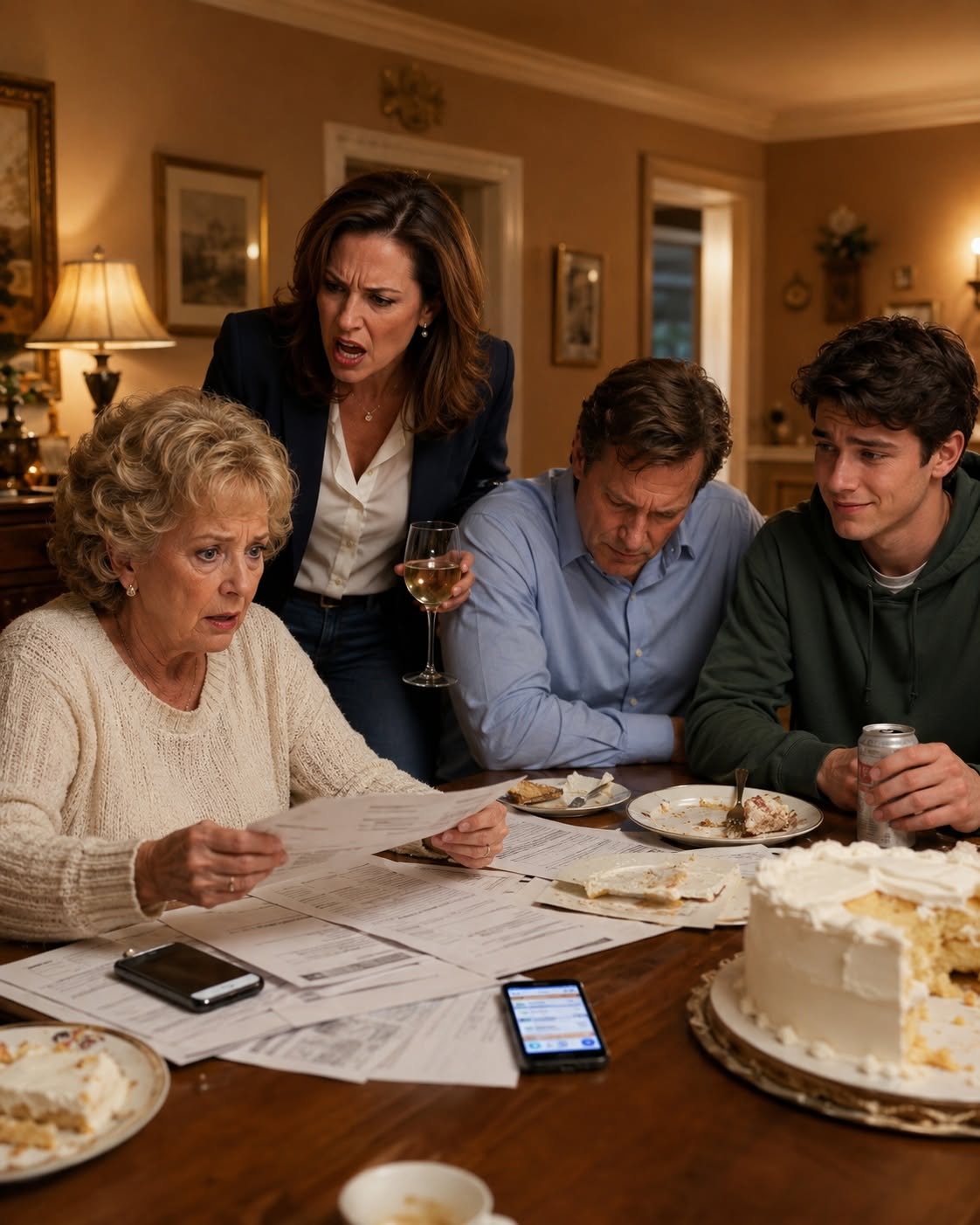
The first thing I did when I got into my car was nothing.
I sat in the driver’s seat with both hands on the steering wheel, my purse in my lap, the strap tangled around my fingers. Through the dining room window, I could still see them.
My mother was standing now, one hand pressed to her chest, the other fluttering as she spoke. Connor had his phone out, probably checking whether the Wi-Fi was still working. Dad remained seated at the head of the table, his birthday napkin folded beside his plate, staring at the empty space where I had been.
The porch light above my car flickered once.
I almost laughed.
Not because anything was funny, but because after a year of paying to keep that light burning, it had chosen that exact moment to remind me how fragile everything was.
My phone began vibrating before I even started the engine.
Mom.
Then Connor.
Then Mom again.
I turned the phone facedown in the passenger seat and backed out of the driveway.
The Bennett house disappeared in my rearview mirror, warm and yellow against the early November dark. For most of my life, that glow had meant home. It meant Dad raking leaves into uneven piles. It meant Mom’s cinnamon candles burning on the windowsill. It meant Connor racing down the porch steps with a football tucked under his arm, yelling at me to throw better.
That night, it looked like a bill someone else expected me to pay.
By the time I reached my apartment across town, I had fourteen missed calls and nine text messages.
Olivia, call me immediately.
This is not how family behaves.
Are you really going to punish us over one comment?
Liv did you cancel the internet????
Dad needs his phone service for emergencies.
You embarrassed me.
Please don’t be dramatic.
We can discuss this like adults.
The last one was from Dad.
Just call when you get home so I know you’re safe.
I stared at that message longer than the others.
Dad had never been cruel the way Mom could be. Not openly. He was a quiet man, the kind who avoided tension by disappearing into the garage or lowering his eyes to a newspaper he wasn’t reading. When Mom got sharp, Dad went still. When Connor made excuses, Dad sighed. When I picked up the slack, Dad thanked me in ways so small they barely counted: a nod, a hand on my shoulder, a murmured “appreciate it, kiddo” when no one else could hear.
But he had let it happen.
For twelve months, he had let me pay.
For twelve months, he had watched Mom pretend they were managing and Connor treat the house like a hotel.
And at dinner, when Mom called me selfish, he had looked at his plate.
I typed back, I’m home.
Then I turned off my phone.
The silence that followed was unfamiliar. Not peaceful exactly, but clean. Like opening a window in a room that had smelled wrong for too long.
I changed out of the dress I had worn for Dad’s birthday and put on sweatpants. I washed the red lipstick from my mouth. I stood in my small kitchen and ate two pieces of the cake I had bought, straight from the bakery box I had taken with me because I couldn’t bear the thought of leaving it there.
Then I opened my laptop.
There was no dramatic satisfaction in checking the accounts. No villainous thrill. Just numbers.
Electric company: autopay canceled, final payment posted three days earlier.
Gas: autopay canceled.
Water: canceled.
Internet: canceled.
Phone bundle: canceled.
I had not shut anything off. I didn’t have that power. I had simply removed myself as the payment source and changed the login passwords for accounts that had my name, my card, and my email attached to them.
The services would continue until the next due date. There would be notices. Grace periods. Options. My parents were not helpless.
That was the part I kept repeating to myself.
They were not helpless.
They had income. Not much, but enough if they made choices. They had a house nearly paid off. They had two cars, though one mostly sat in the garage. They had a son downstairs who could get a job that paid actual money instead of “trying to stream full-time” to seventeen viewers and calling it a career.
They had options.
They just did not have me as a silent bank account anymore.
The next morning, I woke to forty-six missed calls.
My mother had moved from outrage to fear sometime after midnight.
Olivia, please.
We need to talk.
Your father didn’t sleep.
I know I said something wrong, but this is too much.
At 8:17 a.m., Connor sent: You’re seriously messing with people’s lives because Mom hurt your feelings?
At 8:19: Real mature.
At 8:22: Also the internet still works so joke’s on you.
I made coffee and stared at that one.
It was such a Connor thing to say that I almost smiled.
When we were kids, he could break a lamp and somehow convince Mom the problem was that I had left a book on the floor. He had an instinct for sliding away from blame, smooth as water around a stone. By the time he was fifteen, he had learned the exact wounded tone that made Mom fold. By twenty-nine, he had perfected helplessness into a lifestyle.
I didn’t answer him.
Instead, I called the utility companies one by one and confirmed what I had already done. Then I made a folder on my laptop labeled BENNETT PAYMENTS and downloaded every receipt from the past year.
It was not revenge.
It was evidence.
Not for court. Not for posting online. Not for waving around at Thanksgiving.
For me.
Because already, a small, familiar voice in my mind had begun whispering that maybe I had overreacted. Maybe Mom hadn’t meant it. Maybe I should cover one more month while they adjusted. Maybe Dad would be cold. Maybe Connor would make things worse for them. Maybe family meant swallowing the hurt until it dissolved somewhere inside you.
So I built myself a wall of facts.
January: $482.11.
February: $519.87.
March: $463.22.
April: $401.76.
By the time I reached October, the total was $6,084.39.
I sat back and looked at the number.
Six thousand dollars.
That was not love freely given anymore. That was a pattern.
Around noon, my doorbell rang.
I froze.
I lived in a third-floor apartment in a quiet building where nobody dropped by unannounced unless they were delivering food or trying to sell windows. I looked through the peephole.
My father stood in the hallway wearing his brown canvas jacket and holding his old Cleveland Browns cap in both hands.
For a second, I was twelve again, waiting for him to fix whatever had gone wrong.
Then I remembered he had been there last night.
I opened the door.
“Hi, Liv.”
His voice was rough, like he hadn’t used it yet that day.
“Hi, Dad.”
He looked past me, not in a nosy way, but like he needed somewhere to rest his eyes. “Can I come in?”
I hesitated only long enough for him to notice. His face changed slightly, and the guilt that moved through me was immediate and unwanted.
“Sure,” I said, stepping aside.
He entered carefully, as if my apartment had rules he didn’t know. He had been there maybe five times in the three years since I moved in. Mom didn’t like driving downtown. Connor said parking was annoying. Dad always said he’d come by more, then didn’t.
He stood near the couch and looked at the framed print above my bookshelf.
“Nice place,” he said.
“You’ve seen it before.”
“I know.” He nodded. “Still nice.”
I poured him coffee because I didn’t know what else to do. He took the mug with both hands and sat on the edge of my sofa.
For a while, neither of us spoke.
Finally, he said, “Your mother’s upset.”
I leaned against the kitchen counter. “I figured.”
“She shouldn’t have said that.”
“No. She shouldn’t have.”
His fingers tightened around the mug. “Connor shouldn’t have laughed either.”
“No. He shouldn’t have.”
Dad nodded again.
The old dance. Admit enough to seem fair. Stop short of changing anything.
I folded my arms. “Did you come here to ask me to start paying again?”
He looked down into his coffee.
That was answer enough.
Something inside me sank—not because I was surprised, but because I had hoped not to be right.
“Dad.”
“I’m not saying it’s fair,” he said quickly. “I know it’s a lot. I know you’ve helped more than anyone had a right to ask.”
“Then why are you here?”
He rubbed one hand over his face. Under the morning light, he looked older than he had at dinner. The lines near his mouth were deeper. His hair, once thick and dark, had gone mostly silver at the temples. I wondered when that had happened, and why I hadn’t noticed.
“Because I don’t know what to do,” he admitted.
The honesty softened me despite myself.
I moved to the chair across from him. “What does that mean?”
“It means your mother handles the household accounts.”
“She told me she was overwhelmed.”
“She is.”
“With what?”
He flinched. Not dramatically, but enough.
“Dad,” I said, quieter now. “Where is your pension going?”
He stared at the mug.
My chest tightened.
For the first time since I had stormed out of the dinner, anger gave way to something colder.
Fear.
“Dad.”
“I don’t know exactly.”
The room seemed to shift around me.
“What do you mean, you don’t know?”
“I mean I know what comes in. I know what should be there. But when I ask, your mother says things got expensive. Prescriptions. Groceries. Repairs.”
“What repairs?”
He shook his head. “I don’t know.”
I stood and walked to the window, then turned back because pacing felt too much like panic.
“You’re telling me you came here to ask me to keep paying bills, but you don’t actually know why you can’t afford them.”
His face went red. “When you put it like that—”
“How else should I put it?”
He said nothing.
A car horn sounded somewhere below. The world went on, rude and ordinary.
I lowered my voice. “Is Mom gambling?”
His eyes snapped up. “No.”
“Are you sure?”
“Yes.”
“Is Connor taking money?”
“Not like that.”
“Then like what?”
Dad set the mug on the coffee table with both hands. “He asks. Your mother gives. Sometimes I don’t find out until later.”
“How much?”
“I don’t know.”
“Dad.”
“I don’t know, Olivia.”
His voice cracked on my name.
That stopped me.
My father was not a man who cracked. He got quiet. He got tired. He went out to the garage and organized screws into jars. But he did not crack.
He looked at me then, and for one small moment, he wasn’t the silent parent at the dinner table. He was a man in trouble, ashamed of not understanding how he had arrived there.
“I thought retirement would be different,” he said. “I thought I’d know how to manage it. Your mother always paid the bills because she was better at it. I worked. She handled the house. That was how we did things. Then prices went up. My pension wasn’t what I expected. Connor moved back home. Your mother said she had it under control.”
“And you believed her.”
“I wanted to.”
That answer was so honest it hurt.
I sat again.
“Dad, I’m not paying anymore.”
He closed his eyes.
“I can help you look at the finances,” I said. “I can help you make a budget. I can help you call the utility companies and set up payment plans. But I am not putting my card back on those accounts.”
He nodded slowly, but I could see the disappointment settle over him like dust.
“Your mother won’t like that.”
“I know.”
“She’ll say you’re trying to control us.”
“No,” I said. “I’m trying to stop being controlled by guilt.”
For the first time that morning, he looked directly at me.
There was sadness in his eyes. Also recognition.
“I’m sorry,” he said.
Two words. Small ones.
But they landed somewhere deep.
I wanted them to fix everything. I wanted to be the kind of daughter who could hear them and immediately feel clean. Instead, I felt tired.
“Thank you,” I said.
He stayed for another twenty minutes. We didn’t solve anything. We didn’t even come close. But before he left, he stood awkwardly near the door and asked, “Can I come by next week? With the bank statements?”
The question surprised me.
“Yes,” I said. “Bring everything.”
He nodded, put on his cap, and stepped into the hallway.
Then he turned back.
“Liv?”
“Yeah?”
“Don’t let your mother talk you into feeling like the bad guy.”
I swallowed.
“I’ll try.”
After he left, I stood in the open doorway until the elevator doors closed behind him.
Then I shut the door and leaned my forehead against it.
By Monday morning, my mother had changed tactics.
She sent a text at 7:03.
I raised you better than this.
At 7:41:
Your father is humiliated.
At 8:15:
I hope proving your point is worth hurting your family.
I read them at my desk while waiting for payroll reports to load.
For once, I didn’t answer.
Work was usually where I felt most competent. Numbers behaved. Spreadsheets did not sigh dramatically or call me cruel. If something didn’t balance, there was a reason. You found it, corrected it, moved on.
But that day, even the clean rows and columns seemed to blur.
Around lunch, my coworker Maya appeared beside my cubicle holding two salads.
“You look like you’re either about to cry or audit someone into prison,” she said.
I blinked up at her. “Both are possible.”
“Conference room?”
Maya had been my closest friend at work for six years. She had the rare gift of asking direct questions without making you feel cornered. Ten minutes later, I was sitting across from her under fluorescent lights, telling her everything.
Not the polished version.
The real one.
The final notice. The autopay. The brunch photos. The birthday dinner. The toast. Dad at my apartment. The missing money that might not be missing but certainly wasn’t accounted for.
Maya listened without interrupting. When I finished, she pushed a plastic fork into her salad and said, “You know what stands out?”
“That I’m apparently a gullible idiot?”
“No.” She pointed the fork at me. “That nobody in your family thought you deserved basic transparency while using your money.”
I looked away.
“That’s the part,” she said gently. “Not just the money. The secrecy.”
I nodded because if I spoke, I might cry.
Maya lowered her voice. “When your dad brings the statements, don’t do it alone.”
“He’s my father.”
“And you love him. Which makes you easier to pressure.”
“I don’t think he would.”
“Maybe not on purpose.”
That stayed with me.
So on Saturday, when Dad arrived with a grocery bag full of folders, I asked Maya to come over.
Dad looked surprised when he saw her sitting at my kitchen table with a notebook and three pens lined up by color.
“This is Maya,” I said. “She’s my friend. She’s also very good at noticing when numbers don’t make sense.”
Maya smiled warmly. “Hi, Mr. Bennett.”
Dad took off his cap. “Call me Paul.”
We spent four hours sorting through a year of bank statements, pension deposits, Social Security payments, credit card bills, and envelopes Mom had labeled in her looping handwriting.
At first, it was exactly what Dad had said. Groceries were higher. Utilities had gone up. Insurance premiums had increased. Connor had received regular transfers: $75 here, $150 there, sometimes $300 with notes like “car repair” or “job application fees,” whatever that meant.
Then Maya found the first odd charge.
“Bloom & Bridle,” she said.
Dad frowned. “What’s that?”
I leaned over. “Sounds like a boutique.”
“Monthly charge,” Maya said. “One hundred eighty-nine dollars. Same date every month.”
Dad shook his head. “I don’t know.”
There were others.
A storage facility on the north side of Columbus.
An online subscription I didn’t recognize.
A series of payments to something called Larkspur House.
That one made Dad go completely still.
“What?” I asked.
He took the statement from Maya.
His eyes moved over the page once, then again.
“Dad?”
“I need to ask your mother.”
“About what?”
He folded the paper, though it wasn’t his to fold. His hands trembled.
“Dad.”
But he stood up too quickly, knocking his knee against the table.
“I should go.”
Maya and I exchanged a look.
“Paul,” she said carefully, “is Larkspur House a person? A business?”
“I said I need to ask Linda.”
His voice wasn’t angry. It was frightened.
I had never heard that in him before.
He gathered the folders badly, shoving papers into the grocery bag without order. Receipts slid onto the floor. I picked one up and saw the letterhead before he took it from me.
Larkspur House
Private Mailbox Services
My stomach turned.
“Dad,” I said, “why would Mom need a private mailbox?”
He looked at me, and the answer was clearly written on his face.
He had no idea.
He left without another word.
That night, my mother called me seventeen times.
I answered on the eighteenth.
“What did you say to your father?” she demanded.
No hello. No pretense.
“What did you hide from him?” I asked.
Silence.
It lasted just long enough to confirm something was wrong.
“I don’t appreciate being interrogated by my own daughter,” she said.
“I don’t appreciate paying bills while you send money to private mailboxes and boutiques.”
Her breath sharpened. “You had no right going through our accounts.”
“Dad brought them to me.”
“You manipulated him.”
“No, Mom. He asked for help.”
“He is confused.”
“He seemed scared.”
“That is enough.”
I gripped the phone tighter. Outside my window, rain began tapping against the glass, soft and steady.
“What is Larkspur House?”
Another silence.
Then she laughed.
It was the wrong laugh. Too bright, too thin.
“You always were dramatic.”
“What is it?”
“A mailing service.”
“I know that. Why are you paying for it?”
“Because I have personal correspondence.”
“Personal correspondence that costs money every month while I’m paying your heat?”
“You make everything sound ugly.”
“Then make it make sense.”
She inhaled sharply. I pictured her in the kitchen, one hand braced on the counter, Dad somewhere nearby pretending not to listen, Connor downstairs with headphones on.
“You don’t understand marriage,” she said.
The sentence landed like a slap because it was designed to.
I closed my eyes.
“No,” I said. “I understand bills.”
“You understand numbers. Not people.”
“Maybe that’s why numbers don’t lie to me.”
She went quiet again.
When she spoke, her voice had changed. Softer. More dangerous.
“Your father and I had a life before you, Olivia.”
“I’m aware.”
“There are things children don’t need to know.”
“I’m thirty-two.”
“You’re still my child.”
“Then stop treating me like your creditor.”
The rain thickened. Somewhere in the building, a dog barked once.
Finally, Mom said, “I did what I had to do.”
“For who?”
She did not answer.
“Mom. For who?”
The line went dead.
For the next week, everything became strangely calm.
Too calm.
Mom stopped texting.
Connor sent one message asking whether I knew the Wi-Fi password had changed, then apparently remembered I no longer cared.
Dad did not call.
I went to work, came home, made dinner, and slept badly. Every evening, I imagined the Bennett house dim and cold, though I knew the power was still on. The next billing cycle hadn’t hit yet. Consequences, I was learning, rarely arrived like thunder. More often, they approached slowly, wearing ordinary shoes.
On Thursday, I received a letter.
No return address.
My name and apartment number were written in blue ink on a cream envelope. The handwriting was careful but unfamiliar, each letter slightly slanted to the right.
Inside was a single photograph.
It was old. Maybe twenty-five years old, judging by the faded colors and glossy paper.
My mother stood in a garden beside a woman I didn’t recognize.
Mom looked younger than I had ever known her. Her hair was longer, her smile unguarded. She wore a yellow sundress and held a baby wrapped in a white blanket.
At first, I thought the baby was Connor.
Then I turned the photo over.
On the back, someone had written:
Linda and Rose with baby Emily — June 1995.
Emily.
I sat down on the edge of my bed.
My name was Olivia.
My brother’s name was Connor.
There was no Emily in our family.
I looked again at the woman beside my mother. She had curly auburn hair, kind eyes, and one hand resting lightly on Mom’s shoulder. They stood close, not like casual friends. Like sisters, maybe. Or something equally intimate.
The envelope contained no note.
Just the photograph.
I called Dad.
He answered on the second ring.
“Liv?”
“Who is Emily?”
There was a sound on the other end. Not speech. A breath caught halfway.
“Where did you hear that name?”
“A photo came in the mail. Mom is in it. With a woman named Rose and a baby named Emily.”
Dad said nothing.
“Dad.”
“I can’t talk right now.”
My pulse quickened. “You can’t keep doing this. You can’t bring me halfway to the truth and then disappear.”
“I know.”
“Then talk.”
In the background, I heard a door close.
His voice dropped low. “Your mother is upstairs.”
“Good. Ask her.”
“No.”
“Dad—”
“No, Olivia.” His voice was firm for the first time. “Not like this.”
I stood and began pacing. “Who is Emily?”
A long pause.
Then he said, “I thought she was gone.”
The floor seemed to tilt.
“What does that mean?”
“I have to go.”
“Dad, don’t hang up.”
But he did.
That was the moment the story stopped being about utility bills.
I wish I could say I handled it gracefully. I did not.
I searched the name Larkspur House online. It was exactly what the receipt had said: a private mailbox service located in a brick storefront between a tax preparer and a florist. I stared at the street-view image until the awning blurred.
Then I searched for Rose and Emily, which was useless. Too many names. Too many lives.
I pulled out the folder of receipts I had scanned before Dad fled my apartment. There were three Larkspur House charges, each monthly. One receipt had a box number partially visible.
Box 214.
I did not sleep much that night.
The next morning, before work, I drove to Larkspur House.
The storefront smelled faintly of paper, dust, and lilies from the florist next door. A brass bell rang when I entered. Behind the counter sat an older man with round glasses and a gray cardigan, sorting envelopes into cubbies.
“Morning,” he said.
“Hi.” My voice sounded too loud. “I’m trying to find out who rents Box 214.”
His expression did not change, but something closed. “We don’t provide customer information.”
“I understand. I’m not asking for private mail. It’s connected to my mother. Linda Bennett.”
“I’m sorry.”
“She may be in financial trouble.”
“I’m still sorry.”
I placed the photograph on the counter.
The man glanced down.
For half a second, his face changed.
Not much. But enough.
“You recognize them,” I said.
He pushed the photo back toward me. “I can’t help you.”
“Is Rose a customer?”
“I can’t help you.”
“Is Emily?”
His eyes lifted to mine.
Behind the glasses, they were not cold. They were sad.
“You should talk to your mother,” he said.
I let out a humorless laugh. “Everyone keeps saying that like she’s willing to answer.”
He hesitated.
Then he reached beneath the counter and pulled out a sticky note. He wrote something quickly, folded it in half, and slid it toward me.
“I didn’t give you customer information,” he said.
I opened the note in my car.
It contained only four words.
Ask about St. Agnes.
My hands went cold.
St. Agnes was a hospital on the west side. I had been born there. So had Connor.
At least, that was what I had always been told.
I called in sick to work from the parking lot.
Then I drove to my parents’ house.
The place looked the same as always: white siding, blue shutters, maple tree in the front yard nearly bare now. A ceramic pumpkin still sat on the porch even though Halloween had passed. The porch light was on in broad daylight.
Old habits.
I knocked instead of using my key.
Mom opened the door wearing a cream sweater and a face prepared for battle.
“Olivia.”
“Who is Emily?”
All the color drained from her cheeks.
For once, she had no immediate answer.
I held up the photograph.
Her eyes moved to it, and something raw passed over her face before she buried it.
“Where did you get that?”
“It came to my apartment.”
“Who sent it?”
“I don’t know.”
She reached for it, but I pulled it back.
“Who is Emily?”
Mom looked over her shoulder. “Not here.”
“Then where?”
She stepped onto the porch and closed the door behind her. The November air was cold enough to turn her breath white.
“You had no right digging into things you don’t understand.”
“I didn’t dig. A photo was mailed to me after Dad found payments you hid.”
Her mouth tightened. “Your father had no business showing you our statements.”
“I paid your utilities for a year.”
“And now you think that entitles you to every corner of my life?”
“No. I think the lying does.”
She flinched, and for a second I saw the younger woman from the photo—the one in the yellow dress, smiling like the world had not yet taught her caution.
“Mom,” I said, softer. “Who is she?”
Mom wrapped her arms around herself.
When she spoke, her voice was thin.
“Emily was Rose’s daughter.”
“Who was Rose?”
“My sister.”
I stared at her.
“You don’t have a sister.”
“I did.”
The words hung between us in the cold.
Leaves scraped along the driveway. Somewhere inside the house, a television murmured.
“What do you mean, you did?”
Mom looked toward the maple tree. “Rose died a long time ago.”
I waited.
She swallowed. “She was younger than me. Reckless, bright, impossible. Everyone loved her. Especially my parents. Especially your father.”
“My father?”
“They were friends first.”
There it was again: that sense of standing at the edge of a room I had lived beside my whole life but never entered.
“What happened to Emily?”
Mom’s eyes filled, but no tears fell.
“After Rose died, Emily went to live with her father’s family.”
“Why have I never heard about any of this?”
“Because it hurt.”
“That’s not an answer.”
“It is the only one I had.”
I studied her face, searching for the practiced manipulation I knew too well. I found some of it. Mom was still Mom. Defensive. Proud. Skilled at turning pain into a shield.
But underneath, there was something else.
Grief, maybe.
Or guilt.
“Why are you sending money to a mailbox?” I asked.
Her jaw tightened. “I’m not sending money to a mailbox. I’m paying for one.”
“For Emily?”
She looked away.
My breath caught. “She’s alive.”
Mom nodded once.
“And you’re in contact with her.”
Another nod.
“Why hide it?”
“Because I didn’t know how to explain.”
“To Dad?”
“To any of you.”
“Why would Dad say he thought she was gone?”
Mom’s face changed.
“What?”
“That’s what he told me,” I said. “When I asked who Emily was. He said he thought she was gone.”
For the first time, my mother looked truly confused.
Then afraid.
“He said that?”
“Yes.”
She turned toward the door, then stopped.
“Mom?”
She pressed a hand to her mouth.
“What aren’t you telling me?”
Before she could answer, the front door opened behind her.
Connor stood there in sweatpants, his hair messy, a bowl of cereal in one hand.
“What’s going on?” he asked.
Mom straightened instantly.
“Nothing.”
I looked at him, and for the first time in days, I really saw my brother. Not just the lazy basement-dweller, not just the smirk at the dinner table. He looked pale. Younger than twenty-nine. Uncertain in a way he rarely allowed.
His gaze dropped to the photo in my hand.
The cereal bowl slipped slightly in his grip.
“Where did you get that?” he whispered.
The porch went silent.
Mom turned slowly toward him.
“You’ve seen this?” I asked.
Connor’s eyes lifted to hers.
And in that brief exchange, I understood something that made my stomach sink.
My brother knew.
Maybe not everything.
But something.
Mom’s voice was barely audible. “Connor.”
He stepped back into the doorway. “I didn’t tell her.”
“Tell me what?” I said.
Neither of them answered.
A car pulled into the driveway.
Dad’s sedan.
He parked crookedly, got out too fast, and came toward the porch with his coat unbuttoned. He must have seen my car from the street. His expression shifted from alarm to resignation when he saw the three of us standing there.
“Olivia,” he said.
“Everyone inside,” Mom said suddenly.
It was not a request.
For once, nobody argued.
We gathered in the living room like strangers waiting for bad news. Connor sat on the arm of the sofa. Dad stood near the fireplace. Mom remained by the window, arms crossed tightly.
I stayed near the doorway.
No one offered coffee.
No one pretended this was normal.
Finally, I placed the photograph on the coffee table.
“I want the truth.”
Mom looked at Dad.
Dad looked at Connor.
Connor stared at the floor.
I laughed once, quietly. “Amazing. The one time everyone in this family agrees on something, it’s silence.”
Dad closed his eyes. “Emily was your cousin.”
“Was?”
“Is,” Mom said sharply.
Dad nodded. “Is.”
“And?”
Mom’s voice trembled. “And she contacted me last year.”
I frowned. “Last year?”
“Right before I called you about the electric bill.”
The room seemed to tighten.
“She needed help,” Mom continued. “She had been sick. She was trying to get back on her feet. She didn’t want everyone knowing her business.”
“So you gave her money.”
“When I could.”
“With what money?”
Mom’s eyes flashed. “Not yours.”
I stared at her.
She looked away.
Dad spoke quietly. “Linda.”
Mom’s shoulders sagged.
“At first, it was grocery money,” she said. “Then savings. Then credit cards. I thought it was temporary.”
“And then you asked me to pay the utilities.”
She did not deny it.
A clean anger rose in me. Not loud. Not hot. Clean.
“You let me believe you and Dad were about to lose heat because of retirement and Connor.”
“You were never supposed to carry it that long.”
“But I did.”
“I know.”
“No, Mom. I don’t think you do.”
Connor shifted. “Olivia—”
I turned on him. “How long have you known?”
He rubbed both hands over his face. “A few months.”
“And you said nothing?”
“I didn’t know what to say.”
“That has never stopped you before.”
He flinched.
Good, I thought, then immediately felt tired of wanting anything to hurt him back.
Dad stepped forward. “This isn’t all on Connor.”
“No,” I said. “It seems like it’s on everyone except me, which is refreshing.”
Mom sank into the chair by the window. She looked suddenly small.
“I was ashamed,” she said.
The words pulled at me despite everything.
“She was Rose’s child,” Mom continued. “My baby sister’s child. After Rose died, there was a terrible fight. Emily’s father blamed us. My parents blamed him. Your father tried to help, but…” She glanced at Dad. “Everything fell apart. Emily was taken away, and eventually the letters stopped.”
“Why did Dad think she was gone?”
Dad’s face went gray.
Mom looked at him.
Something passed between them again, older and deeper than the current argument.
Dad said, “Because we were told she died.”
My mouth went dry.
“What?”
“In 2008,” he said. “A letter came. No return address. It said Emily had passed away after an illness. Your mother fell apart.”
Mom stared at him. “You saw that letter?”
Dad frowned. “Of course I saw it.”
“No,” she whispered. “No, Paul. I never showed it to you.”
The room chilled.
Dad stared back at her.
“What are you talking about?”
Mom stood slowly. “I received a letter in 2008. It said Emily didn’t want contact. That she had a new family and wanted us to stop looking for her.”
“No,” Dad said. “Linda, that’s not what it said.”
They looked at each other with identical confusion.
Then Connor spoke.
“I saw one too.”
Everyone turned toward him.
His face had gone white.
“When?” Mom asked.
Connor swallowed. “Last year. Before Emily called you.”
“What letter?” Dad demanded.
Connor looked at me, then at Mom.
“I didn’t know what it meant. It was in the mail. Addressed to the house, no name. I opened it because I thought it was junk.”
“What did it say?” I asked.
He stood, went to the bookshelf near the hallway, and pulled out an old dictionary. From between the pages, he removed a folded envelope.
Mom made a sound like she had been struck.
Connor held it out.
No one moved.
So I took it.
The paper inside was cheap and white, the words typed in plain black ink.
Linda,
If you care about your daughters, stop sending money and stop asking questions.
There was no signature.
For a long moment, nobody spoke.
Then I looked up.
“My daughters?”
Mom’s lips parted.
Dad gripped the edge of the mantel.
Connor whispered, “That’s why I kept it. I thought it was a typo.”
I looked at my mother.
Her face had emptied of every defense.
“Mom,” I said carefully, “why would someone write daughters?”
She did not answer.
The house hummed around us—the refrigerator in the kitchen, the old clock on the wall, the faint electrical buzz of lamps I had paid to keep lit.
Dad turned to her slowly.
“Linda,” he said, his voice barely holding together. “Tell her.”
My heart began pounding.
Mom pressed both hands to her mouth.
I looked from her to Dad, then to Connor.
“What is going on?”
Dad’s eyes filled with a sorrow I had never seen before.
And then my mother looked at me and said, “Olivia, there is something about the night you were born that we never told you.”
END OF PART 2 – LIKE, SHARE AND COMMENT “THE ENTIRE STORY” IF YOU WANT TO READ THE FULL STORY