Part 2: The Unwritten Debt

The walk to the stage felt longer than the four years it took Daniel to earn his degree. The heels of my modest shoes clicked against the polished hardwood floor, a sharp, steady rhythm breaking the suffocating silence of the alumni hall.
Daniel tried to catch my eye as I passed him. His lips parted, a silent “Mom?” forming on them, but his voice was trapped in his throat. Beatrice stood frozen beside him, her fingers still wrapped tightly around her glass of lemon water, her perfect, cream-silk composure beginning to fracture.
I didn’t look back. I kept my eyes fixed on the dean, Dr. Harrison, a man I had only ever seen in university brochures, who was now looking at me with a profound, unwavering respect.
As I stepped up the short wooden stairs onto the stage, Dr. Harrison adjusted the microphone. The feedback gave a low hum, vibrating through the room like a collective heartbeat. He cleared his throat, looked down at the paper in his hand—a letter he had received weeks prior—and began to read.
“Dear Committee of Academic Excellence,” the dean’s voice echoed, rich and steady. “As you finalize the selections for this year’s Presidential Circle Endowment, I am writing not to request funding for my own research, but to formally disclose the sole source of the anonymous $120,000 grant that saved our department’s laboratory closure four years ago. A grant that was delivered in cash installments and cashier’s checks, signed only under the pseudonym ‘A Believer in Daniel.’“
A collective gasp rippled through the front rows.
Daniel’s head snapped up. His eyes widened, darting from the dean to me, then down to the floor as if the ground beneath him had suddenly shifted. He knew that grant. It was the very funding that had kept his specific senior research project alive, the breakthrough project that had just landed him a six-figure corporate job straight out of graduation. He had spent years bragging to Valerie and Beatrice about how “luck and merit” had saved his academic career.
The dean continued reading, his eyes scanning the crowd, locking onto Daniel.
“The donor requested absolute anonymity until graduation day, stating that the student in question must never feel the weight of a debt he could not repay. The donor is not a corporate entity. She is a woman who, for the past forty-eight months, worked three concurrent night shifts at the Saint Jude Medical Archives and sold her late husband’s remaining shares in the local railyard. She did this so her son could study without the crippling burden of student loans, and so this university could keep its doors open for minds like his.”
Dr. Harrison stepped away from the podium and turned directly to me.
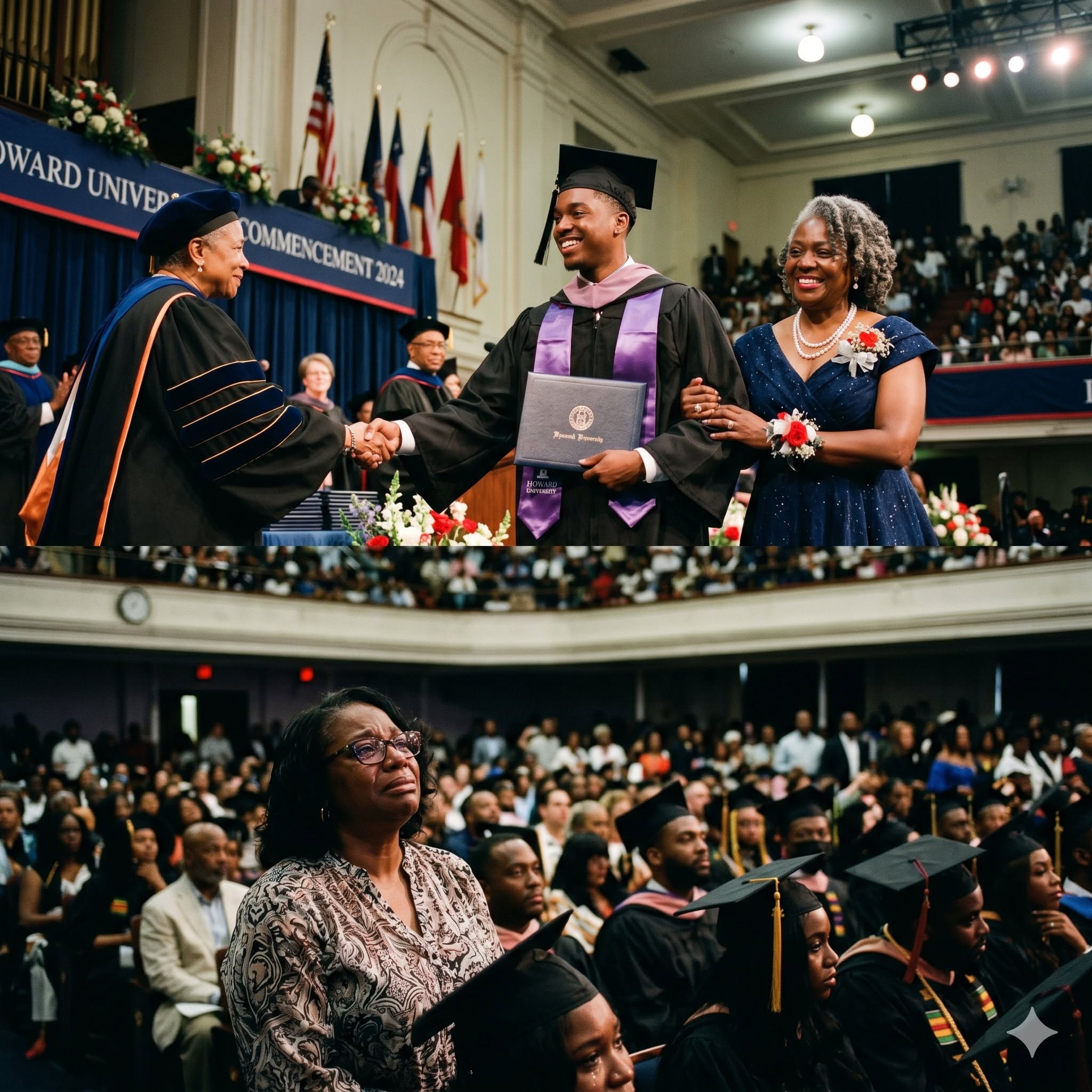
“Mrs. Elaine Harper,” he said, his voice carrying an emotional weight that brought tears to several faculty members’ eyes. “The board, the faculty, and the presidency of this institution do not just congratulate your son today. We honor you. Without your silent, monumental sacrifice, the young man standing in the front row would not be wearing those gold cords. You are the foundation of his success.”
The applause started in the back. It began as a slow, rhythmic clap from a few professors, then cascaded forward like a wave. Within seconds, the entire alumni hall was on its feet. Hundreds of people—strangers, parents, donors—were clapping for me.
I stood on the stage, the small white envelope still clutched in my hands. I looked down at Daniel.
The color had completely drained from his face. He looked entirely hollowed out, as if the expensive suit and the tailored robe he wore had suddenly become three sizes too big for him. Beside him, Valerie was staring at him in utter shock, her hand covering her mouth, realizing in an instant that the “wealthy anonymous benefactor” they had toasted to at their engagement dinner wasn’t a mythical tech mogul. It was the woman they had sat in the third section of the bleachers.
And Beatrice? Beatrice looked as if she had been slapped in public. The smug, polite smile she had worn all afternoon had vanished, replaced by a pale, tight mask of humiliation. The crowd was cheering for the mother who had built the man, while the mother-in-law who had merely dressed him up for the photo-op stood in the stinging shadow of the truth.
Dr. Harrison handed me a heavy, velvet-lined box containing the university’s highest honor for community distinction, shaking my hand warmly. “Thank you, Elaine,” he whispered. “You may join your family.”
As I walked off the stage, the applause faded into a tense, whispering hum. The atmosphere in the room had completely shifted. The invisible wall that Beatrice and Daniel had built around themselves all morning had been utterly demolished.
Before I could even reach the bottom step, Daniel intercepted me. His hands were shaking as he reached out, trying to grab my arms, his voice cracking with an emotion I hadn’t heard since he was a frightened little boy.
“Mom… Mom, why didn’t you tell me?” he choked out, his eyes rimmed with red. “Three jobs? The railyard shares? Dad’s legacy? You told me you got a small administrative promotion! You told me everything was handled!”
“It was handled, Daniel,” I said quietly, my voice calm, contrasting sharply with his panic. “I told you what you needed to hear so you could focus on your exams. A heavy heart doesn’t earn straight A’s.”
“But I… I treated you like…” He couldn’t even finish the sentence. He looked back at Beatrice, then at Valerie, who was walking toward us with a look of deep shame on her face. “Mom, I am so sorry. The walk-in… the photos… I thought you just wanted a quiet day. I thought Beatrice handling the logistics was easier for you…”
“You thought I was too emotional, Daniel,” I corrected him gently, though the words cut like a scalpel. “You thought I didn’t fit the image of the life you are building with Valerie and her family. And that’s alright. You are a man now. You get to choose who walks beside you.”
“Elaine, please,” Valerie chimed in, her voice trembling as she reached for my hand. “We didn’t know. If we had known the financial burden you were carrying—”
“You wouldn’t have asked me to sit in the back row?” I asked, looking her dead in the eye.
Valerie flinched, stepping back.
Beatrice finally approached, her heels clicking aggressively against the floor, trying desperately to regain control of a narrative that had completely spun out of her hands. She forced a strained, brittle smile onto her face.
“Well,” Beatrice said, her voice a pitch higher than usual, attracting the attention of several nearby donors. “This is certainly an… overwhelming revelation, Elaine. Of course, we are all incredibly grateful for what you did. It’s magnificent, really. But surely, we can discuss the family finances privately. Daniel has a very important networking dinner with the senior partners in twenty minutes, and we shouldn’t let this… dramatic moment overshadow his professional future.”
She reached out to place a hand on Daniel’s shoulder, attempting to pull him back into her circle. “Come along, Daniel, dear. Let’s go greet the partners. We can take your mother out for a nice, quiet dinner tomorrow to make up for the misunderstanding.”
Daniel didn’t move. He looked at Beatrice’s hand on his shoulder as if it were a venomous snake. For the first time in two years, he didn’t follow her cue.
“No,” Daniel whispered, pulling his shoulder away from her grip. He turned back to me, tears finally spilling over his eyelids. “Mom, please. Give me the envelope. The one you tried to give me earlier. Let me open it. Please.”
The room around us seemed to hold its breath. A few professors and administrative staff were still lingering nearby, pretending to sip their water but listening to every single word.
I looked down at the crumpled white envelope in my hand.
“Are you sure, Daniel?” I asked quietly. “Once I give this to you, the smooth day you wanted so badly is over. The life you thought you were stepping into changes.”
“I don’t care,” he pleaded, his voice breaking. “Please.”
I handed him the envelope.
Daniel’s fingers were trembling so violently he nearly tore the paper as he ripped it open. Valerie leaned in close over his shoulder, her eyes wide, while Beatrice stood a foot away, her arms crossed, trying to maintain an air of aristocratic indifference.
Inside the envelope was the letter I had rewritten four times, and a single, heavy, tarnished brass key.
Daniel pulled the letter out first. He didn’t read it silently. His eyes scanned the first few lines, and his breath hitched so loudly it sounded like a sob.
“Read it aloud, Daniel,” Beatrice said, her patience wearing thin, her tone laced with a dangerous edge. “Let’s see what this is really about. If there is a legal or financial matter, my family’s attorneys can handle it.”
Daniel looked up at his mother-in-law, a look of profound horror dawning on his face. He looked back down at the paper, his voice shaking as he read the words I had penned in the quiet hours of five o’clock that morning:
“My dearest Daniel,
Today you graduate, and today you become a man entirely independent of the struggles of our past. I know I am quiet. I know I do not speak the language of high society, of cream silk and corporate mergers. But I know how to keep a promise.
When your father passed away, he left us with nothing but a mountain of medical debt and a secret he made me swear to protect until the day you crossed the stage with honors. He always said, ‘Let the boy build his wings before you show him the cage.’
The key enclosed in this envelope does not belong to a new car, nor does it belong to the safety deposit box of the railyard shares. This key belongs to the iron vault in the basement of the old municipal archive building on 4th Street—the building where I worked the night shifts for four years.”
Daniel stopped reading. He looked at the brass key in his palm, his brow furrowing in confusion. “The municipal archive? Mom, what is in the vault?”
I said nothing. I only looked at him, my heart aching for the storm that was about to break over his perfect new life.
Valerie snatched the letter from Daniel’s shaking hands, her eyes racing down the remaining paragraphs. As she read the next section, the color left her face even faster than it had left Daniel’s. She staggered backward, dropping her clutch purse, the contents spilling across the floor unnoticed.
“Valerie?” Daniel asked, panic rising in his voice. “What is it? What does it say?”
Valerie looked at her mother, Beatrice, with an expression of pure betrayal and terror. “Mom…” Valerie whispered, her voice trembling. “Oh my god, Mom… what did you do?”
Beatrice’s composure finally shattered. She snatched the paper out of Valerie’s hand, her eyes scanning the final lines written in my sharp, neat handwriting.
As Beatrice read the words, her eyes bulged. The glass of lemon water she had been holding slipped from her fingers, shattering on the hardwood floor, splashing water and shards of glass across the hem of her pristine cream silk gown.
The entire alumni hall went dead silent again. Everyone was staring at our circle.
Daniel violently grabbed the letter back from Beatrice’s frozen fingers. He read the final paragraph aloud, his voice echoing through the quiet hall, delivering a truth that would tear his new family apart:
“The vault contains the original, unredacted land deeds and corporate acquisition files from twenty-two years ago. The files prove that the railyard closure that bankrupted your father—the financial ruin that stressed his heart until it failed—was not an accident of the market. It was a hostile, illegal acquisition orchestrated by a shell company owned entirely by Beatrice’s family trust. They stole your father’s life’s work, Daniel. And there is one more thing you need to know about the woman who walked beside you today…”
Daniel choked on the next word, his eyes wide with a terror so deep he couldn’t form the sound. He looked at Beatrice, then at me, as the final line of the letter stared back at him from the page, threatening to destroy everything he thought he knew.
TO BE CONTINUED IN PART 3…