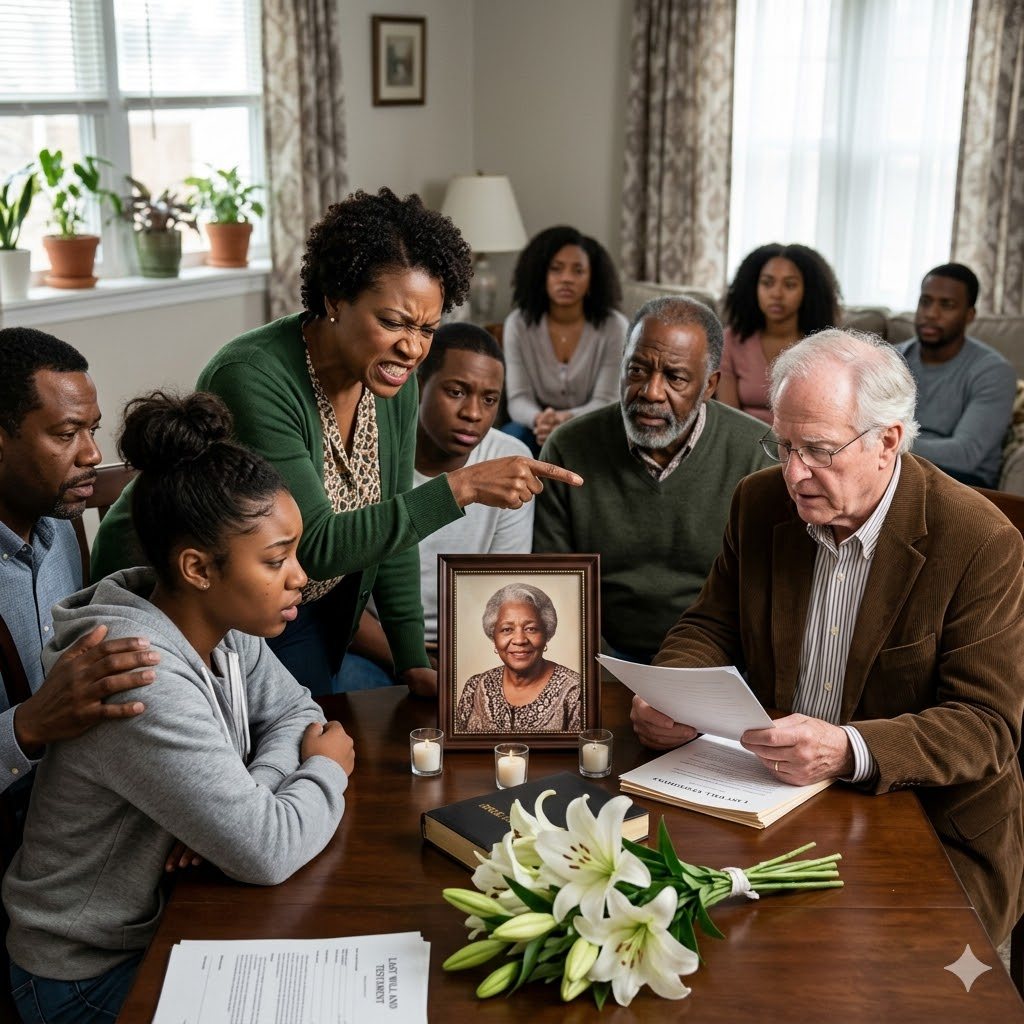
Mr. Caldwell did not raise his voice.
He did not need to.
The paper in his hand was thin, almost harmless-looking, just one cream-colored sheet with Nana’s signature at the bottom. But the moment he cleared his throat, my mother’s fingers curled into the arm of the sofa like she already knew that single page had teeth.
He read slowly.
“I, Margaret Elaine Whitaker, being of sound mind and full intention, do hereby amend the distribution of my estate…”
My father’s face tightened.
My mother gave a small laugh, sharp and fake.
“Sound mind?” she said. “She was dying.”
Mr. Caldwell did not look up. “Mrs. Whitaker, please let me finish.”
That was the first strange thing.
People did not interrupt my mother.
Not in that house.
Not when she was wearing pearls and grief like a costume.
He continued.
“…I revoke all prior instructions regarding personal archives, handwritten records, private correspondence, and any contents connected to the blue velvet box located in my home.”
The room tilted.
My mother’s head turned so fast I heard the tiny click of her pearl earring against her jaw.
My father looked at me.
Not confused.
Not curious.
Afraid.
And that was how I knew.
They knew the box existed.
Maybe not where it was.
Maybe not what was inside.
But they knew enough to fear it.
My mouth went dry.
Because that morning, before coming to my parents’ house, I had gone to Nana’s cottage.
I had told myself I only wanted one thing. Her yellow cardigan. The one that still smelled faintly like lavender soap and cinnamon. I needed proof that she had been real, that she had loved me, that my mother’s Facebook post had not swallowed the truth of her life whole.
The cottage had been locked.
Of course it had.
My father had probably changed the locks before Nana’s body was cold.
But Nana had been Nana.
She had raised three children, survived one cruel husband, buried two sisters, and hidden Christmas money in flour tins for thirty years. A woman like that did not trust locks.
She trusted habits.
So I walked around back, lifted the cracked ceramic frog beside the tomato pots, and found the spare key wrapped in wax paper.
Inside, the cottage was too quiet.
No radio humming in the kitchen.
No kettle screaming.
No Nana calling, “Sarah-girl, don’t just stand there letting all the warm air out.”
I stood by the kitchen table and cried so hard I had to sit down.
Then I remembered her whisper.
Check the blue velvet box.
I searched the bedroom first. Jewelry drawer. Closet shelf. Sewing basket. Nothing.
Then the hall cabinet. Then under the bed. Then the old cedar chest where she kept quilts.
Still nothing.
I almost gave up.
Then I saw the coffee can.
It was on the kitchen windowsill, tucked behind a dead basil plant. Blue label. Chipped lid. One of the cans she used for tomato seedlings every spring.
I don’t know why I opened it.
Maybe grief makes you notice strange things.
Maybe Nana was standing somewhere behind me, tapping her slipper on the floor, waiting for me to stop being slow.
Inside the can was dirt.
Under the dirt was a plastic freezer bag.
And inside the bag was a small blue velvet box.
Not bigger than my palm.
My hands were shaking when I opened it.
I expected a ring.
A locket.
Some tiny sentimental thing my mother would call worthless.
Instead, I found a key, a folded photograph, and a USB drive wrapped in one of Nana’s handkerchiefs.
The photograph was old.
My mother stood on Nana’s porch in a bright red coat, much younger, maybe thirty. My father was beside her, one hand on the railing, face turned away from the camera. Between them stood a man I did not recognize.
But Nana had written on the back in blue ink:

THE DAY THEY MADE ME SIGN.
I had stared at those six words until my vision blurred.
Now, in my parents’ living room, Mr. Caldwell was reading about that same box, and my mother’s face had gone the color of wet paper.
He continued.
“The contents of said box, along with all documents referenced therein, are to be transferred immediately and solely to my granddaughter, Sarah Anne Whitaker.”
My mother stood up.
“No.”
It came out too fast.
Too raw.
Not like grief.
Like panic.
Mr. Caldwell finally looked at her. “This amendment was properly signed, witnessed, notarized, and filed with my office.”
“She was drugged,” my mother snapped. “She didn’t know what she was signing.”
My father said nothing.
That scared me more.
My father had always been the calm one. He was the man who could destroy you without wrinkling his shirt. My mother screamed. My father smiled. My mother made threats. My father made arrangements.
But now he was staring at the paper in Mr. Caldwell’s hand like it was a loaded gun.
I pulled my arm away from my mother.
She noticed.
Her eyes cut to me.
“You went to her house.”
I did not answer.
“You went into that house without permission.”
“She was my grandmother,” I said.
“She was my mother.”
“No,” I said, and my voice surprised me because it did not tremble. “She was your opportunity.”
The slap never came.
For a second, I thought it would. My mother’s hand lifted slightly, just enough for childhood to flash behind my eyes.
Christmas Eve.
My eighth-grade graduation.
The night I spilled cranberry juice on her white rug and she gripped my shoulder hard enough to leave marks.
But this time, Mr. Caldwell moved.
Just one step.
Professional. Quiet. Enough.
My mother saw it too and lowered her hand.
My father finally spoke.
“Sarah,” he said softly, using that dangerous voice he reserved for public places. “This is emotional. Your grandmother was unwell. Whatever you think you found—”
“I didn’t tell you what I found.”
Silence.
His jaw moved once.
My mother looked from him to me.
And for the first time, I wondered if even she knew everything.
Mr. Caldwell set the amendment on the coffee table, smoothing it with two fingers.
“There is more.”
My mother laughed again, but this time there was no sharpness left in it. Just fear trying to dress itself up.
“Of course there is.”
Mr. Caldwell ignored her.
“The amendment also states that if any party attempts to intimidate, coerce, threaten, sue, defame, or otherwise obstruct Sarah Whitaker’s access to these materials, all previously assigned distributions to that party are to be frozen pending review.”
My father’s face changed.
Not much.
Just enough.
His eyes went cold.
My mother whispered, “She couldn’t do that.”
“She did,” Mr. Caldwell said.
My father stepped forward. “I want to see the original.”
“You may request a copy through formal channels.”
“I said I want to see it.”
“And I said,” Mr. Caldwell replied, “you may request a copy.”
That was when I understood something else.
Mr. Caldwell had not come alone because of the paperwork.
He had come prepared because Nana had warned him.
My mother turned on me fully now.
“What did she tell you?”
I saw Nana in that hospital bed.
Small. Pale. Fighting for every breath.
Don’t let them win, Sarah.
Check the blue velvet box.
“She told me enough.”
My mother’s eyes filled with hatred so quickly it almost looked like pain.
“You ungrateful little girl.”
There it was.
Not woman.
Not granddaughter.
Not person.
Little girl.
The version of me she could still drag by the wrist into a bathroom during a party and hiss at until I apologized for things I had not done.
But Nana had died.
And something in me had died with her.
The scared part, maybe.
Or the obedient part.
I stood.
“I’m leaving.”
My father blocked the hallway before I took two steps.
Not aggressively.
Not obviously.
That was his gift. He made control look like concern.
“You’re upset,” he said. “Sit down.”
“I’m leaving.”
“Sarah.”
“No.”
His eyes flicked to my purse.
And that was when my stomach dropped.
The USB drive was inside.
The key too.
The photograph.
I had wrapped them in a napkin from Nana’s kitchen and shoved them into the inside pocket before driving here.
My father knew.
Maybe not for sure.
But enough.
He reached toward my bag.
I stepped back.
Mr. Caldwell’s voice cut through the room.
“Mr. Whitaker.”
My father stopped.
Mr. Caldwell lifted his phone from his briefcase and placed it on the table.
The screen was already lit.
A call was active.
I looked down.
The number was not a contact name.
Just a law office line.
Then Mr. Caldwell said, very calmly, “As instructed by your mother, this meeting is being documented.”
My mother made a sound.
Small.
Almost animal.
“She recorded us?” she whispered.
“No,” Mr. Caldwell said. “She protected Sarah.”
The rain outside grew harder, ticking against the windows like fingernails.
For a few seconds, nobody moved.
Then my father smiled.
It was worse than anger.
“Sarah,” he said gently, “you have no idea what your grandmother was involved in.”
That sentence did something to me.
Because it was not denial.
It was not confusion.
It was a warning.
I stared at him.
“What does that mean?”
My mother snapped, “It means you should stop digging before you ruin this family.”
“This family was ruined long before I opened a box.”
Her face twisted.
“You think she loved you more because she let you eat cookies in that ugly kitchen? You think that old woman was innocent?”
My father said her name once.
“Elaine.”
Too late.
The room had cracked open.
And my mother, who had spent her whole life polishing every surface, had finally let something ugly crawl out.
“She lied to you,” my mother said. “She lied to everyone.”
“About what?”
My father’s voice dropped. “Elaine. Enough.”
But my mother was breathing hard now, eyes wet, mascara darkening under one lash.
“She wanted to punish me,” she said. “That’s all this is. One last little performance. One last chance to turn my own daughter against me.”
“I was already against you,” I said.
The words landed harder than I expected.
For a second, she looked wounded.
Then the wound became rage.
“You have always been dramatic.”
“No,” I said. “I have always been alone.”
Mr. Caldwell closed the folder.
“I believe this meeting should end.”
My father did not move from the hallway.
Mr. Caldwell looked at him.
“Now.”
Something passed between them.
Old recognition.
Old dislike.
Maybe old history.
Then my father stepped aside.
I walked past him with my purse clutched under my arm so tightly my fingers hurt.
At the front door, my mother called after me.
“Sarah.”
I turned.
She stood in the center of that perfect living room, pearls glowing at her throat, hands shaking at her sides.
For one second, I thought she might say something human.
Something like I’m sorry.
Something like please don’t.
Instead, she smiled.
A thin, trembling smile.
“You think the box makes you powerful,” she said. “But you haven’t even opened the worst part yet.”
I froze.
My father shut his eyes.
And Mr. Caldwell looked at me like he wished she had not said that.
I left without answering.
Outside, the rain soaked through my sweater before I reached the car.
I sat behind the wheel, locked the doors, and pulled the blue velvet box from my purse.
The key was still there.
The photograph.
The USB drive.
But now, under the folded handkerchief, I noticed something I had missed that morning.
A second piece of paper.
Tiny.
Tucked into the seam.
I unfolded it with wet fingers.
It was Nana’s handwriting.
Only one line.
Safe deposit box 317. Ask for Daniel Hart. Do not go alone.
My breath caught.
Daniel Hart.
I knew that name.
Not well.
Not from family stories.
From the photograph.
Because when I looked again at the back, under Nana’s first sentence, there was another line I had not noticed before.
Smaller.
Almost scratched into the paper.
Daniel tried to stop them.
I looked up through the rain-streaked windshield.
My parents’ front door had opened.
My father stood on the porch, phone pressed to his ear.
And he was not looking at me like a father watching his daughter leave.
He was looking at me like a man realizing a secret he buried had just learned how to breathe.